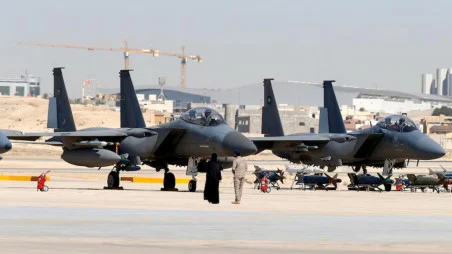
Saudi Arabia joins US strikes against Iranian proxy forces for the first time since this war began, and the decision reshapes a conflict that had already outgrown its original borders. Overnight, American and Saudi fighter aircraft flew together against targets in eastern Iraq — an operation that ends Riyadh’s long effort to influence the war without appearing in it.
U.S. Central Command described the targets as logistics and weapons facilities scattered across the eastern part of the country. The stated trigger was a run of more than thirty drone attacks in recent days, which American officials attribute to direction from Iran’s Islamic Revolutionary Guard Corps. The Saudi Defense Ministry confirmed participation and said little else.
Iraq’s Popular Mobilization Forces, an umbrella of largely Iran-aligned factions, reported twenty of its members killed.
The Missiles That Came First
The joint operation followed a separate incident hours earlier, when American forces in the region shot down several ballistic missiles fired by Iran. Officials characterized it as an attempted surprise attack on U.S. personnel.
Tehran acknowledged the launch and framed it as retaliation for what it called aggressive American military behavior, saying it had aimed at a U.S. base inside Jordan. On Wednesday, Jordanian authorities said their own air defenses brought down five Iranian missiles.
Whether the missile salvo and the joint air strikes were directly linked has not been established. Officials have not drawn that connection publicly, and the two events may reflect nothing more than a single day of unusually intense activity.
What is clear is the effect. Both cut against the pause President Donald Trump had engineered to give stalled negotiations a chance, and together they point toward a fifth month of war that expands rather than winds down.
Why Riyadh Moved
Saudi Arabia explained itself through its Foreign Ministry, saying the strikes came after Iran-backed militias in Iraq attacked Saudi oil facilities. The kingdom insisted it is not seeking escalation but will not hesitate to answer attacks on its infrastructure.
Analysts read the moment as significant regardless of the framing.
Mark Cancian, a senior adviser at the Center for Strategic and International Studies, called it a major step and one that may preview deeper involvement. In his view, the Saudis have run out of patience and crossed a threshold they had previously avoided, which is striking directly at other Arab organizations.
He flagged a further implication that could matter more than the strikes themselves. Riyadh’s willingness to fly these missions may indicate openness to letting American forces operate from Saudi soil — either against Iran directly or in support of operations tied to the Strait of Hormuz. Basing access is a structural change, far harder to reverse than a single night of sorties.
Anna Jacobs, a nonresident fellow at the Arab Gulf States Institute, offered a more measured reading. She agrees Riyadh is under mounting pressure to act militarily in order to restore deterrence. But she cautioned against treating this as an abandonment of diplomacy, which she said remains central to how the kingdom manages both Iran and regional security. It is not a binary choice, in her assessment, and the Saudi actions in Yemen and Iraq still look relatively contained — closer to a message aimed at Iran and its partners than to the opening of a full campaign.
The Squeeze on Saudi Oil
The economics behind the decision are not subtle.
Washington and Tehran have gone through repeated negotiating rounds without resolving the standoff over the Strait of Hormuz, the Persian Gulf channel through which a large share of Middle Eastern crude reaches world markets. Iran has kept the strait closed since the United States and Israel opened the war in late February.
Then last week the Houthis in Yemen declared a blockade on Saudi oil moving through the Red Sea.
That leaves the kingdom constrained at both exits. Its primary export faces obstruction going east and going west simultaneously. Analysis from the Institute for the Study of War indicates Saudi forces have been striking Houthi positions in Yemen in recent days, attempting to reduce the group’s capacity to sustain the pressure.
The cooperation with Washington is not new in that theater. The United States backed Riyadh’s long bombing campaign against the Houthis in earlier years. What is new is the two air forces working together against Iranian proxies in Iraq, where the political complications run deeper.
Markets Responded Immediately
Brent crude, the international benchmark, climbed roughly 3.5 percent to about $87 a barrel on Wednesday following the overnight attacks.
Prices had spiked the previous week on the Red Sea blockade threat before easing somewhat. The pattern is by now familiar: each escalation resets the risk premium, and the cost travels outward to economies with no involvement in the fighting.
A War Declared Over That Never Ended
The chronology explains why officials now speak in terms of pauses rather than conclusions.
Trump announced the war finished in May, following a ceasefire. Military operations continued anyway. Two carriers stayed on station. Air patrols persisted. Limited exchanges of fire recurred through the spring. Full hostilities resumed in July.
The casualty figures reflect that continuity. Eighteen American service members have been killed and more than six hundred wounded since the conflict began. Four of those deaths came this month alone. Three troops died on July 17 when an Iranian ballistic missile hit a base in Jordan, and a fourth was killed the following day during a controlled detonation of an Iranian drone at a base in Iraq.
The Risk Ahead
The immediate danger is geographic spread. A confrontation that started between three countries now touches Iraq, Yemen, Jordan, two contested waterways and a Gulf monarchy that has just committed combat aircraft.
Every added participant brings its own red lines and its own timetable for retaliation. Jacobs may be right that Riyadh intends a message rather than a campaign. The difficulty with messages sent by air strike is that the recipient decides how to read them.
Author
-
Lucienne Albrecht is Luxe Chronicle’s wealth and lifestyle editor, celebrated for her elegant perspective on finance, legacy, and global luxury culture. With a flair for blending sophistication with insight, she brings a distinctly feminine voice to the world of high society and wealth.