Eight Dead in Ukraine, a Crater in Poland: The Night Russia’s Barrage Crossed a NATO Border
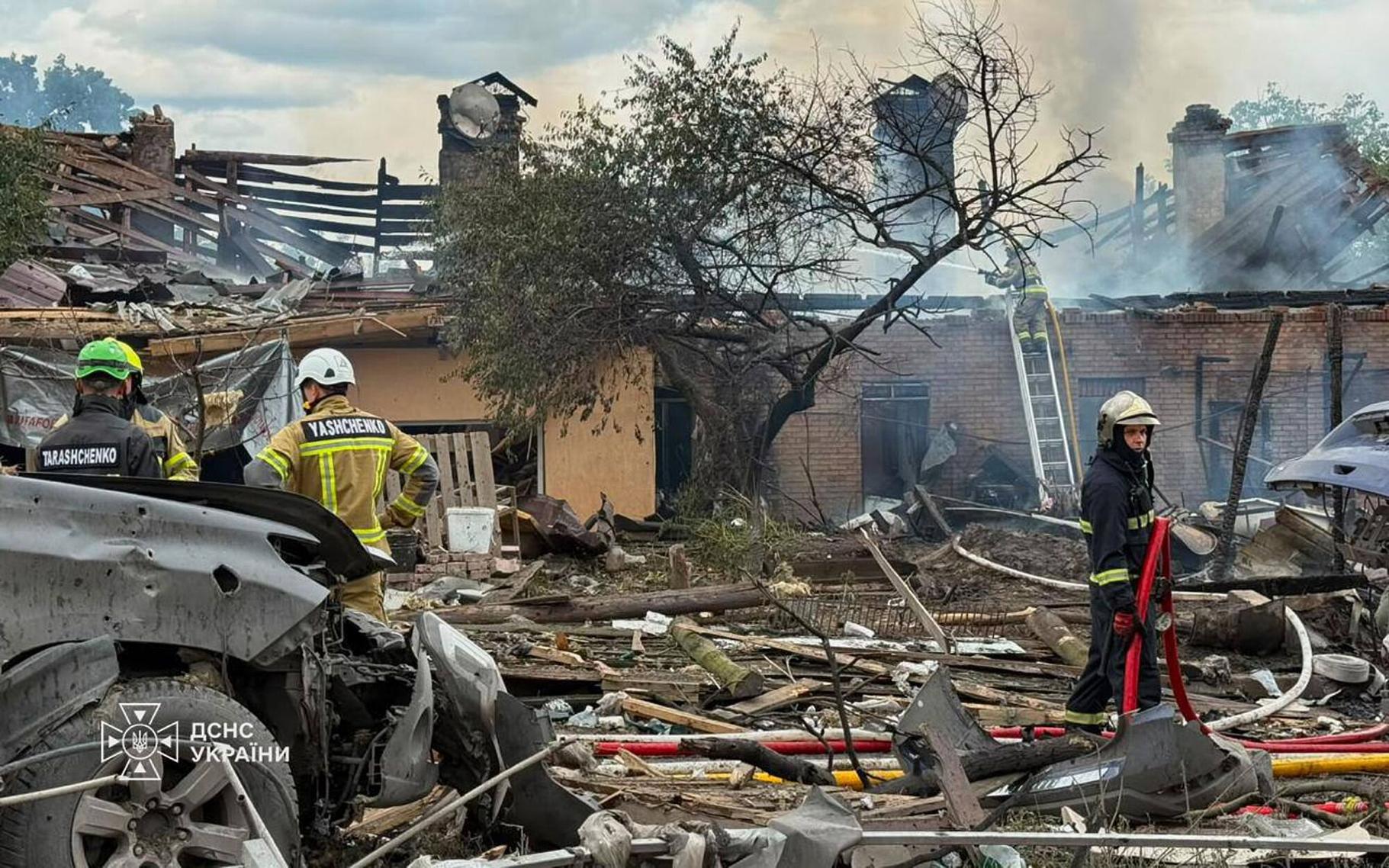
The overnight Russian strikes on Ukraine that carried into Thursday morning killed at least eight civilians, including three children from a single family, and wounded dozens more. They also produced something that has happened only rarely in more than four years of war: an object crossing deep into NATO airspace and hitting the ground inside Poland.
By mid-morning, Polish Prime Minister Donald Tusk was standing at a crater in a field roughly 90 kilometres from the Ukrainian border.
The Scale of the Attack
President Volodymyr Zelensky said at least ten Ukrainian regions were struck. Russia launched more than 70 missiles — a substantial share of them ballistic — along with over 280 attack drones. Ukrainian forces intercepted more than 260 of the drones.
The geography of the barrage is telling. It reached areas near the Polish border, far from the eastern front, where Ukraine is believed to store and manufacture weapons. Dozens of homes, businesses and infrastructure facilities were damaged or destroyed.
Ballistic missiles are the harder problem. They arrive fast and steep, and the only reliable defence against them is the Patriot system, which Ukraine does not have in sufficient quantity.
Where People Died
In the Dnipropetrovsk region, six people were killed and ten wounded, according to Oleksandr Hanzha, head of the regional military administration.
Among the dead were three children in the Kryvyi Rih area — a six-year-old girl and two boys, aged eleven and seventeen. Their parents were killed in the same strike. Two more children were pulled alive from the rubble.
Zelensky described the target as an ordinary home destroyed by a ballistic missile.
In Kyiv, ballistic missiles killed a 31-year-old man and wounded two others, national police said. Residential buildings, a market, a garage cooperative, storage facilities and vehicles were damaged. Residents sheltered in metro stations as air raid alerts sounded.
In the western city of Lviv, a cruise missile strike on a residential building wounded more than 30 people, including three children aged six, thirteen and fifteen, according to regional military head Maksym Kozytskyi. Emergency crews were still working through the rubble hours later.
In the Poltava region, a drone struck company warehouses and killed one person, regional military head Vitalii Diakivnych said.
The Interceptor Problem
The timing of the attack is not coincidental. It came two days after Zelensky met President Donald Trump in Washington alongside representatives of American defence firms, pressing for faster and larger deliveries of Patriot systems.
The obstacle is supply. The war with Iran has drawn down American stockpiles of Patriot interceptors substantially, and demand now outstrips production by a wide margin. Trump has promised to grant Ukraine licences to manufacture its own Patriots, but standing up that capability would take years, not months.
Zelensky framed the night’s results as a credit to his forces operating under those constraints, saying that given the critical shortage of air defence missiles from partners, Ukrainian personnel were accomplishing remarkable things. He added that protection against the Russian missile threat remains the single most important task for saving lives.
Moscow’s Account
Russia’s Defence Ministry described the operation as aimed at military infrastructure: air bases, arms factories, and military telecommunications and logistics facilities.
Its stated target list included drone production plants and storage depots, a missile plant, an aircraft repair facility, a factory producing electronic components, and a chemical plant.
Those claims cannot be independently verified, and they sit alongside the confirmed destruction of a family home in a village outside Kryvyi Rih.
What Happened Over Poland
The Polish sequence unfolded quickly. At about 3:40 a.m. local time, the Operational Command of the Polish Armed Forces tracked an unidentified object flying westward while at least a dozen missiles were operating over western Ukraine. An F-16 was launched to identify and intercept it.
Roughly six minutes later, the radar signal vanished.
A helicopter crew flew to the object’s last known position and located a probable impact site in an undeveloped area near the village of Tarnawa-Kolonia in Lublin province. Police said residents had reported hearing a powerful blast. Emergency personnel found a crater around ten metres across with debris scattered nearby.
Air raid warning systems were activated in Lublin and several other parts of the province. Polish commanders scrambled fighter jets, deployed early-warning aircraft and placed ground-based defences on alert.
Tusk stated that a violation of Polish airspace had occurred during the Russian attack on western Ukraine. Defence Minister Władysław Kosiniak-Kamysz described it as an extremely difficult night for Polish air defence and detection systems, and said an investigation is underway to determine exactly what crashed.
Ukraine’s foreign minister, Andrii Sybiha, was more specific, saying a Russian Kh-101 cruise missile had crossed into Poland as part of the strike. He argued the incident demonstrates that strengthening Ukrainian air defence also protects Europe more broadly. Polish authorities have not confirmed the identification, and it is not clear whether Sybiha was describing the same object.
Why the Precedent Matters
Poland has scrambled jets many times in response to strikes on western Ukraine. Actual incursions have been unusual.
In September of last year, roughly 20 Russian drones violated Polish airspace, and NATO aircraft shot several down — the first time a NATO member had fired in the course of this war. In November 2022, a stray missile killed two people in the Polish village of Przewodów; that one was subsequently attributed to Ukrainian air defence rather than a Russian strike.
The distinction matters, which is why Warsaw is being careful before naming what landed in Lublin. Forensic teams are securing the site.
The Other Direction
Ukraine’s long-range campaign continued the same night. Russia’s Defence Ministry said its air defences downed 258 Ukrainian drones.
Two warehouses belonging to the online retailer Wildberries were set ablaze. One, in the Penza region southeast of Moscow, left one person injured and forced the evacuation of 200 workers, according to Governor Oleg Melnichenko. The other, in Sarapul in Udmurtia, sits more than 1,000 kilometres from Ukraine — the company said its staff were safely evacuated.
Ukraine accuses the retailer of supplying goods usable by the Russian military. Its drone campaign has also battered Russia’s oil sector, contributing to a domestic fuel crisis.
Where This Leaves Things
The pattern is now familiar and grinding: near-daily bombardment of Ukrainian cities, long-range Ukrainian strikes on Russian industry, and an air defence gap that Moscow appears to be timing its ballistic salvos to exploit.
The variable this week is the crater in Lublin. Whatever the investigation concludes, it will sharpen an argument Kyiv has been making for months — that Ukrainian air defence and European air defence are, at this point, difficult to separate.
Author
-
Lucienne Albrecht is Luxe Chronicle’s wealth and lifestyle editor, celebrated for her elegant perspective on finance, legacy, and global luxury culture. With a flair for blending sophistication with insight, she brings a distinctly feminine voice to the world of high society and wealth.