The Cost After the Cameras Leave: What the Fauci Hearing May Do to the Next Generation of Scientists
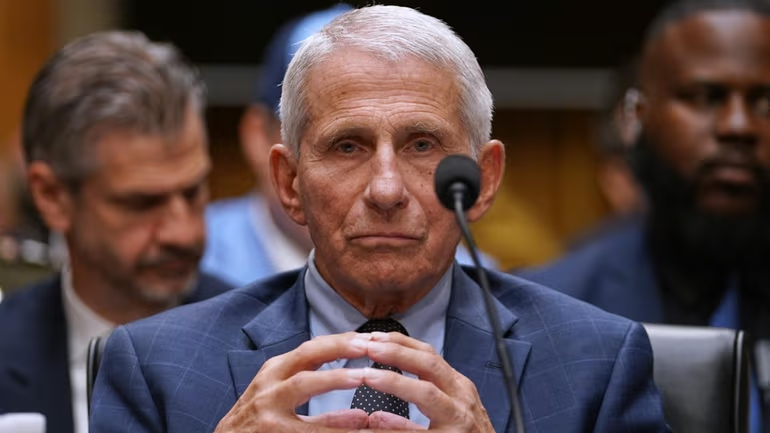
The public health chilling effect that professionals in the field have been warning about for years found a vivid illustration on Wednesday morning, when Anthony Fauci sat before a Senate committee for nearly three hours and declined to answer more than a hundred questions.
He invoked his Fifth Amendment protection repeatedly. Senator Rand Paul responded by announcing he would move to hold Fauci in contempt of Congress next week.
For epidemiologists, health officials and university faculty watching the exchange, the concern is not primarily about one 85-year-old scientist. It is about who is watching, and what they conclude about the career they were considering.
What Was Actually at Issue
Paul has argued for years that the virus behind COVID-19 may have escaped from a laboratory in Wuhan and that Fauci concealed relevant information from Congress. Fauci has denied that emphatically, accusing the chairman of an unhinged obsession with prosecuting him.
The origins question itself remains unresolved. The scientific mainstream leans toward natural emergence; American intelligence agencies are split, with some favouring a lab-related incident at varying levels of confidence. Neither side of that argument has produced conclusive evidence.
What has changed is the temperature around it.
The Argument About Deterrence
Senator Andy Kim of New Jersey made the case explicitly during the hearing. He described the combination of firings and funding cuts as producing a chilling effect on people who might otherwise consider public service — young researchers now weighing whether the work is worth it while watching colleagues and mentors come under attack.
Georges Benjamin, who heads the American Public Health Association, framed the same worry in terms of what officials will feel able to say. If experts expect to be threatened by members of Congress, he argued, they will be considerably less willing to be candid and to give decision-makers the information they need. The work cannot be done, in his view, under fear that speaking plainly will destroy a career or endanger someone’s safety.
Epidemiologist Katelyn Jetelina, who writes a widely read newsletter and teaches at Yale, put it in personal terms. Scientists, she said, were never meant to be television figures receiving death threats or having food thrown at them. That represents a new category of risk, and risk forces calculations.
Watching a public servant of five decades be thoroughly vilified, she said, makes her wonder about the next emergency — and whether she would raise her hand.
The Pipeline
Jetelina has seen the effect in enrollment figures, which have declined, and in conversations with students uncertain about what a future in the profession looks like.
That matters on a delay. A drop in graduate enrollment now translates into a shortage of trained epidemiologists, laboratory scientists and health officers in five to ten years — which is to say, during whatever the next outbreak turns out to be.
Senator Gary Peters, the committee’s ranking Democrat, argued the erosion is already underway structurally, saying the workforce has been hollowed out through firings, departures and funding reductions, with the CDC’s staff shrinking by roughly a quarter.
The Health Freedom Shift
Nicole Huberfeld, a health law professor at Boston University, situates all of this in a longer arc.
During the pandemic, she notes, there was a surge in people asserting a right to refuse medical treatments and public health measures — a movement often called health freedom. Objections to requirements such as school vaccination rules, she says, were generally grounded in religious or moral positions rather than empirical claims.
Masking, distancing and closures also became progressively unpopular. Initial acceptance, in her reading, did not last long, partly because of swift pushback from the top during the first Trump administration.
Interest in the movement declined during the Biden years and has risen again since. Huberfeld attributes that to how people take cues from leaders who speak to them — and suggests Republican lawmakers at this week’s hearing may have been addressing their base as much as the witness.
The Other Side of the Argument
There is a case the critics are not making, and it deserves stating.
Congressional oversight of officials who wielded extraordinary influence over American life is a legitimate function, not an attack by definition. A witness who declines to answer more than a hundred questions is, from that vantage, not being persecuted — he is exercising a right while declining to provide the accounting the inquiry sought.
There is also a harder point about trust. Public confidence in health institutions did not collapse solely because of political attacks. Shifting guidance, communication that overstated certainty, and policies whose costs fell unevenly all contributed. Some in the field acknowledge this openly; the demand for a more participatory approach implicitly concedes it.
Whether one finds the hearing legitimate oversight or a political exercise depends heavily on what one already believed about the pandemic response. Both readings have honest adherents.
What Is Actually at Stake
Benjamin points to current problems rather than hypothetical ones, citing difficulties responding effectively to hantavirus, measles and cyclospora outbreaks.
Huberfeld’s assessment is blunter. Combined with recent sweeping changes to healthcare, she expects more illness and injury, and therefore preventable deaths.
Those are predictions rather than measurements. But measles, in particular, is a reasonable indicator — it spreads readily wherever vaccination coverage falls below a threshold, and it does not care about anyone’s political read of a Senate hearing.
What Comes Next
Paul’s committee is expected to vote on a contempt resolution next week. If it passes, the full Senate would need to approve it. Formal approval could expose Fauci to a criminal fine and up to twelve months’ imprisonment, or to civil action.
Jetelina, for her part, has suggested two ways forward. The first is building systems in which health professionals and the public genuinely talk to each other — listening to questions, concerns and confusion at ground level, then folding that into both communication and operations. People, she says, are demanding a far more participatory model.
The second is something resembling a 9/11 Commission for COVID-19: a structured accounting of what went right, what went wrong and how to fix it.
That is, notably, not far from what Paul says he wants. The difference is who conducts it, and whether the goal is a finding or a prosecution.
Jetelina thought the country had been healing around COVID. What this week did, in her view, was reopen wounds that had not closed as much as anyone hoped.
Author
-
Lucienne Albrecht is Luxe Chronicle’s wealth and lifestyle editor, celebrated for her elegant perspective on finance, legacy, and global luxury culture. With a flair for blending sophistication with insight, she brings a distinctly feminine voice to the world of high society and wealth.