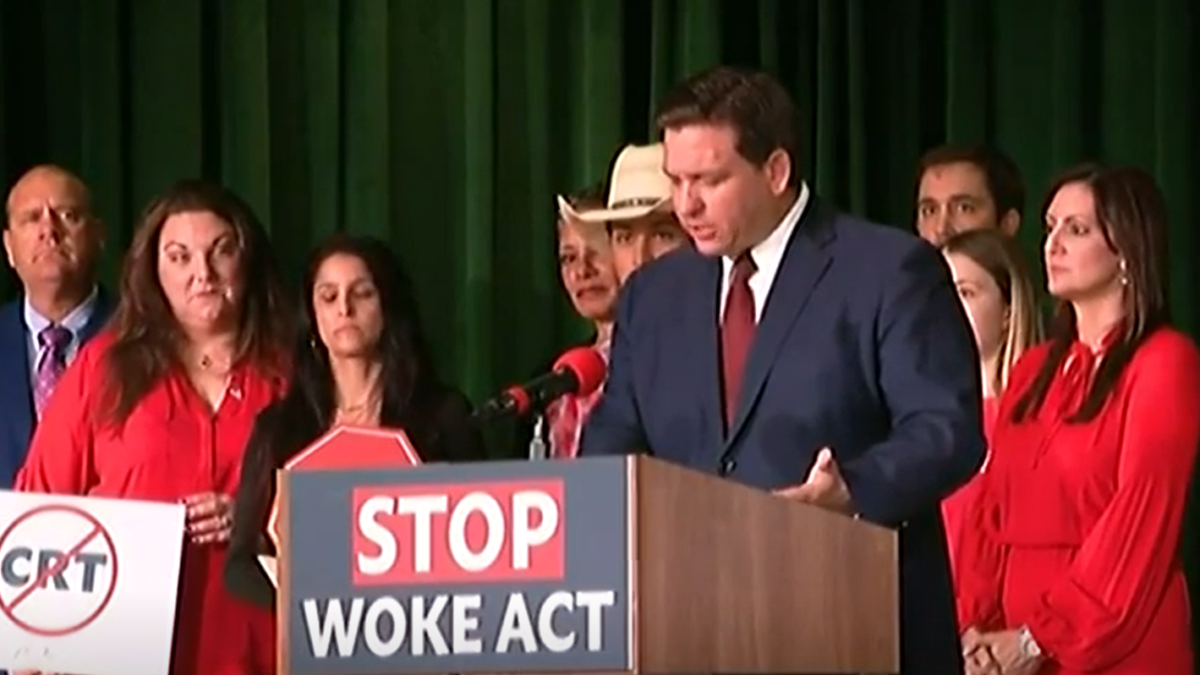
The Stop WOKE Act suffered a significant legal setback this week, as a federal appeals court ruled that Florida cannot enforce the parts of the law that restrict how professors teach about race and gender in public colleges and universities. The decision marks one of the most serious challenges yet to a policy that has become central to Governor Ron DeSantis’ political identity.
A Divided Court Draws a Line
On Tuesday, the U.S. Court of Appeals for the 11th Circuit handed down a 2-1 decision declaring that the higher-education provisions of the law clash with the First Amendment. The ruling keeps the state from enforcing those restrictions while the legal battle plays out.
Passed in 2022, the measure was a cornerstone of DeSantis’ wider campaign against what he described as “woke” ideology. It targeted critical race theory, diversity initiatives, and certain classroom discussions the governor argued had no place in publicly funded education.
But the court saw the issue differently. The majority concluded that Florida’s approach reached too far into what teachers are permitted to say in the classroom.
Why the Judges Rejected Florida’s Argument
At the heart of the case was a bold claim from the state: because professors are paid with public money, their classroom speech belongs to the government. Judge Britt Grant, appointed by former President Donald Trump, firmly rejected that reasoning.
Grant warned that accepting Florida’s logic would hand the state sweeping authority over what educators can and cannot teach. She wrote that if the First Amendment protects public university classrooms at all, this law had clearly gone beyond the limit.
The majority acknowledged that the case pushed the court into unsettled territory. The Supreme Court has never fully defined how much free-speech protection professors enjoy while teaching, and this dispute forced the judges to confront that gap directly.
Grant also pushed back on the idea that exposure to uncomfortable viewpoints is inherently harmful. In her view, encountering an opinion you disagree with is not a form of discrimination but a chance to sharpen your own thinking or even reconsider it.
She and Judge Charles Wilson, a Bill Clinton appointee who joined the majority, described Florida’s stance as an extraordinary attempt to erase unpopular ideas from public university discussions.
What the Law Actually Banned
Officially titled the Individual Freedom Act, the law prohibited instruction that promoted or pressured students into accepting a specific set of beliefs about race, sex, national origin, and privilege.
Among the concepts it barred were the ideas that:
- A person is inherently racist or sexist simply because of their race or sex.
- Someone should feel guilt or emotional distress over actions committed in the past by others who share their race or sex.
Supporters framed these rules as protecting students from ideological pressure. Critics argued they amounted to state-imposed censorship that stripped educators of the freedom to teach difficult subjects honestly.
The Dissent: A Different View of State Power
Not every judge agreed with the outcome. Judge Barbara Lagoa, also a Trump appointee and a former Florida Supreme Court justice chosen by DeSantis himself, dissented sharply.
Lagoa argued that Florida was well within its rights to decide what messages its own classrooms may endorse. She drew a distinction between protecting speech in the broader public square and requiring the state to promote every viewpoint through its educational institutions.
In her words, the First Amendment shields all perspectives in public life, but it does not obligate the government to lend its endorsement to each of them. She accused the majority of overstepping by narrowing the state’s control over public university instruction and cautioned that judges should not reshape legal precedent simply because they dislike the results.
Her position drew praise from Florida Attorney General James Uthmeier, who publicly called her one of the finest judges in the country and suggested she deserved a seat on the Supreme Court.
The Road Ahead
Because the ruling upheld a preliminary injunction rather than delivering a final verdict, the law remains blocked while the case moves forward. Importantly, the split decision leaves Florida with clear options to keep fighting.
The state can:
- Request that the full 11th Circuit rehear the case.
- Petition the U.S. Supreme Court to take up the matter.
Given the unresolved constitutional questions at stake, many observers believe this dispute is well positioned to eventually reach the nation’s highest court.
Part of a Broader Legal Struggle
This is not the first courtroom loss for DeSantis in his push to reshape how race and identity are addressed in schools and workplaces. The same appeals court had previously blocked a separate section of the law that limited how private employers could conduct workplace training.
Tuesday’s ruling grew out of two lawsuits filed by professors, students, and a student organization who argued the law amounted to unconstitutional censorship in the classroom. One case was brought by the Foundation for Individual Rights and Expression, while the other united the American Civil Liberties Union, the ACLU of Florida, the Legal Defense Fund, and the law firm Ballard Spahr.
Advocates celebrated the decision as a meaningful victory. Leah Watson, a senior attorney with the ACLU’s Racial Justice Program, said the ruling reinforced the principle that higher education should not bend to the shifting preferences of politicians.
The Bigger Picture
The fight over the Stop WOKE Act reflects a larger national tension over who controls the boundaries of classroom discussion and how far governments can go in shaping what students learn. For now, professors in Florida retain the freedom to teach these subjects without the law’s restrictions.
But with the possibility of Supreme Court review looming, the final chapter of this legal battle is far from written, and its outcome could set lasting standards for academic freedom across the country.
Author