The Case That Collapsed
The Lincoln Memorial Reflecting Pool has spent months at the centre of a political storm, and that storm has now taken a sharp turn. Federal prosecutors have abandoned their case against a retired Olympic canoeist who was accused of damaging the newly refurbished landmark, conceding in court that the destruction blamed on him was actually the product of a poorly executed construction job.
David Hearn, 67, a three-time Olympian in canoe slalom, had been staring down a felony charge of property destruction that carried a maximum sentence of a decade behind bars. On Friday evening, that threat evaporated when the US attorney’s office for the District of Columbia filed a lengthy motion asking a judge to throw the case out.
From Presidential Showpiece to Public Embarrassment
The 610-metre pool underwent an expensive facelift that the president personally promoted and celebrated when it reopened. The enthusiasm did not last long. Within weeks, visitors were greeted by a thick carpet of green algae floating across the surface, and the fresh blue sealant applied to the basin began separating in wide sheets.
Rather than pointing to the workmanship, the White House pointed to the public. Officials described the culprits as disturbed individuals bent on defacing a national treasure. The response was aggressive by any measure:
National Guard members were stationed along the perimeter.
AI-enabled surveillance cameras were installed to monitor the area.
Video clips showing tourists dipping their hands in the water were circulated publicly in an effort to identify suspects.
At least six people were arrested or issued citations during the sweep. Hearn was among them, detained on 19 June after he paused at the memorial in the middle of a bike ride.
The Allegations Against Hearn
When the indictment came down last month, the language from prosecutors was severe. Jeanine Pirro, serving as US attorney for the District of Columbia, characterised Hearn’s conduct as an intentional and aggressive act, alleging he had torn away the material lining the basin floor and caused damage exceeding the one-thousand-dollar threshold required for a felony.
Hearn told a very different story from the beginning. He insisted that the fragment of liner he handled was already detached, drifting loose in the shallows near the edge where anyone walking past could have seen it. He never disputed touching it. He disputed that touching it was a crime, and he disputed that he caused anything to come apart.
What the Documents Revealed
The government’s own paperwork ultimately undid the prosecution. In the twenty-page filing seeking dismissal, prosecutors explained that internal records handed over late in the process painted a picture wholly inconsistent with vandalism.
The peeling was not concentrated near the edges where a passerby could reach. It appeared uniformly across the entire structure, including in the deepest sections of the basin, areas that no one standing on the shoreline could possibly have accessed. Damage distributed that evenly points to a materials or application failure, not to human interference.
Prosecutors went further, stating that the Department of the Interior had not been forthcoming ahead of the grand jury proceedings. The office indicated it only learned the true cause of the deterioration after those withheld records finally surfaced, well after the indictment had already been secured.
A Deadline That Doomed the Project
The filing also identified the pressure that likely produced the failure. Crews were racing to complete the work in time for the nation’s 250th independence anniversary on 4 July, a target the administration had set for itself. That compressed timeline produced what the court document described as a hurried and defective installation.
Sealants and liners applied to large water-retaining structures require specific curing conditions, careful surface preparation and time. Compress that schedule and adhesion failures become almost inevitable. The green bloom that followed was a predictable consequence of a basin whose chemistry and circulation had been disturbed.
Hearn’s Legal Team Responds
Hearn’s attorneys, Norm Eisen, Mary Dohrmann and Steve Levin, welcomed the dismissal but refused to treat it as a resolution. In a statement, they argued the prosecution should never have been initiated in the first place and said dropping it does not undo the harm caused by arresting and charging a man who had done nothing wrong. They accused the administration of acting first and investigating afterwards, and said an apology was owed.
Questions Around the Contract
Scrutiny has now shifted to how the refurbishment was arranged. The project carried a price tag of roughly 16.4 million dollars and was driven by the president himself, including his instruction that the basin floor be coated in a shade described as American flag blue.
The work went to Atlantic Industrial Coatings, a company owned by an associate of the president. Notably, the contract was handed over without an open competitive bidding process, a detail that has fuelled criticism from watchdogs and lawmakers alike.
An Empty Landmark
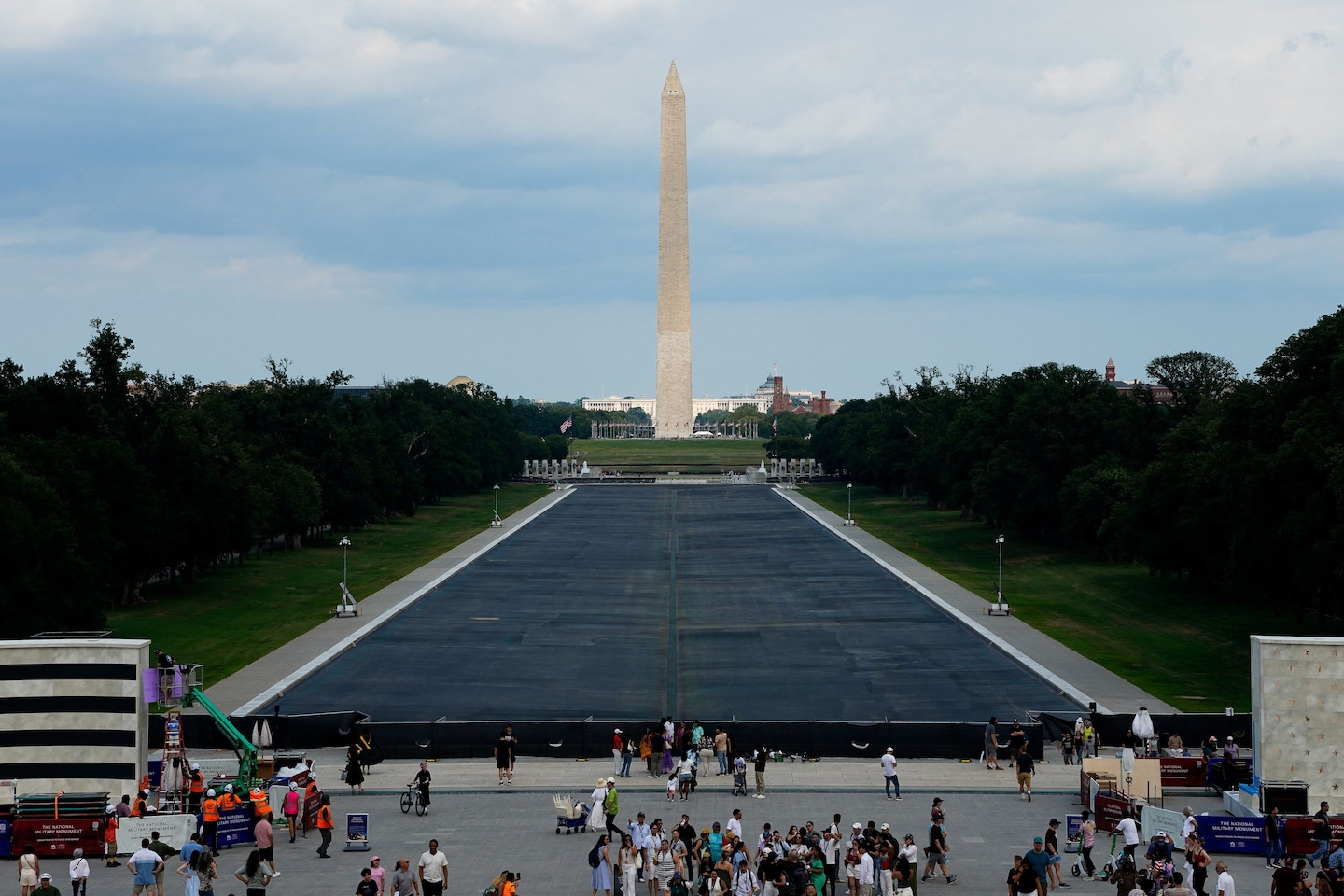
For now, one of the capital’s most photographed sites sits dry. The pool has been drained for the second time in three months while engineers assess whether the existing lining can be repaired or whether the entire surface must be stripped and redone.
Tourists arriving expecting the mirrored view of the Washington Monument instead find bare concrete and construction barriers. The White House has not offered a response to questions about the dismissal.
The Larger Lesson
What began as a story about supposed vandals has become a story about accountability. The Lincoln Memorial Reflecting Pool saga illustrates how quickly blame can be assigned outward when a high-profile project fails, and how much damage that misdirection can do to ordinary people caught in its path. Hearn walks away without a conviction, but the months he spent facing a possible prison sentence cannot be returned to him.
Author
-
Lucienne Albrecht is Luxe Chronicle’s wealth and lifestyle editor, celebrated for her elegant perspective on finance, legacy, and global luxury culture. With a flair for blending sophistication with insight, she brings a distinctly feminine voice to the world of high society and wealth.