An F-35B crash near San Diego on Friday destroyed a stealth fighter worth well over a hundred million dollars, but the pilot walked away from it. The Marine Corps confirmed that the aviator ejected before impact and was taken to a nearby medical facility in stable condition, where they were assessed and treated for injuries described as non-life-threatening.
The aircraft went down close to Marine Corps Air Station Miramar in a dirt field just off the flight line.
The Scene From the Ground
Wade Lott, 36, was driving to his job at a concrete company just south of the flight line when it happened. He watched from his truck as two jets came in together on approach.
The first touched down normally. The second began behaving strangely, decelerating in a way that made it look almost like it was attempting to hover in place. At roughly a hundred feet above the ground, the canopy blew and the pilot went out.
By Lott’s account the parachute opened as the seat carried the pilot upward another two hundred feet, and the timing was close. He described the aircraft coming down beside another plane, striking the runway and detonating.
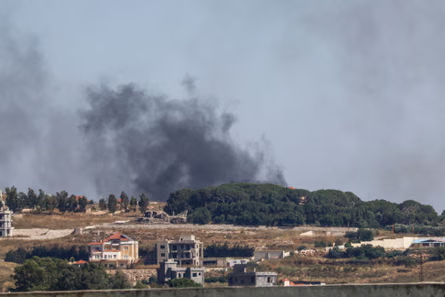
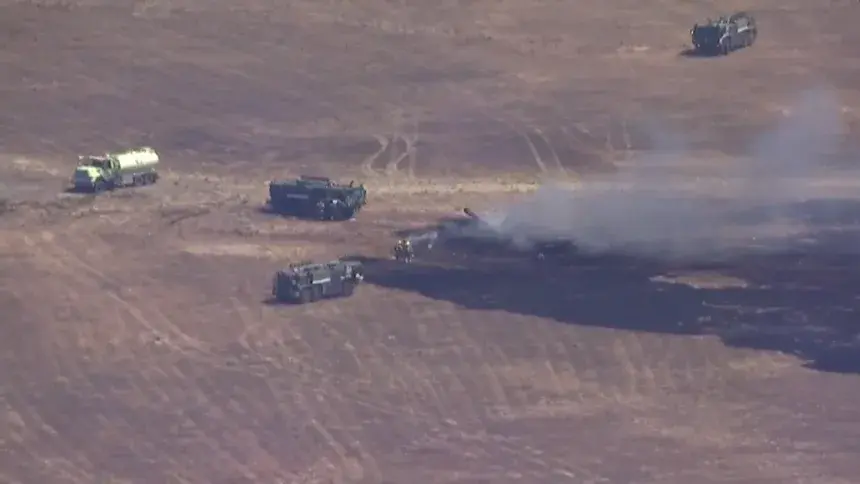
Aerial footage from a news helicopter showed thick black smoke pouring off the wreckage. Military and firefighting vehicles surrounded the site, personnel stood at a distance, and what looked like white flame retardant coated the surrounding ground. At least one firefighter was visible working the debris with a hose.
Candace Hadley of San Diego Fire said crews responded to a vegetation fire that ignited near the crash site. She directed further questions to the air station.
Classified as a Class A Mishap
The Marine Corps labelled the incident a Class A mishap, the most serious designation in the military’s accident taxonomy. That category applies when any of three conditions are met:
Damage exceeds two million dollars
An aircraft is destroyed
A service member is killed
The first two clearly apply here. Air Force Safety Center records indicate that at least seventeen other Class A mishaps involving F-35 aircraft have occurred in that service alone since 2000.
Across the US military this year, the Flight Safety Foundation’s Aviation Safety Network database has logged at least seven other aircraft mishaps.
The Aircraft and Its Price Tag
The F-35B is the short takeoff and vertical landing variant of the family, built around an engine configuration that lets it operate from confined spaces and amphibious ships. That capability is precisely what makes the eyewitness description of the jet appearing to hover notable, though no official cause has been released.
A single F-35B runs approximately 109 million dollars.
Across the Marine Corps, Navy and Air Force, more than 630 F-35s were in service according to a 2024 Government Accountability Office analysis. That same review projected the entire programme will reach roughly two trillion dollars once the military purchases another 1,800 or more airframes and operates the fleet across its full service life.
A Base With Cinematic History
Miramar carries a reputation that predates its current tenants. It once housed the Navy fighter weapons school featured in the original Top Gun film and earned the nickname Fightertown USA during that era.
The school moved to Naval Air Station Fallon in Nevada in 1996, when the base changed hands and came under Marine Corps control.
How the F-35 Safety Record Actually Reads
Despite the dramatic footage, the type’s overall record compares favourably with predecessors. The Lexington Institute, a think tank focused on defence technology and national security, regards the F-35 as the safest and most capable fighter in the American inventory.
Since entering service in 2015, the aircraft has experienced fewer crashes across all variants than other fighters did at comparable points in their introduction. Fatal accidents in F-35s are uncommon.
Ejections Have Worked
Friday’s outcome fits a pattern that speaks well of the escape system. In five F-35 crashes, pilots have successfully ejected. At least one of those aviators was hurt, in a May 2024 accident near the international airport in Albuquerque, New Mexico. That jet was en route from Texas to an Air Force base in California when it went down.
Ejection at a hundred feet leaves almost no margin. Modern seats are designed to function at zero altitude and zero airspeed, but the outcome still depends on the pilot recognising the situation early enough to pull the handle. In this case, that judgment appears to have made the difference.
What Remains Unknown
The Marine Corps has not identified the pilot or offered any explanation for what went wrong. Investigations into Class A mishaps typically take months and examine maintenance records, flight data, engine performance and cockpit decisions before reaching conclusions.
Whether the unusual deceleration Lott described reflects a mechanical failure, a systems fault or an attempted recovery from some other problem will not be established until that process runs its course.
For now, the essential fact is the one the Marine Corps led with. An aircraft was lost, and the person flying it survived.
Author
-
Lucienne Albrecht is Luxe Chronicle’s wealth and lifestyle editor, celebrated for her elegant perspective on finance, legacy, and global luxury culture. With a flair for blending sophistication with insight, she brings a distinctly feminine voice to the world of high society and wealth.