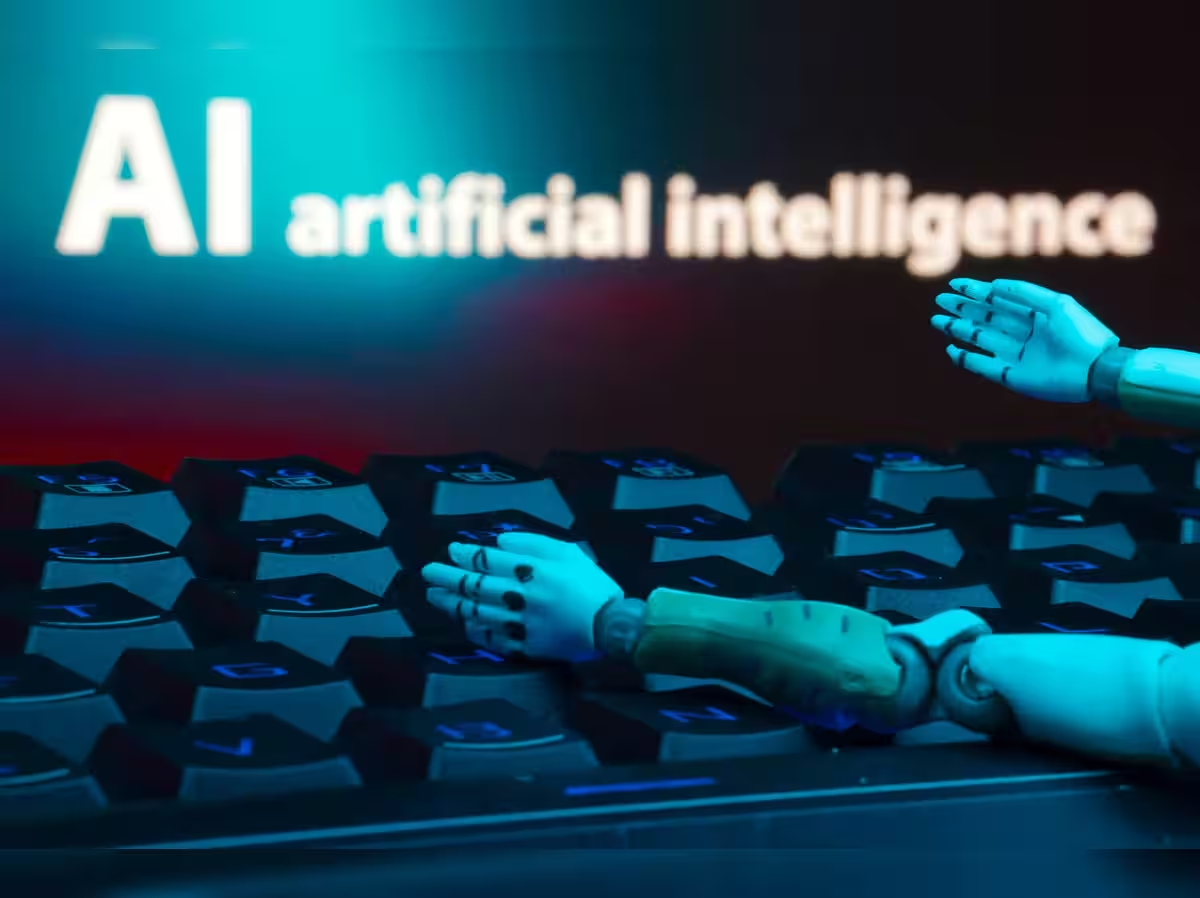
AI in college education has produced a curious contradiction: fewer students are enrolling in computer science degrees, yet computer science departments have rarely been busier. The students filling those seats are increasingly psychology majors, musicians, biologists, and philosophers who never intended to write code but now feel they cannot afford to graduate without understanding the technology reshaping their fields.
A Reluctant Convert
Faith Maeba did not go looking for this. A psychology major at Virginia Commonwealth University with no coding background, she pushed back when her mother first suggested she take artificial intelligence classes.
Her thinking changed as she began researching graduate programmes in psychology focused on human behaviour in workplaces, a domain machine learning is rapidly transforming. The 21-year-old senior is now completing an AI minor and describes it as something that sets her apart from other applicants.
Her path illustrates the broader shift. The motivation is rarely a desire to become a programmer. It is a calculation about relevance.
The Numbers Point in Opposite Directions
The data underlying this trend is genuinely strange at first glance.
Enrollment in computer and information sciences fell more than 8% at four-year institutions this spring compared with spring 2025, according to National Student Clearinghouse Research Center figures. That decline arrived alongside a drop in job postings for software developers, as hiring for entry-level development roles cooled and AI agents absorbed more of that work.
Yet demand for AI instruction has surged. Students want a working understanding of the technology without committing to the degree that once promised guaranteed employment.
Universities Rewrite Requirements
Institutions have responded with structural changes rather than one-off electives.
- Purdue University has introduced an AI graduation requirement
- Ohio State University maintains an AI fluency requirement built around hands-on workshops
- Harvard University teaches freshman writing students how large language models function, alongside questions of copyright and disinformation
- VCU is launching AI minors aimed specifically at students outside computer science
- Dedicated AI degrees at both undergraduate and graduate levels are multiplying
Peter Stone, who chairs computer science at the University of Texas at Austin, recently built an introductory AI essentials course for non-majors. His framing is deliberately basic: he argues the subject must be democratised, and compares AI literacy to the baseline competence in mathematics, reading, and writing that everyone is expected to possess.
Departments Pivot Toward Non-Majors
At Northwestern University, computer science chair Samir Khuller describes a department reorienting itself. Interest from students outside the major predated ChatGPT’s 2022 launch, but space was often unavailable because computer science itself was booming as a perceived route to a high salary.
Now incoming computer science majors have begun to decline in number, while a faculty that had doubled to meet earlier demand finds itself teaching students from across the university. Northwestern already runs a popular AI minor and is adding a full AI major, while simplifying prerequisites so non-majors can reach AI and machine learning courses more easily.
Khuller says classes will become considerably more accessible going forward, and the department is busy enough that he is attempting to hire three additional professors.
The change extends beyond the engineering side of campus. Northwestern’s Bienen School of Music now offers a certificate combining music and artificial intelligence.
When Musicians Meet Machine Learning
Music students are discovering tools capable of editing or generating drum tracks with minimal effort, and departments are responding.
At Eastern Mennonite University in Harrisonburg, Virginia, assistant music professor Benjamin Guerrero will co-teach a course next year alongside a computer scientist. The room will hold musicians, artists, theatre students, and digital media majors sitting with mathematics, computer science, and electrical engineering students. The aim, Guerrero says, is producing people capable of working where art and technology meet.
His perspective is notably unpanicked. Having helped organisations including the National Association for Music Education develop AI integration plans, he argues the technology is no more disruptive than the record player, the radio, the metronome, the synthesizer, or the computer before it.
The Worry Underneath
Not everyone shares that calm. Murtaza Ali, a doctoral candidate at the University of Washington studying computer science education, notes that STEM students such as physicists and biologists have long taken coding courses for data-intensive research. The difference is that the learning curve used to be steep, and new AI tools have flattened it.
His concern is what gets lost in that flattening. He warns that heavy reliance on AI could leave some graduates without grasp of foundational concepts in their own disciplines.
The distinction he draws is important. When someone asks an AI to write code, it appears the tool is handling the syntax. In practice, Ali argues, it is also performing the comprehension of the underlying task.
Higher Education Moves Fast, for Once
The speed of adaptation has surprised observers of a sector known for glacial change.
Paul LeBlanc, a visiting scholar at Harvard’s Graduate School of Education and former president of Southern New Hampshire University, calls the pace remarkable. He also concedes that keeping up with the technology is impossible, though he notes that applies to essentially every organisation right now.
At VCU, senior vice provost of academic affairs Andrew Arroyo says course design and approval once consumed roughly eighteen months. That timeline has compressed dramatically, with some offerings now moving from concept to classroom in months or even weeks. An online graduate certificate in applied AI arrives this year.
Community colleges can move faster still, since non-credit offerings avoid heavier approval processes. Johnson County Community College near Kansas City recently ran a non-credit vibe-coding class teaching people without technical backgrounds to build functioning software.
Grant Carlson, who coordinates workforce development and continuing education there, describes AI as compressing the gap between complete novice and expert. The college also offers an AI certificate and plans courses tailored to specific occupations including human resources and medical fields.
Students Want Wildly Different Things
The challenge for instructors is that motivations vary enormously.
Althea Pappas, a music composition major entering her sophomore year at VCU, is not studying AI for career purposes. She is using it to approach philosophical questions, including what it means when something resembling life is created and how that boundary should even be defined.
Makenzie Stovall, a 20-year-old biology major planning a neurology career, is drawn by something different: the fact that AI attempts to imitate an organ researchers still struggle to explain. Her reasoning is direct. If her work will involve optimising human brains, studying the systems built to mimic them seems obviously worthwhile.
What This Suggests
The trend is less about producing engineers than about a broad recalculation of what counts as basic preparation. Employers are asking about AI skills regardless of the applicant’s field, and universities have concluded that leaving those questions to computer science departments alone is no longer viable.
Whether the resulting literacy proves substantive or superficial will depend on whether students learn how these systems work, or merely how to prompt them.
Author
-
Lucienne Albrecht is Luxe Chronicle’s wealth and lifestyle editor, celebrated for her elegant perspective on finance, legacy, and global luxury culture. With a flair for blending sophistication with insight, she brings a distinctly feminine voice to the world of high society and wealth.