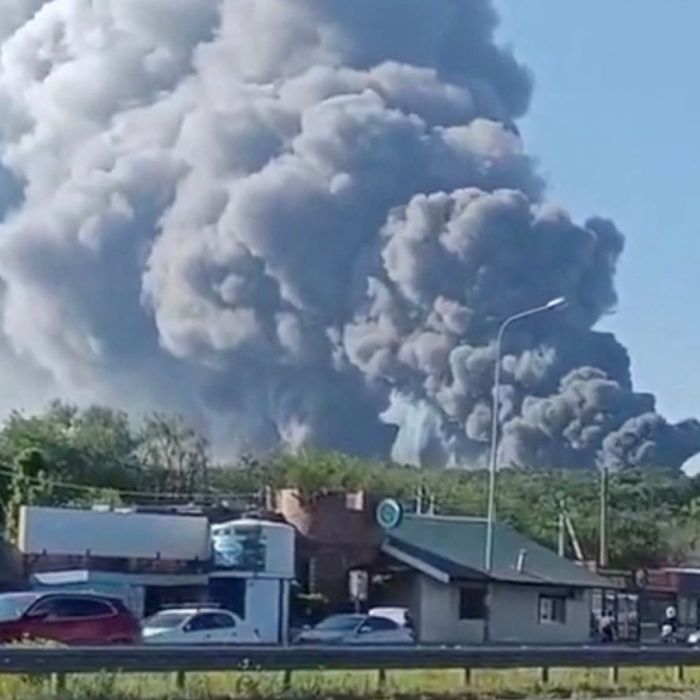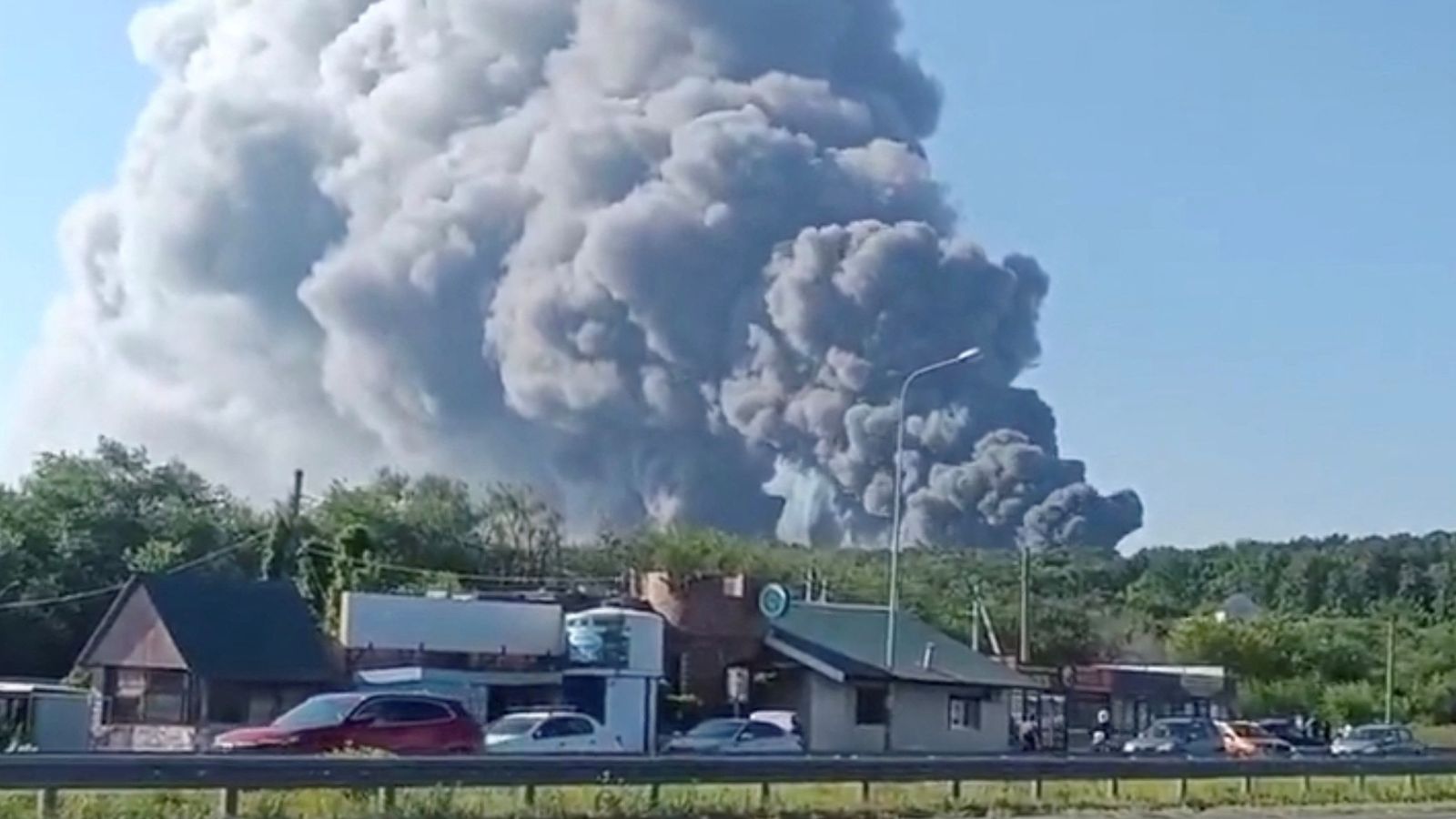
A Ukrainian drone strike has reportedly hit a warehouse belonging to Wildberries, the retail giant frequently described as Russia’s answer to Amazon, in a location far removed from any active front line. The incident marks another step in a campaign that has increasingly targeted infrastructure deep inside Russian territory rather than positions along the contested border.
Where the Strike Landed
Footage circulating after the incident shows an explosion near a warehouse facility in the Vladimir region, situated roughly 112 miles, or about 180 kilometres, east of Moscow.
That distance is the detail that matters most. Vladimir sits well beyond the country’s western border regions, in an area that has historically been treated as safe interior territory. For a drone to reach it, the operation required considerable range, planning, and successful navigation past layers of air defence.
BBC Verify has examined the available footage to assess its authenticity and location, a standard practice given how quickly unverified war imagery circulates online.
Why Wildberries Is a Target
Wildberries is not a minor commercial operation. It stands as Russia’s largest online retailer, and its parent group carries a valuation of approximately 12.6 billion dollars, equivalent to around 9.3 billion pounds.
The company’s warehouses have been struck repeatedly by Ukrainian forces over recent weeks, which indicates a deliberate pattern rather than a series of isolated incidents.
Ukraine’s justification is specific. Kyiv maintains that these distribution depots form part of the supply chain feeding the Russian military, making them legitimate military objectives rather than civilian commercial property.
Moscow rejects that characterisation outright, insisting the facilities serve ordinary consumers and nothing more.
The Logic Behind Hitting Logistics
The disagreement over Wildberries touches on one of the more difficult questions in modern conflict: where commercial infrastructure ends and military infrastructure begins.
Large-scale distribution networks are built to move goods efficiently at enormous volume. Warehousing, sorting capacity, transport fleets, and last-mile delivery routes are exactly the assets any military would want access to when supplying troops at scale.
If Ukraine’s assessment is correct, striking these hubs degrades Russian resupply without requiring attacks on more heavily defended dedicated military depots. If Russia’s position is correct, the strikes damage civilian commerce and inconvenience ordinary consumers to little military effect.
Neither claim can be independently verified from outside, and both sides have obvious reasons to frame the facilities as they do.
A Shift in How Russians Experience the War
The strategic value of these operations may be secondary to their psychological effect.
As the BBC’s Russia editor Steve Rosenberg has observed, the war has for most Russians been a distant matter, something occurring somewhere else and reported through television rather than experienced directly. That separation has been a defining feature of domestic life throughout the conflict.
That insulation is eroding. When explosions occur at facilities that ordinary people use routinely, when deliveries are delayed, when local news carries footage of fires at warehouses in provincial regions, the war stops being an abstraction.
This shift may be the more significant consequence of the deep-strike campaign. Material damage to a warehouse can be repaired. A change in public perception is harder to reverse.
Deaths From Falling Debris
The costs of the drone campaign are not confined to targeted infrastructure. In a village in south-west Russia, six people were killed by falling drone debris, according to the regional governor.
This is an underreported dimension of drone warfare. Interceptions and shoot-downs do not make wreckage disappear. Damaged aircraft, unspent munitions, and structural fragments fall to the ground, and where they land is largely a matter of chance.
Successful air defence can therefore still produce civilian deaths on the ground below. The people killed in that village had no involvement in the strike or its interception, and their deaths illustrate how the risk of these operations extends well beyond the intended target.
Five Years and Counting
The war has now entered its fifth year, a duration that few observers anticipated when it began.
The current phase looks markedly different from its opening stages. Large-scale territorial offensives have given way to attritional fighting along relatively static lines, combined with long-range strike campaigns that both sides now conduct against targets far from the front.
Drone technology has been central to this evolution. Relatively inexpensive systems capable of travelling hundreds of kilometres have allowed both sides to reach targets that would previously have demanded manned aircraft or ballistic missiles, at a fraction of the cost and political risk.
The result is a conflict in which geographic distance from the front line offers steadily diminishing protection.
What This Signals Going Forward
The repeated targeting of Wildberries facilities suggests Ukraine has settled on a deliberate strategy rather than pursuing targets opportunistically. Commercial logistics, energy infrastructure, and industrial capacity all now feature regularly in the target list.
For Russia, the challenge is one of arithmetic. Defending a small number of high-value military sites is achievable. Defending an entire national distribution network spread across an enormous landmass is a different proposition altogether, and air defence coverage cannot be extended everywhere at once.
For ordinary Russians, the practical effects will accumulate gradually rather than dramatically. Slower deliveries, higher prices, occasional shortages, and the growing sense that the conflict has arrived somewhere close to home.
Whether that translates into political pressure remains an open question. What is already clear is that the war can no longer be experienced from a safe distance, and that change is unlikely to be undone.
Author