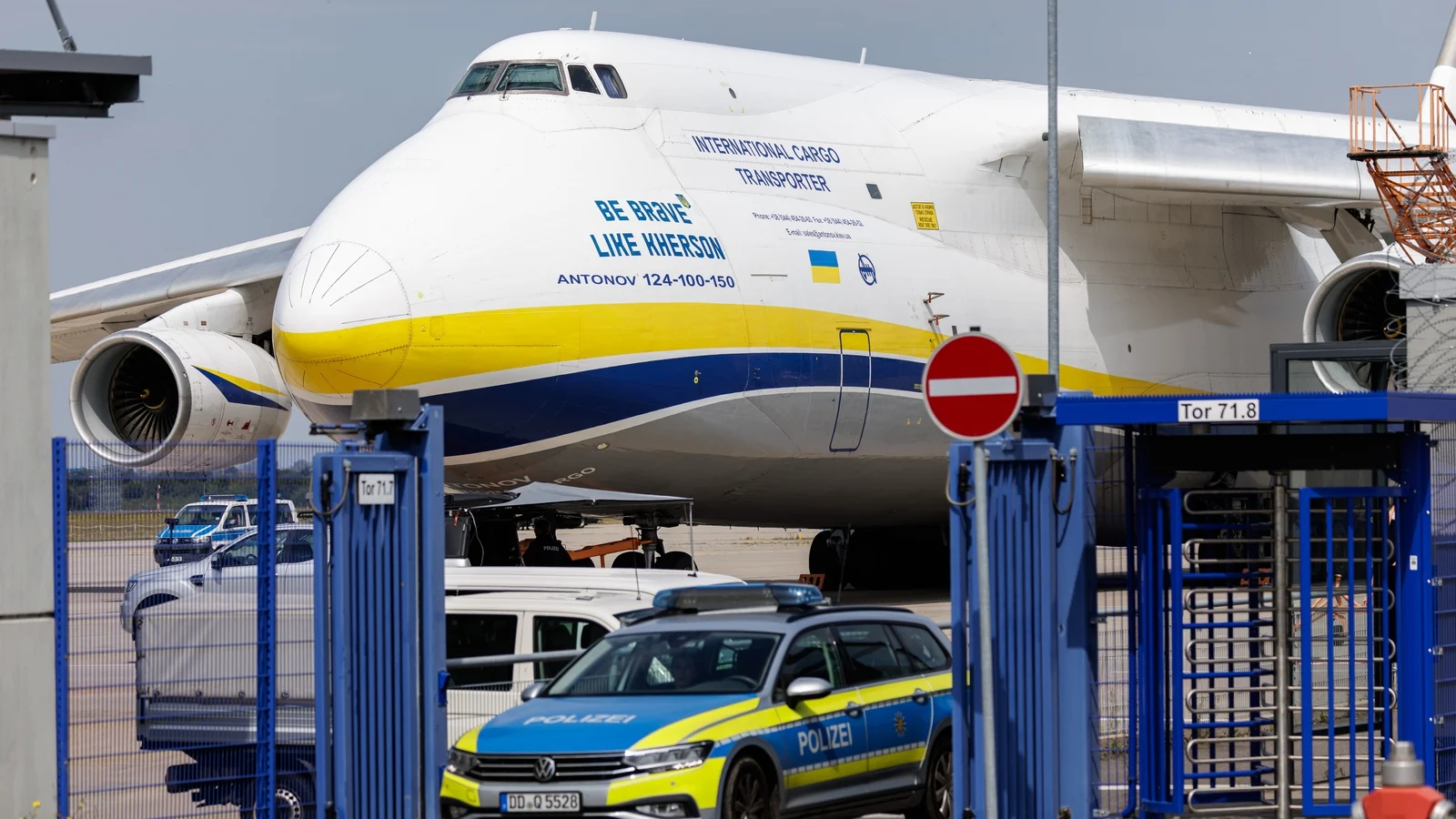
An explosive drone discovered at Leipzig airport beside a Ukrainian cargo aircraft appears to have failed for one reason only: its detonator had snapped off.
That detail, drawn from documents seen by German outlet Die Welt, transforms the incident from a security scare into something considerably more serious. Investigators believe an explosion was averted by mechanical failure rather than by detection or intervention.
Where the Device Was Found
The unexploded drone was located Tuesday night on the apron at Leipzig/Halle airport in eastern Germany, the area where aircraft load and unload cargo and passengers.
According to police documents, it sat close to an Antonov Airlines aircraft. Video footage from a local news agency showed a bomb disposal robot working near the plane, which bore the phrase “Be Brave Like Kherson” along its side, referencing the Ukrainian region that has endured sustained Russian bombardment.
The location is not incidental. Leipzig/Halle serves as a significant node for military logistics, handling shipments for the German armed forces and NATO allies, and it functions as a base for Antonov operations.
What Investigators Found
Examination of the device revealed it had been fitted with a detonation mechanism. Initial testing indicated the presence of explosive nitrates, according to German outlet Bild.
Reporting from Die Welt suggests the explosive was Semtex, a plastic explosive used in military applications and in building demolition. It is a serious material, not something improvised from commercially available components.
A bomb disposal robot was deployed to handle the device, and flight operations were disrupted while authorities secured the area.
Treated as an Attempted Attack
German security officials have classified the incident internally as a suspected attempted attack.
State prosecutors have assumed control of the investigation, including specialist units that focus on terrorism and extremism. That transfer of jurisdiction signals how the case is being assessed at senior levels.
Ukraine’s ambassador to Germany, Oleksii Makeiev, made no effort to hedge when asked about responsibility. Speaking to Welt TV, he posed the question rhetorically, asking who else it could possibly be other than Russia.
A Chaotic Night at the Airport
Police described a sequence of overlapping events in a statement Wednesday morning.
Shortly before midnight, an unidentified flying object was spotted near the airport, prompting several aircraft including a passenger plane to be diverted elsewhere. Separately, an object was detected near the southern runway, which federal police examined using an explosives disposal robot.
Authorities did not confirm whether the object was detonated in place, or whether it was the same device sighted earlier in the evening.
A Second Incident in the Air
While traffic was being redirected away from Leipzig, a DHL cargo aircraft struck an unidentified object during its climb and was forced into an unscheduled landing at Hanover, according to a source familiar with the matter who spoke to Reuters.
Inspection reportedly found minor damage to the nose of the aircraft.
Lower Saxony police have classified that incident as a state-security-related offence and are conducting a forensic examination of the plane.
Whether the two events are connected has not been established publicly, but the classification indicates investigators are not treating it as an ordinary bird strike.
Operations Resumed by Morning
The southern runway at Leipzig/Halle, a major hub for logistics group DHL, remained closed while explosives specialists examined the drone, a police spokesman said.
Several aircraft were diverted overnight. Normal operations resumed Wednesday morning.
Part of a Wider Pattern
This incident does not stand alone. Germany and other European countries have recorded repeated drone sightings over sensitive locations including airports, military installations, and industrial facilities.
German authorities, representing one of Ukraine’s most significant military backers, have said they suspect Russia of orchestrating many of these episodes as elements of a broader campaign involving sabotage, espionage, and disinformation.
Russia has consistently denied any involvement.
Why This Case Stands Apart
Most drone incidents over European infrastructure have involved surveillance or intimidation. Aircraft appear, are observed, and depart. The message is the point.
An explosive device positioned next to a specific aircraft belonging to a specific country represents something different in kind. It suggests intent to cause damage rather than to demonstrate reach.
Several elements make the case particularly notable:
The choice of Semtex, a military-grade explosive rather than an improvised compound
The proximity to a Ukrainian aircraft at a facility handling NATO military logistics
The presence of a functioning detonation mechanism, indicating the device was meant to explode
The apparent fact that only a mechanical failure prevented that outcome
What Comes Next
Prosecutors now face the task of establishing how the device reached a secured airport apron, who placed or delivered it, and whether the DHL incident forms part of the same operation.
Airports maintain layered security precisely to prevent this scenario, which means investigators will be examining perimeter integrity and personnel access alongside the forensic work on the drone itself.
For European governments watching, the incident raises an uncomfortable question about whether the pattern of drone activity over sensitive sites has entered a new phase, and whether existing countermeasures are adequate to what they now face.
Author
-
Lucienne Albrecht is Luxe Chronicle’s wealth and lifestyle editor, celebrated for her elegant perspective on finance, legacy, and global luxury culture. With a flair for blending sophistication with insight, she brings a distinctly feminine voice to the world of high society and wealth.