Trump Posts DronePort Images of Planned Ballroom Roof a Day After Court Halts Construction
The White House ballroom drone port concept arrived on social media in dramatic fashion this weekend, roughly twenty four hours after a federal appeals court told the administration it could not keep building the ballroom itself.
President Donald Trump shared two images, apparently generated by artificial intelligence, showing military drones stationed on the roof of his planned ballroom. The first depicts several large drones spread across a flat rooftop under armed guard. The second goes further, adding military vehicles including two fuel trucks along with dozens of personnel.
Both carry the label DronePort. Trump did not say who created them, nor did he indicate whether they correspond to any actual architectural plan.
The Post That Followed the Ruling
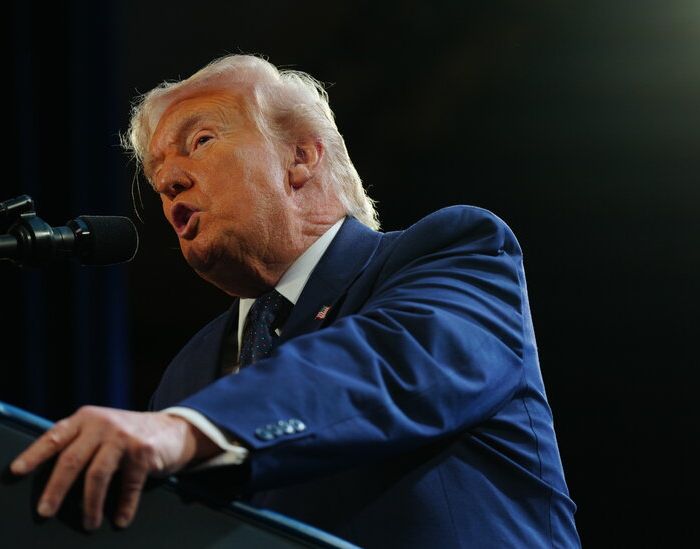
Writing on Truth Social on Saturday, Trump described the facility as a great and very important military asset sitting atop the heavily protected ballroom. He said it would provide national security for Washington, D.C., and protect future presidents.
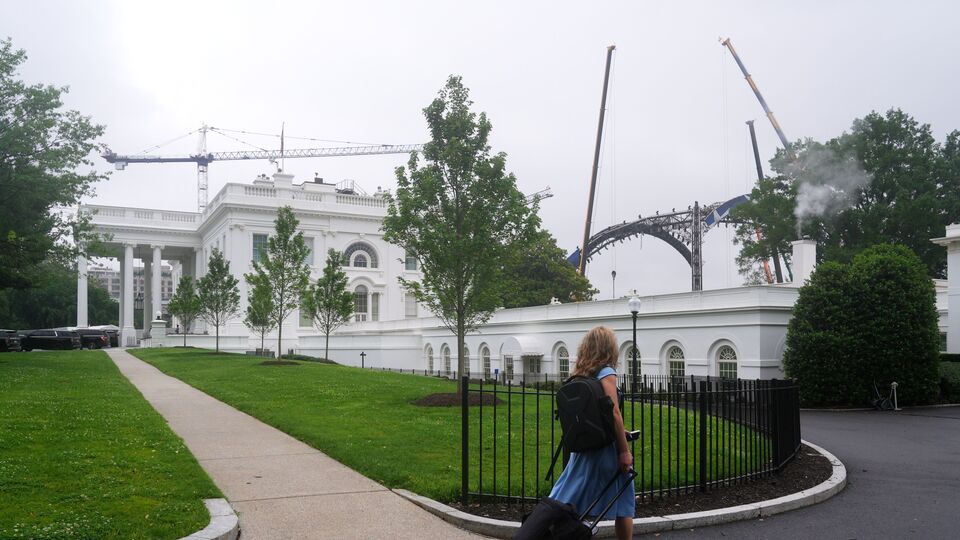
The timing was pointed. One day earlier, a divided panel of the U.S. Court of Appeals for the District of Columbia Circuit had ruled two to one that aboveground construction on the 400 million dollar project must stop.
The judges concluded that the president lacks unilateral authority to erect the roughly 90,000 square foot ballroom on the site of the demolished East Wing without approval from Congress.
Trump called the decision unjust and announced his administration would take the fight to the Supreme Court.
Importantly, the ruling did not shut down the site entirely. Work on underground national security facilities may continue. What is blocked is the ballroom rising above them while the litigation plays out.
The Legal Reasoning Behind the Decision
The central question was narrow but consequential: does existing law give a president independent authority to make a change of this scale to the White House?
Writing for the majority, Judges Patricia Millett and Bradley Garcia pointed to the Constitution’s Property Clause, which vests Congress with broad control over federal property. They also cited a statute barring the erection of any building or structure on federal public grounds in Washington without express congressional authority.
Their framing of the building itself drew attention. The White House, they wrote, belongs to the people. Each president occupies it as a temporary tenant rather than an owner.
The court added that it was aware of no prior instance of a president using privately raised funds to demolish a substantial portion of a building constructed with money Congress had authorized.
The Statute the Administration Relied On
The administration’s argument rested on a federal law permitting appropriations for the care, maintenance, repair, alteration, and improvement of the executive residence.
The majority rejected that reading. In its view, the provision governs funding Congress may elect to provide, not a grant of independent construction power to the executive branch.
The judges also drew a line between altering something and building something new. Replacing the East Wing with a structure that would dwarf other portions of the White House, they found, constitutes new construction rather than an improvement to what already existed.
How the Case Reached This Point
The ruling upheld a preliminary injunction won by the National Trust for Historic Preservation, which filed suit after Trump ordered the East Wing demolished in October 2025.
The majority reasoned that permitting construction to advance before the case was decided would inflict permanent damage on the architectural, historic, and aesthetic character of the White House and President’s Park. Once a structure of that size is built, there is no meaningful way to undo it if the courts later rule against it.
What Can Still Be Built
The injunction is more limited than it might appear.
Underground work continues unaffected. That includes bunkers, bomb shelters, and military and medical infrastructure. Aboveground construction is also permitted where strictly necessary to protect those underground facilities or to ensure the safety of the president, White House staff, and the grounds.
The majority said this carve-out sufficiently addressed the administration’s stated national security concerns for the duration of the case.
The judges were also careful about what they were not deciding. Their opinion did not assess whether a ballroom is a good idea, and it does not permanently bar one from ever being built. The holding is procedural: the administration cannot proceed without congressional authorization while the underlying dispute is litigated.
Whether a massive ballroom should be constructed, the majority wrote, is a question for Congress rather than a matter for executive self-help.
The Dissent
Judge Neomi Rao disagreed on two grounds.
She argued the National Trust had not established legal standing, since its claim rested on alleged aesthetic harm to a single member. She also read the word improvement more expansively than her colleagues, suggesting it could reasonably cover an addition to the executive residence.
Trump seized on her opinion in his response, accusing the two judges in the majority of endangering national security. He characterized the project as part of a wider security effort for the White House complex and described the ruling as a vote by two judges appointed under previous Democratic administrations against a desperately needed military center.
What Happens Next
The case now heads toward the Supreme Court, where the administration will seek to overturn the injunction. Whether the justices take it up quickly, and on what terms, remains open.
In the meantime, the East Wing is gone, underground work continues, and the ballroom exists only in plans and, apparently, in rendered images posted to social media.
The DronePort visuals themselves remain unverified. Without a stated source or confirmation that they reflect official design documents, they function more as messaging than as blueprint.
Author
-
Lucienne Albrecht is Luxe Chronicle’s wealth and lifestyle editor, celebrated for her elegant perspective on finance, legacy, and global luxury culture. With a flair for blending sophistication with insight, she brings a distinctly feminine voice to the world of high society and wealth.