Ankara Insists New Three-Way Defence Bloc Has No Target as Tehran Calls It Paper
The Mecca defence pact signed on Friday has done what any new military alliance tends to do: it has raised immediate questions about who exactly it is meant to deter.
Turkish officials spent Saturday answering that question with a firm denial. The agreement, they insist, is not aimed at Iran.
What Was Signed
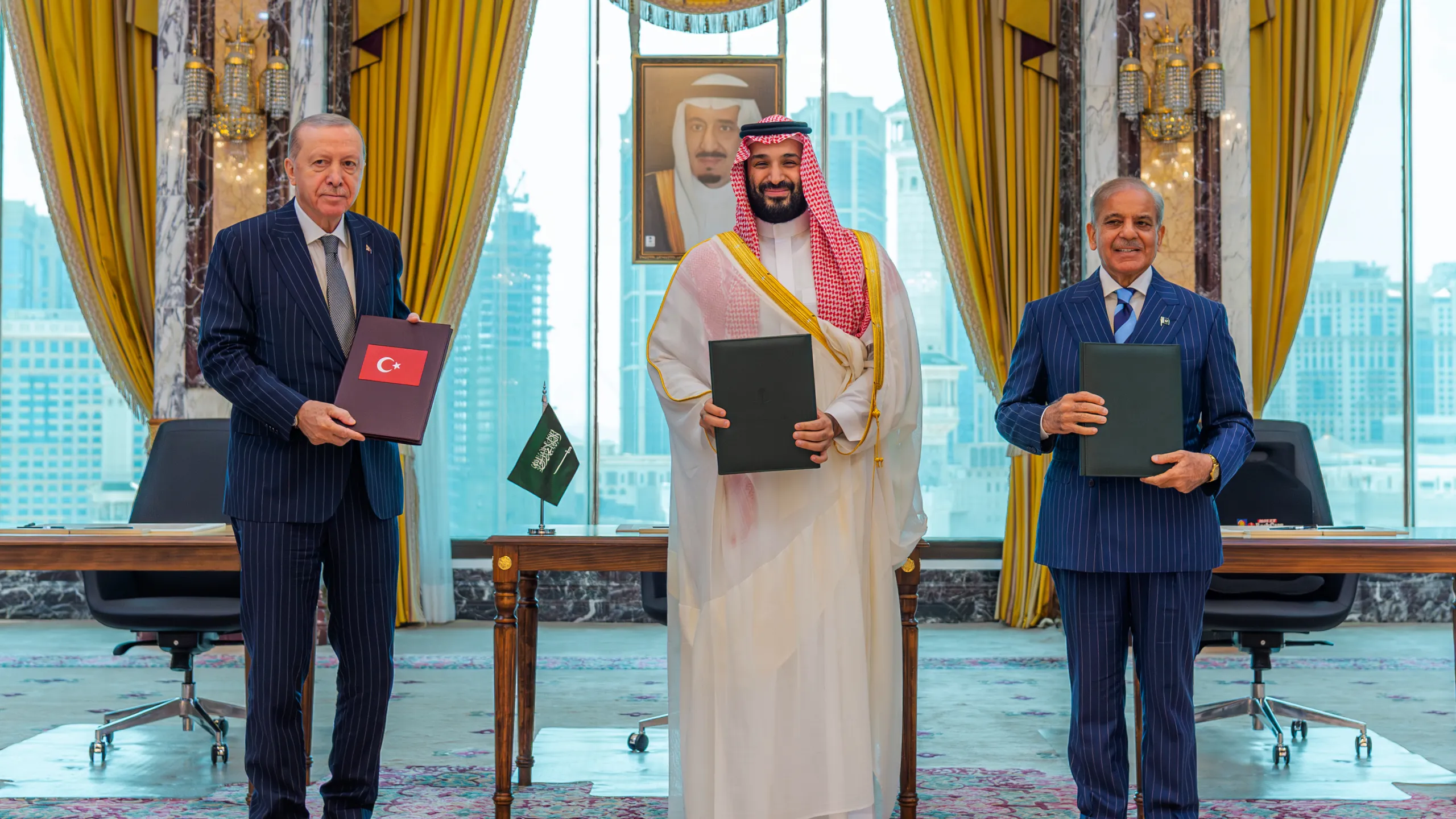
The Mecca Joint Defence Agreement was concluded by Turkish President Recep Tayyip Erdogan, Saudi Crown Prince Mohammed bin Salman and Pakistani Prime Minister Shehbaz Sharif.
Its central provision is deceptively simple. An armed attack on any one of the three signatories will be treated as an attack on all of them.
That formulation places the pact in familiar territory. It closely mirrors the collective defence principle that underpins NATO.
Ankara’s Denial
Turkish Foreign Minister Hakan Fidan addressed the Iran question directly in remarks to the state-run Anadolu agency.
He said the agreement does not identify Iran, or any other country, as a common threat. Nothing to that effect was committed to writing.
Fidan added a broader assurance: countries that do not attack the signatories will not be considered targets.
He also pushed back on the idea that the pact was assembled hastily in response to current regional tensions. Preparations, he said, had been under way for nearly two years and eight months.
How the Commitment Would Actually Work
Fidan described the arrangement as technically similar to NATO’s Article 5, but the mechanics he outlined are notably more conditional.
A member under attack would not automatically trigger a unified military response. Instead, that country would need to request assistance and specify what form it required.
The possible responses range widely. They could involve intelligence sharing, logistical support, ammunition supply, or the deployment of military units.
That flexibility is both a strength and a weakness. It gives signatories room to calibrate their involvement, but it also means the deterrent value depends on what an adversary believes will actually happen rather than what the text promises.
Building the Machinery
The pact is not intended to remain a declaration on paper.
The three countries plan to establish political and military committees bringing together foreign ministers, defence ministers and military chiefs. A permanent secretariat will be based in Saudi Arabia.
Fidan outlined a working agenda covering joint training, intelligence sharing, logistics, threat assessments and military interoperability.
Interoperability in particular signals long-term intent. Making three separate militaries capable of operating together requires years of shared procedures, compatible communications and repeated exercises.
Defence Industry at the Centre
One element received unusual emphasis.
Fidan said defence-industry cooperation was among the main topics the three leaders discussed in Mecca, including how each country might benefit from the others’ military technologies.
That interest is easy to understand. Turkey has built a formidable drone and defence manufacturing sector. Pakistan brings established production capacity and nuclear expertise. Saudi Arabia brings capital and an explicit strategy of localising defence production.
The combination offers each party something it cannot easily obtain alone.
Tehran Responds With Scepticism
Turkish reassurances have not fully landed in Iran.
Mahmoud Nabavian, a member of Iran’s parliamentary National Security and Foreign Policy Commission, warned that Saudi leaders should not assume cooperation with Turkey and Pakistan guarantees their security.
A fellow commission member, Ebrahim Rezaei, was more dismissive still, characterising the pact as a paper agreement.
Iranian Foreign Minister Abbas Araghchi took a subtler approach. In a message posted on X on Friday, he avoided naming the agreement directly but urged regional states to rely on themselves and pursue what he described as true brotherhood.
He paired that appeal with a reminder of the strength and readiness of Iran’s armed forces.
A Bloc Designed to Grow
Fidan framed the pact within a larger argument about who should be responsible for regional security.
External hegemons entering the region, he said, do not solve problems but make them sharper.
He described Turkey, Saudi Arabia and Pakistan as the core countries of the initiative and made clear that Ankara does not want it to stop there. Under the president’s vision, he said, the arrangement should not remain limited to three states but should expand and, if necessary, bring all countries under the same umbrella.
Several countries have already expressed interest, according to Fidan. He singled out Egypt as a natural partner and said he expects it to join once outstanding technical issues are settled.
The Unanswered Questions
For all the structure being built, significant practical details remain undefined.
How the three militaries would actually coordinate during a fast-moving crisis has not been spelled out. Command arrangements, decision timelines and thresholds for action all remain to be worked through.
There is also the geographic problem. Turkey, Saudi Arabia and Pakistan do not share contiguous territory, and their strategic priorities diverge considerably. Ankara’s concerns centre on its own neighbourhood and the eastern Mediterranean. Islamabad’s are shaped overwhelmingly by India. Riyadh’s focus sits squarely on the Gulf.
Reconciling those differing threat perceptions into a functioning alliance is a substantially harder task than signing a document.
What It Signals
Whatever its operational limits, the pact represents a meaningful shift.
Three influential states have formalised a mutual security commitment without American mediation, at a moment when regional confidence in external guarantees is uncertain.
Whether it develops into a genuine alliance or remains largely symbolic will depend on whether the committees meet, the secretariat functions, and the interoperability work actually happens.
The next visible test may be Egypt.
Author
-
Lucienne Albrecht is Luxe Chronicle’s wealth and lifestyle editor, celebrated for her elegant perspective on finance, legacy, and global luxury culture. With a flair for blending sophistication with insight, she brings a distinctly feminine voice to the world of high society and wealth.