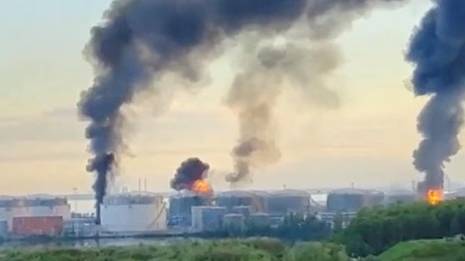
Smoke Over Putin’s Hometown
A Ukraine drone strike on St. Petersburg sent thick plumes of black smoke drifting over Vladimir Putin’s hometown on Wednesday, just hours before the Kremlin welcomed international guests to its flagship economic gathering. The timing was hard to ignore. As Russia tried to showcase prosperity and stability, the war it started came crashing back into view.
The dark smoke rose over a city widely seen as Russia’s second-most-important after Moscow, curling above its golden-domed churches and bustling port. It was a stark visual contradiction to the message the Kremlin hoped to project.
A Forum Designed to Impress
The strike came as Russia opened the St. Petersburg International Economic Forum, known as SPIEF. Often described as Russia’s answer to the World Economic Forum in Davos, the three-day event is built to attract foreign investment and present the country at its most confident and successful.
Putin himself is scheduled to attend and deliver a keynote address on Friday. But the carefully staged optimism was undercut from the very first morning, as the consequences of the conflict unfolded on the city’s outskirts.
The disruption was immediate and practical:
Pulkovo Airport temporarily restricted its airspace.
Roughly 30 flights were delayed or diverted.
Smoke spread across the city, impossible for arriving guests to miss.
What Was Hit
Local officials offered a partial picture of the damage. St. Petersburg’s governor, Alexander Beglov, said unspecified “infrastructure objects” had been struck across three districts. Alexander Drozdenko, governor of the wider Leningrad region, said air defenses had shot down 59 drones overnight, hinting at the scale of the assault.
Ukrainian President Volodymyr Zelensky was more specific. He said the drones had hit the St. Petersburg Oil Terminal, sharing footage of an oil depot engulfed in flames. According to Zelensky, other targets included military facilities at the Kronstadt naval base near St. Petersburg and a weapons production site in the Tambov region.
A Strategy Taking Shape
For Zelensky, the strikes are part of a deliberate, long-term plan rather than isolated attacks. He framed them as a form of pressure designed to push Russia toward peace, writing that Ukraine’s approach to long-range strikes was being carried out exactly as intended to bring an end to the war closer.
These deep strikes inside Russian territory appear to be shifting the dynamics of the conflict. By repeatedly targeting oil infrastructure, Ukraine has triggered fuel shortages that are causing real strain for Russia, turning the country’s energy strength into a vulnerability.
A War Without an End in Sight
The forum unfolded against the backdrop of a grinding conflict now in its fifth year, with no resolution on the horizon. Both sides remain locked in an expanding aerial war, trading increasingly destructive blows.
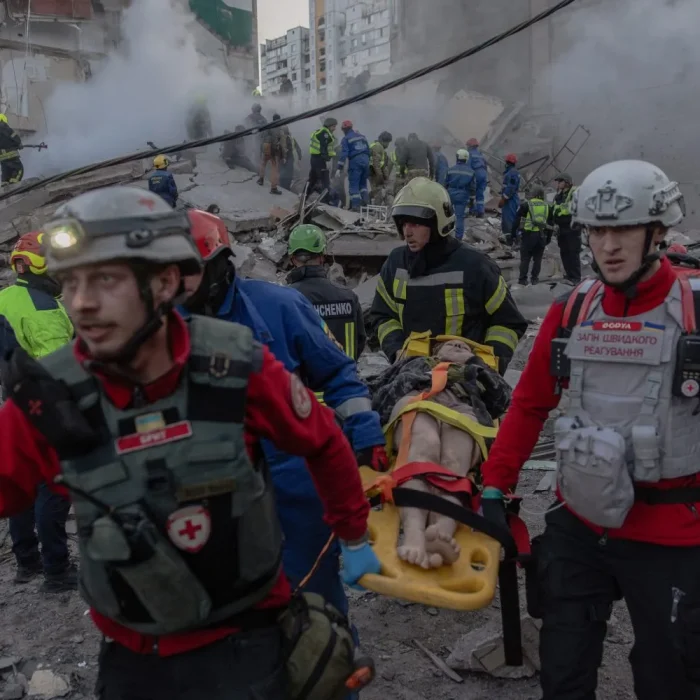
Just a day before the St. Petersburg strikes, Russia launched its own missile and drone attacks on Ukraine, hitting the capital, Kyiv, and the central city of Dnipro. Those attacks killed at least 23 people, according to Ukrainian authorities, and ranked among the deadliest Russian strikes in months.
The pattern has become bleakly familiar. Russia threatens to intensify its bombing campaign, Kyiv absorbs devastating blows, and Ukraine responds by striking Russian refineries deep behind the front lines. Meanwhile, the Trump administration has largely shifted its focus to Iran, leaving negotiations over Ukraine on the back burner.
A Notable American Presence
This year’s forum drew attention not only for the drone strikes but also for some of its guests. Among them was Rodney Mims Cook Jr., chairman of the U.S. Commission of Fine Arts, who is overseeing President Trump’s planned White House ballroom project.
Russian officials portrayed Cook’s attendance as the first official U.S. presence at SPIEF after years of boycotts. Cook has said his participation was approved by the State Department, though he did not appear to be part of an official delegation appointed by the president.
Still, his appearance was read as a sign of warming ties. A Russian presidential aide, Yury Ushakov, noted that Americans had been largely absent at this level since around 2017 to 2018. Cook was set to speak at the forum’s Russia-U.S. cultural dialogue session.
Controversial Names on the Program
Cook was scheduled to share the stage with several prominent but heavily sanctioned figures, highlighting the tense politics surrounding the event.
Among them were Valery Gergiev, director of the Bolshoi and Mariinsky theaters, and Mikhail Piotrovsky, general director of the Hermitage Museum. Both have faced international sanctions.
Gergiev, a close ally of Putin, lost prestigious posts abroad and saw major institutions cut ties with him over his refusal to condemn Russia’s full-scale invasion of Ukraine. Canada sanctioned him in June 2025.
Piotrovsky, linked to Putin since the 1990s, once described the Hermitage’s post-invasion exhibition policy as a “special cultural operation,” echoing the Kremlin’s language for the war. He later backed efforts to absorb Ukrainian cultural objects into Russian state museums, prompting E.U. sanctions in April 2026.
The forum’s program also featured right-wing American podcaster Candace Owens, known for promoting conspiracy theories, who was slated to speak at a session on balancing parenthood in a large family with a successful career.
Adding to the spectacle, brothers Andrew and Tristan Tate, the online influencers known for their misogynistic views, were spotted in Russia ahead of the forum. Andrew Tate posted a video of their arrival at a Moscow airport, where they were greeted with folk songs by costumed performers, though it was unclear whether they planned to attend SPIEF itself. The brothers, who hold dual U.S. and British citizenship, were arrested in Romania in 2022 on trafficking charges they deny and remain wanted in Britain.
The Bigger Picture
The contrast on display in St. Petersburg was impossible to overlook. Inside the forum, Russia worked to project wealth, confidence, and renewed international engagement. Outside, smoke from a burning oil terminal told a different story.
The Ukraine drone strike on St. Petersburg served as a powerful reminder that the war cannot be neatly hidden behind polished conference halls and keynote speeches. As long-range attacks reach deeper into Russian territory, the conflict continues to follow the Kremlin wherever it tries to perform normalcy.
For now, the message from both battlefields is clear. Neither side shows signs of backing down, and events meant to symbolize strength can be overshadowed in an instant by the very war Russia hoped to keep at a distance.
Author