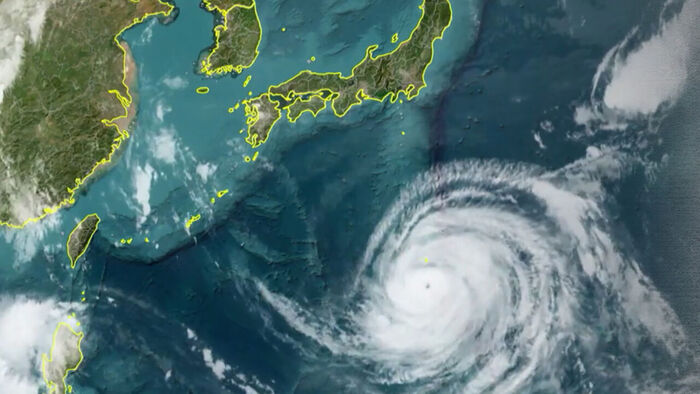
Over a Million Moved as Typhoon Dolphin Bears Down on China’s Eastern Seaboard
Typhoon Dolphin China preparations reached extraordinary scale over the weekend, with more than a million people relocated to safety ahead of a storm set to become the most powerful to strike the country this year.
Landfall is expected Sunday evening along the eastern coast, bringing sustained winds of up to 162 kilometres per hour, roughly 101 miles per hour.
That places Dolphin at the equivalent of a Category 2 storm on the Saffir-Simpson scale, strong enough to cause extensive damage to homes, trees and infrastructure.
Damage Already Done in Okinawa
Dolphin arrived in China with a track record.
The storm swept through Japan’s southern Okinawa prefecture before turning toward the mainland, injuring six people and cutting power to more than 50,000 buildings.
That passage gave Chinese authorities a preview and several days of warning, which they used aggressively.
Preparations Across Multiple Provinces
Ahead of landfall, officials moved offshore workers to safety, ordered vessels back to port, and stepped up inspections at reservoirs, mountain streams, landslide-prone slopes, construction sites and tourist areas.
Zhejiang, Shanghai, Jiangsu and Fujian all activated Level III emergency responses.
In Fujian, authorities evacuated 98,900 people from high-risk zones. Maritime officials there suspended 55 coastal passenger ferry routes, halted all 115 offshore construction projects, and moved 290 construction vessels into sheltered waters.
In Zhejiang, the city of Wenzhou undertook one of the largest single relocations, moving more than 900,000 residents and opening over 1,000 emergency shelters.
Shanghai evacuated at least 30,300 people and saw roughly 1,500 flights cancelled, according to flight-tracking provider VariFlight.
At Shanghai’s Yangshan port, berths were cleared entirely and more than 500 small and medium-sized vessels were relocated to shelter, the city’s maritime safety administration said.
The Rain Is the Bigger Threat
Wind speeds capture headlines, but forecasters are more concerned about water.
Torrential rain is expected through August 10 across Zhejiang, Shanghai, northern Fujian, northeastern Jiangxi, central and southern Anhui, and much of Jiangsu.
Parts of central and eastern Zhejiang could receive between 250 and 500 millimetres, which translates to roughly 10 to 20 inches.
Rainfall at the upper end of that range would overwhelm drainage systems in almost any urban area and saturate hillsides to the point of instability.
Why Dolphin May Linger
The storm’s forecast track compounds the danger.
Wang Haiping, chief forecaster at the National Meteorological Centre, told state broadcaster CCTV that after landfall Dolphin is expected to move westward before slowing over central and southwestern China and gradually weakening.
A slowing storm is not necessarily a safer one. Weakening winds reduce structural damage, but a system that stalls keeps dumping rain over the same catchments for far longer.
That prolongs flooding risk and raises the likelihood of landslides, particularly in mountainous terrain and along smaller river systems that respond quickly to rainfall.
Rivers Under Watch
China’s water resources ministry has flagged specific waterways.
The Qiantang, Yong, Jiao and Shuiyang rivers could experience major flooding. Smaller rivers in the hardest-hit districts may rise above warning levels.
Authorities have also warned of elevated geological disaster risk across parts of Zhejiang. Residents in areas under a red mountain-torrent warning have been instructed to follow local evacuation orders without delay.
Mountain torrents are among the deadliest hazards in these events. They develop with very little warning and move with enough force to destroy structures in their path.
A Traveller’s View From Shanghai
Not everyone caught in the disruption is alarmed.
A 44-year-old tourist from Guangdong, surnamed Chen, found himself stranded in Shanghai after his family’s Sunday evening flight was cancelled. They were rebooked for 10 p.m. Monday, though he was uncertain whether that departure would happen either.
Chen offered a distinctly southern Chinese perspective on the whole affair. To people from Guangdong, he said, a typhoon is as ordinary as sitting down to a meal and feeling a breeze. It is simply part of everyday life.
He did not consider Dolphin especially strong by the standards of China’s southern coast.
His reaction reflects something real about regional experience. Guangdong sits directly in the path of Pacific typhoons year after year, and residents there have built both infrastructure and instincts around them. The eastern coastal provinces face these storms less frequently, which is partly why the response has been so extensive.
What Comes Next
The critical window runs from Sunday evening through Monday and Tuesday.
Landfall will bring the peak winds and storm surge along the coast. The days that follow will determine whether the rainfall totals translate into serious flooding inland.
For residents in affected areas, the guidance is straightforward. Follow evacuation orders rather than waiting to assess conditions personally. Avoid rivers, streams and low-lying roads. Stay away from hillsides during and after heavy rain, since landslides frequently occur hours after rainfall peaks.
Travellers should assume disruption will continue past the storm itself, as airlines work through backlogs and rail services resume gradually.
More than a million people have already been moved. Whether that scale of preparation proves excessive or exactly right will be clear by midweek.
Author
-
Lucienne Albrecht is Luxe Chronicle’s wealth and lifestyle editor, celebrated for her elegant perspective on finance, legacy, and global luxury culture. With a flair for blending sophistication with insight, she brings a distinctly feminine voice to the world of high society and wealth.