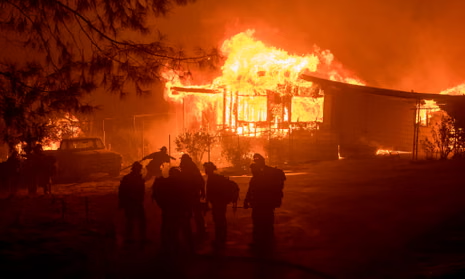
Wildfire evacuations stretched across two countries over the weekend, pushing tens of thousands of people out of their homes and leaving many more waiting anxiously to learn whether they would be next. From the smoke-filled valleys of British Columbia to the scorched hillsides north of Spokane, entire communities spent Sunday watching the wind, refreshing their phones and hoping the flames would turn the other way.
For some families, the waiting is already over. They have fled, and now the only question left is what will be standing when they are finally allowed to go back.
Panic Along Okanagan Lake
In western Canada, more than 20,000 people were ordered out of communities lining Okanagan Lake in British Columbia as a fast-moving fire tore through the area. Homes were destroyed. Dozens of people were plucked to safety by aircraft when road escape was no longer an option.
Anette Boulet was one of the residents who left Summerland, a lakeside town of roughly 12,000. She and her family pulled out at around 4:30 in the morning on Saturday, driving through air so thick with smoke that visibility nearly vanished. What she remembers most is the darkness, and the glowing line of fire creeping down the ridge toward them. She described the fear as something words could not really capture. Her family ended up at an evacuation center in Penticton.
The weekend also brought tragedy. The Royal Canadian Mounted Police reported that an 80-year-old woman died while attempting to escape the blaze that triggered the evacuations in the Okanagan Lake region.
The Bald Range fire, first reported on Friday evening, did not stop at Summerland. Roughly 8,000 more people in and around neighboring Peachland were also forced to leave. British Columbia declared a state of emergency on Saturday as the situation escalated.
Federal help followed quickly. Eleanor Olszewski, Canada’s minister of emergency management and community resilience, announced on social media that she had signed off on the province’s request for assistance to provide shelter and accommodation for displaced residents.
Spokane Residents Live on the Edge
South of the border, crews in eastern Washington have spent more than a week battling three separate fires that ignited in the Spokane area. By Sunday, the news was cautiously encouraging. Teams were focused on mop-up work near containment lines, and none of the fires were expanding.
The damage, though, is already severe. Roughly 920 structures have been damaged or destroyed. And there is an added sting to this one: earlier in the week, a man was arrested and charged in connection with deliberately igniting the largest of the three blazes.
Laurie Allen knows the cost personally. She lives in Nine Mile Falls, a community north of Spokane, and she left the previous weekend with her husband, their dog and two kittens as flames burned nearby. By Sunday, the roads into her neighborhood were still shut, but a friend had passed along the news she had been praying for. Her house was blanketed in ash but still standing, along with several others close by.
Sixty-five years in the area, she said, and nothing like this had ever happened. In the rush to get out, nothing mattered except the animals. But relief is complicated when so many friends and relatives were not as fortunate. She called the whole thing devastating.
A Small Town That Has Been Here Before
Few places understand this fear better than Malden, a tiny rural community about 35 miles south of Spokane. On Saturday, residents were told to leave immediately. By Sunday, officials had eased that order to a standby alert, meaning people should stay packed and ready to move at a moment’s notice.
Conditions had calmed. John Goyke, whose company operates Malden’s water system under contract, said the wind had settled and the fire was no longer pushing forward. Local officials have leaned on social media and community pages to keep everyone informed in real time.
Goyke, who also serves as mayor of nearby Rosalia, said residents have been asked to limit water use so supplies stay available for fire crews. Malden’s fire department has been hauling water in from Rosalia to keep tanks filled.
The caution is not paranoia. In 2020, Malden was almost entirely wiped out by a wildfire that took its fire station, post office, city hall and library. The town has been rebuilding ever since, which makes every plume of smoke on the horizon feel like a threat to start over again.
Two Pilots Lost in Utah
The season has also claimed lives among those fighting it. In Utah, two helicopter pilots were killed when their aircraft went down Friday morning during firefighting operations in the Fishlake National Forest.
Reaching the wreckage proved dangerous in itself. Rugged, steep ground and active flames kept crews away until Saturday, when they were finally able to confirm the deaths.
Sevier County Sheriff Nathan Curtis described arriving to see two separate columns of smoke rising, one from the crash site and another from a fire advancing toward them. The National Transportation Safety Board is now investigating what caused the aircraft to go down.
What Comes Next
The pattern is familiar and unsettling. Dry fuel, shifting winds and steep terrain combine into fires that outrun containment plans and force officials to order wildfire evacuations with only hours of notice.
For residents in fire-prone regions, the lesson repeats itself each season: keep a go-bag packed, know more than one route out, register for local emergency alerts, and treat a standby warning as a signal to load the car rather than wait and see. Documents, medication, phone chargers and pet supplies should be ready to grab in a single trip.
As of Sunday, some fires had stopped growing and some evacuation orders had softened. But thousands of people on both sides of the border are still living out of suitcases, refreshing alert pages and waiting for the call telling them it is safe to drive home.
Author
-
Lucienne Albrecht is Luxe Chronicle’s wealth and lifestyle editor, celebrated for her elegant perspective on finance, legacy, and global luxury culture. With a flair for blending sophistication with insight, she brings a distinctly feminine voice to the world of high society and wealth.