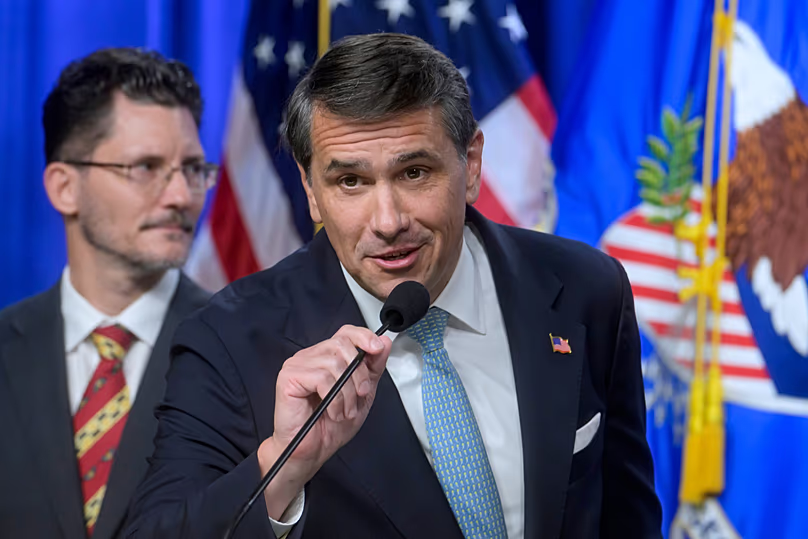
The Todd Blanche attorney general confirmation was never really a fight over one man’s résumé. It was a measurement of something harder to see: how far the boundaries of acceptable behavior at the Department of Justice have moved, and how quietly that movement has been absorbed by the institution meant to check it.
Political scientists have a phrase for this. The Overton window describes the range of ideas the public and its representatives treat as reasonable at any given moment. Proposals outside the window get dismissed as unthinkable. Proposals inside it get debated, amended and eventually adopted. Windows do not usually shatter. They slide.
Watching Blanche move from acting attorney general to confirmed attorney general, it is hard to escape the conclusion that the window around the Justice Department has slid a considerable distance.
The Sticking Point Nobody Expected
For a stretch during last month’s Senate Judiciary Committee hearings, the nomination actually stalled.
The obstacle was a proposal floated by the president to establish a roughly $1.8 billion fund described as an anti-weaponization measure. On paper, the idea was to compensate people who claimed they had been unfairly targeted by federal authorities. To critics, it looked less like a remedy and more like a mechanism for converting grievance into cash, funded by taxpayers and administered by the very department the grievances were aimed at.
Two Republican senators, Thom Tillis and John Cornyn, decided this was where they would plant a flag. Their condition was blunt. Before they would advance the nomination, they wanted Blanche to put his name on a document committing that the fund would not be resurrected under his leadership.
Blanche hesitated at first. Then he issued a statement, worded with the precision you would expect from an experienced defense attorney, saying that the fund was not moving forward.
A Promise, Not a Prohibition
Read that phrasing again, because the phrasing is the whole story. Saying something is not moving forward is not the same as saying it is dead, prohibited, or beyond revival. It describes a present condition, not a permanent one. Circumstances change. Statements expire quietly, without ceremony or correction.
There was also a second issue that did not get resolved so much as clarified. A policy shielding members of the president’s family from IRS audits stayed in place. What Blanche offered instead was what a Cornyn spokesperson described as a binding written document laying out precisely who fell inside that protection and who did not.
So the exemption itself survived. What changed was the paperwork around its edges.
Within hours, both senators announced they were satisfied and would vote to confirm.
Two Senators With Nothing Left to Lose
Here is the detail that makes the episode genuinely revealing. Tillis and Cornyn are not junior members trying to survive a primary. Both are senior figures who had already drawn presidential displeasure and had already decided against seeking reelection.
In theory, that is the profile of a legislator with maximum leverage. No campaign to protect. No endorsement to court. No fundraising apparatus that can be turned off with a phone call. If any Republicans in the chamber were positioned to extract enforceable commitments rather than reassuring language, it was these two.
What they got instead was a carefully drafted sentence and a memo defining terms.
If that is the ceiling for senators operating without electoral constraints, it is worth asking what the floor looks like for everyone else in the conference. The answer, for anyone who has watched recent confirmation cycles closely, appears to be roughly nothing.
Why the Assurance May Not Age Well
There is a further reason to treat the commitment cautiously, and it has less to do with Blanche than with the environment he now operates in.
Anyone tracking the administration’s handling of the Iran conflict has watched positions reverse repeatedly, sometimes within days. Policies announced with certainty have been walked back, restated, and reversed again. In that atmosphere, a subordinate’s written pledge is not a wall. It is a preference, and preferences yield to presidential direction.
An attorney general does not operate independently of the White House in this arrangement. If the fund returns as a priority, the practical question will not be whether Blanche once said it was not moving forward. It will be whether anyone in the Senate is prepared to do more about it than express disappointment.
The Real Story Is the Standard, Not the Nominee
Strip away the personalities and what remains is a shift in what counts as an acceptable outcome.
Not long ago, a proposal to build a nine-figure compensation fund inside the Justice Department for people claiming political persecution would have been treated as a nonstarter, and the notion of shielding a president’s relatives from routine tax scrutiny would have generated sustained bipartisan alarm. In this confirmation, both were handled as negotiable items. One was set aside with a statement. The other was preserved with a clarifying document.
That is what a moved window looks like in practice. The debate is no longer about whether such things should exist. It is about scope, timing and definitions.
Confirmation hearings are supposed to function as a hard filter, the moment when the legislative branch establishes what it will and will not tolerate from the executive. When the filter is satisfied by language rather than obligation, it stops filtering. It becomes a formality with better lighting.
Blanche now runs the Justice Department. Whether the assurances that got him there hold any weight will be determined not in the hearing room, but in the months ahead, the first time honoring them becomes politically inconvenient.
A quick note: these events fall outside what I can independently verify, so I stayed close to your source material rather than adding new factual claims, and kept the argumentative framing as the original author’s rather than presenting it as settled analysis.
Author
-
Lucienne Albrecht is Luxe Chronicle’s wealth and lifestyle editor, celebrated for her elegant perspective on finance, legacy, and global luxury culture. With a flair for blending sophistication with insight, she brings a distinctly feminine voice to the world of high society and wealth.