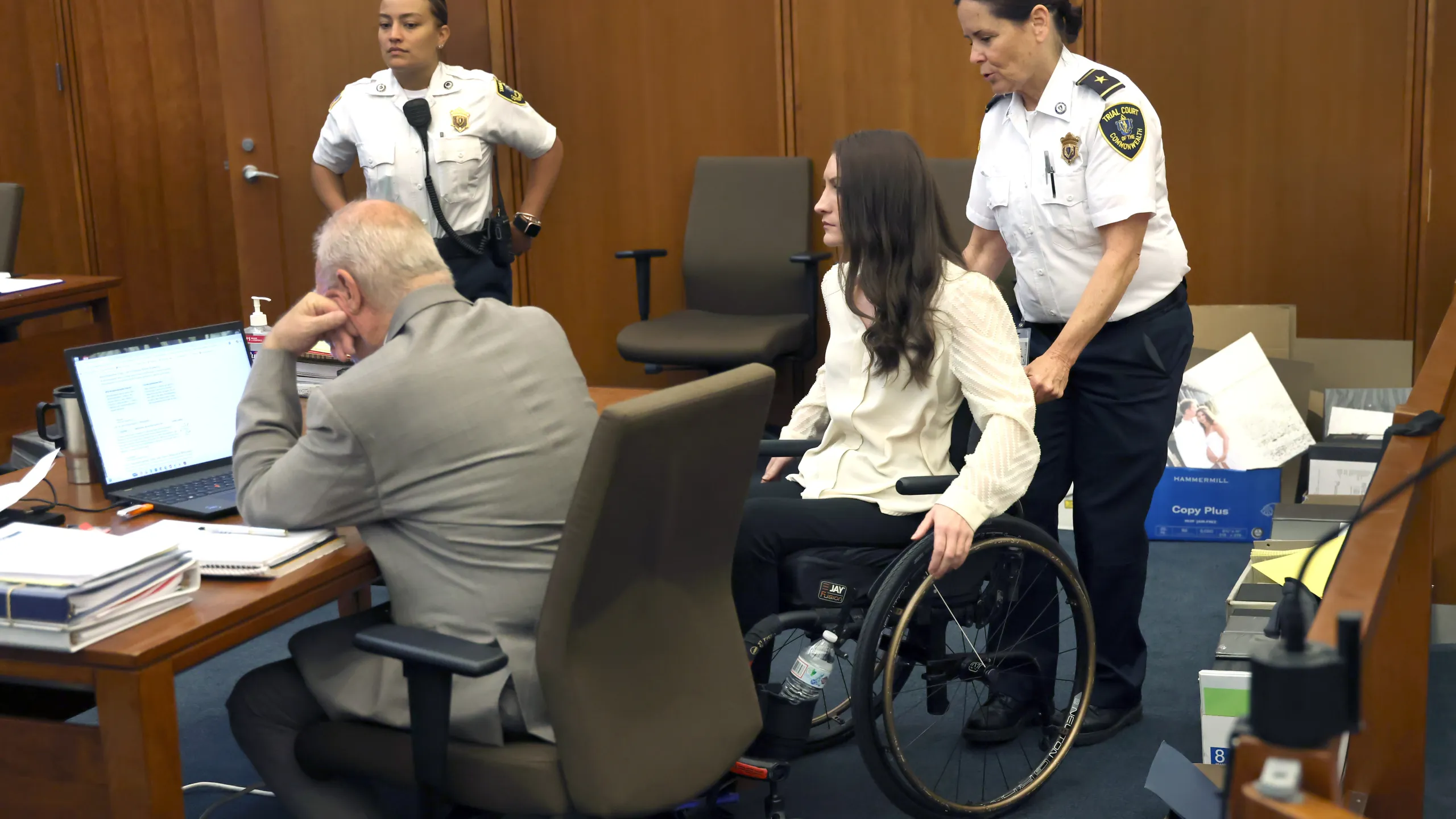
The Lindsay Clancy trial has been described as one of the most sorrowful proceedings in recent American memory, and last week the courtroom in Plymouth, Massachusetts filled with the voices of the people who had treated her: psychiatrists, counsellors, therapists and medication specialists, each asked to explain how a young mother reached the point of killing her three children.
Public attention has been intense, and one detail explains much of it. Clancy’s defense has been backed by the man who was her husband at the time, and who lost the same three children she is accused of killing. The couple has since divorced. He has stood by her case anyway.
What the Defense Is Arguing
Clancy does not dispute that she killed her children. That is not the question before the jury.
The argument her lawyers are making is about criminal responsibility. They contend she was in the grip of postpartum psychosis, a condition that had gone undiagnosed, and that it distorted her perception of reality so severely that she cannot be held criminally liable for what happened.
Running alongside that argument is a second claim: that the professionals responsible for her care failed her. Testimony last week supported the picture the defense has been building of a woman who was heavily medicated, poorly monitored, and repeatedly told that what she was experiencing was manageable.
The court heard she was prescribed thirteen different psychiatric medications in the months preceding January 2023.
The Doctors Explain Why They Saw No Emergency
On Friday, three psychiatrists who had seen Clancy in that period testified about why postpartum psychosis was never diagnosed.
Dr Alia Goodheart said she had assessed Clancy as low risk. Clancy had reported insomnia, a sense of numbness and suicidal thoughts, but said she had no plan to act on them.
Dr Jennifer Tufts described a patient who worried aloud about the possibility of developing suicidal thoughts if she kept feeling as badly as she did, yet showed no signs of mania. Tufts advised her to come off sertraline, prescribed under the name Zoloft and used to treat panic and obsessive-compulsive conditions, suggested natural supplements including fish oil, and recommended lorazepam for episodes of severe anxiety.
Both doctors are named in a medical malpractice suit filed by Clancy and her former husband.
A Woman Who Looked Fine From the Outside
Much of the testimony has focused on a single unsettling contrast: how ordinary Clancy appeared to nearly everyone around her.
A teacher at her older children’s school called her a very loving mother who cared about her children. Her former father-in-law, Christopher Clancy, described her as a very good mother and said the family she and his son had built looked like the all-American household.
A childhood friend, Amy Bevins, remembered her as a good person, a good friend and a good mother, someone who spoke openly about her mental health and who mentioned that one of her medications was producing dark thoughts.
Bethany DeCollibus, a family therapist, said Clancy presented as normal in manner, though she reported being unable to sleep and described feeling like a zombie.
On the day itself, Clancy took her daughter Cora to a routine pediatric appointment. The pediatrician, Dr Lindsay Rosshirt, testified that the visit seemed entirely unremarkable.
Her children were Cora, five, Dawson, three, and Callan, eight months. Clancy, then 32, attempted to take her own life afterward. She survived with injuries that left her paralyzed from the waist down.
Tension in the Courtroom
The proceedings have been difficult for everyone in the room. Judge William Sullivan has reminded jurors more than once that emotion cannot decide the verdict.
Prosecutors have edged toward an argument that has drawn criticism, suggesting that the failure of her suicide attempt lends weight to the claim that killing her children was her intent.
Friday brought an open confrontation. Defense attorney Kevin Reddington stated in court that a prosecutor had said “shut her up” as Clancy wept during the display of autopsy photographs of her infant son while a medical examiner testified.
A state police investigator, meanwhile, told the court that investigators found no evidence Clancy had ever been abusive toward her children.
The Larger Question the Case Raises
Dr Nicole Kumi, a specialist in postpartum mental health, argues that the trial has exposed something far bigger than one family’s catastrophe.
The case, she said, points to a significant gap in care for women during the postpartum period. Postpartum psychosis is often described as rare, but among clinicians who work in the field it is recognized far more often than the public assumes, and Kumi said practitioners regularly watch it escalate because families and communities lack the awareness to intervene early.
Clancy, in her assessment, was actively looking for help. She knew something was seriously wrong. She simply could not name it.
Kumi also pushed back on an assumption that may have worked against Clancy. Having already raised three children offered no protection from the condition, and if anything it may have led those around her to assume she had everything under control. The ordinary exhaustion of motherhood gets normalized, she said, and genuine warning signs disappear inside it.
There is a further blind spot. Attention in maternal mental health tends to concentrate on first-time mothers, which can leave experienced parents under-screened.
Kumi described Clancy as calling out for help both at home and within the healthcare system, and being answered with medication and redirection rather than real intervention. That, she said, is not how maternal healthcare problems get solved.
Sleep loss deserves particular attention. Clancy had told multiple people she could not sleep, and Kumi noted that persistent sleeplessness is one of the clearest indicators clinicians should be watching for in postpartum patients.
Appearing functional, she added, proves nothing about what is happening internally. In her view Clancy was experiencing delusions and hallucinations consistent with psychosis even during periods when she looked composed to observers.
What Kumi calls a maternal healthcare crisis is now on public display in a Massachusetts courtroom, one witness at a time.
This coverage touches on suicide, mental illness and the loss of children. If any of it resonates with your own experience or that of someone close to you, I’m glad to help you find appropriate support resources.
Author
-
Lucienne Albrecht is Luxe Chronicle’s wealth and lifestyle editor, celebrated for her elegant perspective on finance, legacy, and global luxury culture. With a flair for blending sophistication with insight, she brings a distinctly feminine voice to the world of high society and wealth.