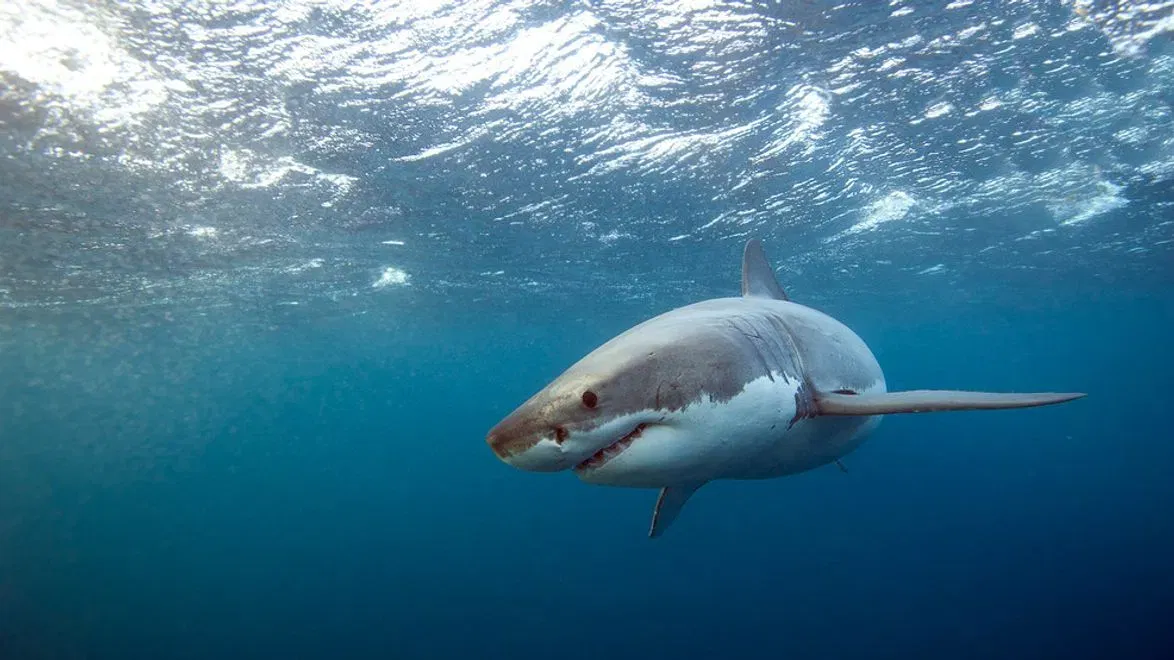
A Scarborough Beach shark encounter that could easily have ended in tragedy instead became a story of quick thinking and a fast decision made underwater. A lifeguard at Scarborough Beach State Park was pulled several feet below the surface Saturday afternoon when a great white shark seized the rescue torpedo he was carrying.
He got free. He swam to shore. He was not injured.
What Happened in the Water
According to a news release issued Monday by the Scarborough Police Department, the lifeguard was using a rescue torpedo, the buoyant device carried by lifeguards during water rescues, when the shark clamped onto it.
The pull took him roughly five to six feet under.
The critical detail is what he was wearing. Rescue torpedoes attach to the lifeguard by a strap, a design meant to keep the flotation device from drifting away during a rescue. In this situation, that same strap tethered him directly to an animal that had decided to take the torpedo with it.
He released himself from the strap and swam back to the beach.
A bystander reported watching the rescue torpedo shoot several feet into the air out of the water shortly after he broke free, an image that gives some indication of the force involved.
Swimming was closed at the park for an hour while public safety personnel assessed conditions.
Not an Isolated Sighting
The encounter capped a week in which sharks appeared repeatedly along this stretch of the Maine coast.
The sequence looked like this:
- Two sharks spotted Tuesday near Pine Point Beach in Scarborough
- Five to seven more observed the following day at the same location
- Reid State Park in Georgetown closed to swimming Friday after a sighting
- Saturday’s encounter with the lifeguard at Scarborough Beach State Park
Police say white sharks continue to be observed at Scarborough Beach State Park and Higgins Beach, including in nearshore waters and around sandbar areas. The department described the situation as an ongoing concern for the town.
A Photographer Watching It Unfold
Karl Ramsdell, a wildlife photographer based in Maine, has been documenting the activity from above using a drone, posting a series of videos over the past week.
His description of the conditions is striking. Once his drone is airborne, he says he can simply fly from one shark to the next.
What makes his account particularly notable is the contrast with previous years. Ramsdell has been flying drones over the Pine Point area for roughly eight years and had never captured footage of a shark until this season. Now, in his words, anyone entering the ocean in Saco Bay is essentially surrounded by them.
That shift from zero sightings across nearly a decade to routine encounters within a single summer is the part local officials are paying closest attention to.
Why Sharks Are Showing Up Here
Great white presence in New England waters has been climbing for years, and the driver is fairly well understood.
Seal populations along the northeastern coast have rebounded substantially under federal protection. Seals are a primary food source for white sharks. Where the prey concentrates, the predators follow.
Sandbars and nearshore shallows are exactly the kind of terrain where seals gather and where sharks hunt them, which is also, inconveniently, where people swim.
Safety Guidance for Beachgoers
Officials issued a set of recommendations following the incident. They are worth reading carefully rather than skimming.
- Exit the water immediately when instructed by lifeguards or public safety personnel
- Report any shark sighting to beach staff
- Avoid swimming near seals or large schools of fish
- Do not swim alone
- Understand that shark activity happens close to shore and in relatively shallow water
That final point deserves emphasis. There is a widespread assumption that staying near the beach means staying safe. Saturday’s encounter involved a lifeguard, a trained professional operating in his own working environment, and it happened in water shallow enough that he could swim back after freeing himself.
Depth is not a reliable indicator of risk.
What This Encounter Actually Shows
It is worth being precise about what occurred. The shark grabbed a piece of equipment, not a person. Rescue torpedoes are bright, buoyant and shaped in a way that can register as prey from below.
That distinction matters because it aligns with what researchers consistently observe: white sharks are not hunting humans. Most interactions involve investigation or misidentification rather than predation.
None of which changes the practical reality for anyone in the water. An animal of that size can cause severe harm without any intent to attack a person, and the lifeguard’s escape depended on his ability to stay composed and release a strap while being pulled under.
Where Things Stand
Scarborough Beach reopened to swimming after the hour-long closure. Sharks continue to be observed in the area.
For a coastal community heading into the peak of summer, the balance between beach access and safety is now a weekly calculation rather than an occasional one. The sightings are no longer rare enough to treat as anomalies.
The lifeguard walked out of the water unharmed, which is the only genuinely good outcome available from a moment like that. The broader question, whether Saco Bay’s shark season is an unusual year or a new baseline, will take more than one summer to answer.
Author