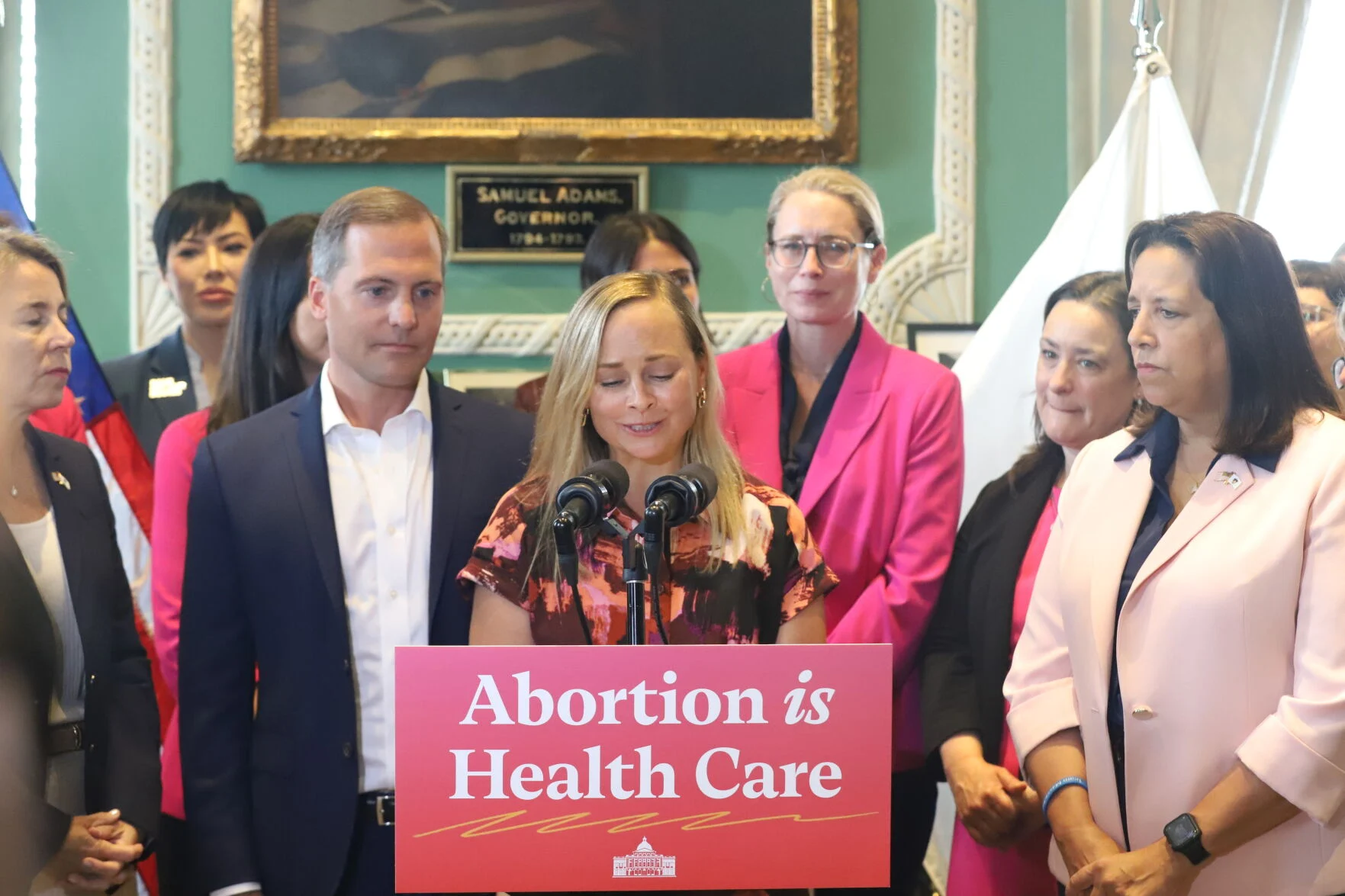
The Massachusetts abortion law signed Monday by Governor Maura Healey strips away the state’s existing restrictions on terminations performed at or after 24 weeks, replacing a rigid statutory framework with a single principle: the decision rests on a physician’s professional judgment.
The legislation, known as H 5595, moved through the State House with unusual speed and takes effect in 90 days.
What the Law Actually Changes
Until now, Massachusetts permitted abortions at or beyond 24 weeks only under a four-pronged framework tied to life-threatening circumstances affecting either the patient or the fetus.
The new statute discards that structure. In its place sits language stating that an abortion may be performed by a physician based on the physician’s professional judgment.
The law also removes the requirement that procedures after 24 weeks take place inside a hospital, a change advocates say allows care to be delivered in other clinical settings.
Why Supporters Pushed for It
The argument for the change centered less on ideology than on a practical failure of the old framework.
Speaking at a press conference in her ceremonial office, surrounded by lawmakers, advocates and physicians, Healey described hearing accounts filled with pain, anguish and trauma, moments she characterized as the worst days of people’s lives. She framed the signing as an act aimed at future patients nobody in the room would ever meet.
Representative Mike Day, who chairs the Judiciary Committee, said this marked the fourth time in sixteen years that legislators had returned to the issue trying to get it right. His stated goal was removing government from a medical decision and reducing trauma for pregnant patients who receive devastating news more than six months into a pregnancy.
Day noted that some clinicians remained uneasy under the previous language, saying it interfered with their medical judgment. The result, he argued, was that patients either left the state or stayed and endured avoidable suffering because a treating physician feared crossing a legal line. Others, lacking money to travel, could not access care at all.
One Family’s Experience
Kate Dineen and her husband Alex Lawton described what that gap looked like in practice.
In 2021, at 33 weeks pregnant, Dineen learned her baby had suffered a stroke in utero. The prognosis offered only two paths: death, or survival with a range of severe outcomes.
When she asked about her options, the answer was that termination might still be possible if she could travel. She recalled standing in her Boston kitchen, less than a mile from some of the country’s leading hospitals, being told to leave the state.
The diagnosis did not meet the statutory exceptions. Their doctor, she said, was constrained by state law rather than by medicine.
The couple traveled to Washington, D.C.
Hospitals Backed the Change
Support came from major institutions across the state’s healthcare system. In mid-July, the Massachusetts Health and Hospital Association, Beth Israel Lahey Health, Mass General Brigham, Tufts Medicine and UMass Memorial Health wrote to House Speaker Ron Mariano arguing that the existing statutory framework failed to meet the needs of all patients.
Worcester Senator Robyn Kennedy made a related point on the Senate floor, noting that medicine does not always sort neatly into legal categories and that physicians need latitude to advise patients through complex, rapidly shifting circumstances.
Public Health Committee Chair Marjorie Decker emphasized what the bill does not do. It does not instruct patients what to choose, does not compel anyone toward termination, and does not remove decision-making authority from patients.
The Votes
The House passed the measure 119 to 33 on July 22. Every Republican who voted opposed it.
Nine Democrats also voted no: Representatives Brian Ashe, Lisa Field, Michael Finn, Dennis Gallagher, Russell Holmes, Christopher Markey, Francisco Paulino, Alan Silvia and Jeffrey Turco. Susannah Whipps, the chamber’s only Independent, voted in favor.
The Senate approved it on July 31 by a 15 to 4 standing vote.
The bill was originally filed by Representative Christine Barber at the start of the two-year session. It gained momentum after clearing House Ways and Means on July 22.
The Numbers Involved
State Department of Public Health data recorded 99 abortions at 24 weeks or later in 2024, up from 84 the previous year.
Total abortions in Massachusetts rose sharply in 2024, which public health officials attribute largely to out-of-state patients obtaining care through telehealth.
Nationally, according to Reproductive Equity Now, procedures after 24 weeks account for less than one percent of all terminations.
Opposition
Conservative organizations mounted a late campaign against the bill. The Massachusetts Family Institute urged supporters on August 3 to demand a veto, describing the legislation as an attempt to eliminate remaining protections for unborn children.
Massachusetts Family Action circulated an email on August 7 calling it among the most extreme abortion measures in the country, objecting both to the absence of gestational limits and to the removal of the hospital requirement. The group scheduled a webinar to discuss the law’s contents and to organize around candidate elections.
An Election-Year Issue
Asked about the political dimension, Healey said abortion will be on the ballot in Massachusetts and nationally this November, describing her opponents as anti-abortion and naming Mike Minogue specifically.
Minogue said in May that he is Catholic and pro-life, while adding that as governor he would uphold existing law. Fellow Republican candidate Brian Shortsleeve has identified himself as a pro-choice Republican and suggested Minogue’s position makes him difficult to elect statewide.
Reaction to the Signing
Claire Teylouni, interim executive director of Reproductive Equity Now, said Massachusetts had reaffirmed that abortion constitutes essential healthcare and that politicians should not stand between patients and their doctors. She said the law’s significance extends well beyond state lines.
She also explained that removing the hospital requirement aims to broaden where care can be provided, particularly as hospitals navigate federal funding pressures.
ACLU of Massachusetts Executive Director Carol Rose said the change means pregnant patients in the state will no longer need to travel far from home to obtain necessary care.
Healey framed the national context directly, pointing to the 2022 reversal of Roe v. Wade and noting that one in three women in America now lives in a state with an abortion ban.
Author
-
Lucienne Albrecht is Luxe Chronicle’s wealth and lifestyle editor, celebrated for her elegant perspective on finance, legacy, and global luxury culture. With a flair for blending sophistication with insight, she brings a distinctly feminine voice to the world of high society and wealth.