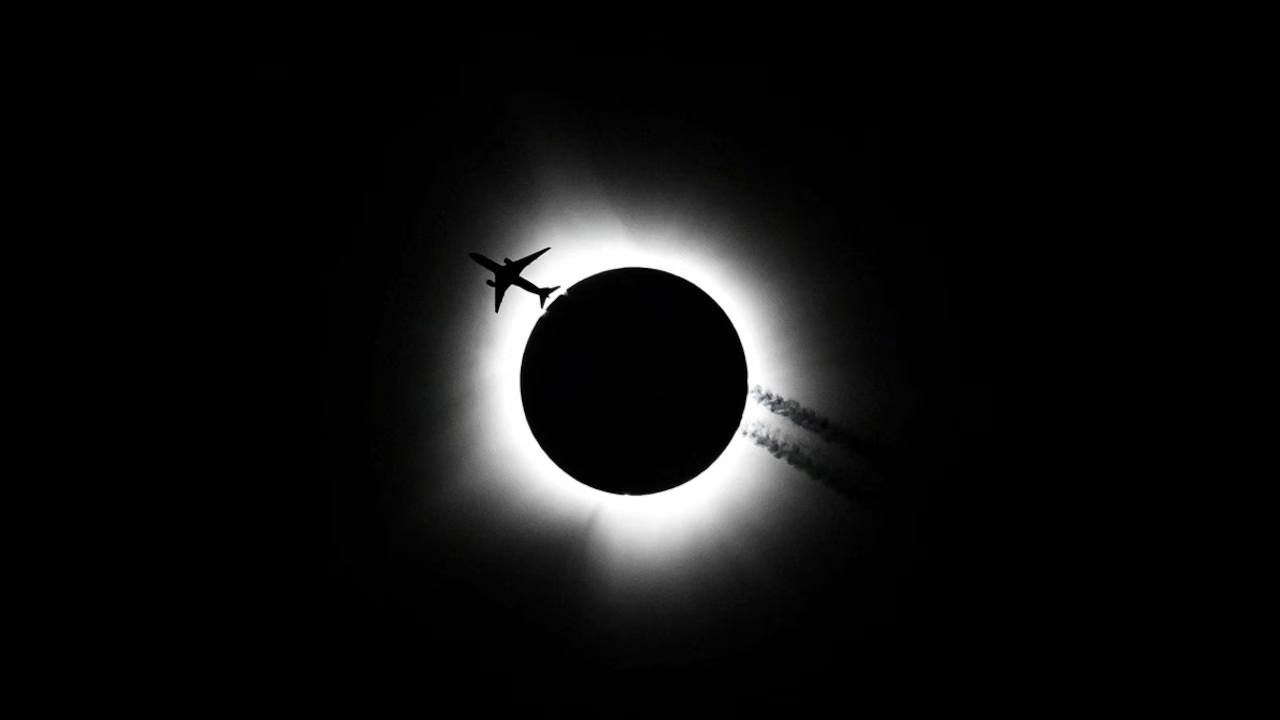
A total solar eclipse swept across parts of Europe on Wednesday, drawing millions outdoors for a spectacle the continent had not experienced since 1999.
Sections of Greenland, northern Spain, and Iceland fell within the path of totality, where the Sun was completely obscured. Much of the rest of Europe, including the United Kingdom and France, saw a partial eclipse instead, with the Moon taking a visible bite out of the solar disc without covering it entirely.
For those inside the narrow band of totality, daylight briefly gave way to something closer to deep twilight.
What Actually Happens During Totality
The mechanics are straightforward. The Moon passes directly between the Earth and the Sun, casting its shadow across a portion of the planet’s surface.
What makes it remarkable is a coincidence of scale. The Sun is roughly 400 times wider than the Moon and sits roughly 400 times farther away, which means the two appear almost identical in size from the ground. That alignment allows the Moon to cover the solar disc almost exactly, revealing the corona, the Sun’s outer atmosphere, as a shimmering halo.
Nothing about that arrangement is guaranteed. It is a temporary feature of this era in the Earth-Moon system, and one that will eventually disappear as the Moon drifts farther away.
Why This One Mattered So Much
Total eclipses occur somewhere on Earth every eighteen months or so, but the path of totality is narrow and frequently falls over ocean or sparsely populated terrain.
For a given location on land, the wait between totalities typically runs into centuries. That is what makes a European event of this kind genuinely rare, and why the 1999 eclipse, which crossed parts of the continent including Cornwall and central Europe, still occupies such a prominent place in collective memory.
Anyone who missed 1999 had waited twenty-seven years for another chance without leaving the continent.
The Economics of Standing in Shadow
Businesses positioned along the path did not miss the opportunity.
Hotels in parts of Iceland and northern Spain were reportedly charging in excess of 1,000 dollars per night for rooms during the event. Accommodation along a totality path routinely sells out months or years in advance, and prices climb accordingly.
Retail saw its own surge. Hundreds of people queued in shops for solar eclipse glasses in the days beforehand, a familiar pattern that repeats before every major eclipse and reliably strains supply.
Eclipse tourism has grown into a substantial niche, with dedicated travellers planning years ahead and building trips around paths that cross remote parts of the world. For host regions, a few days of intense demand can meaningfully affect a season.
The Safety Question
The queues for glasses reflect a genuine necessity rather than novelty purchasing.
Looking at a partially eclipsed Sun without proper protection can cause permanent retinal damage. The danger is heightened precisely because it is painless. The retina has no pain receptors, so there is no warning signal at the moment injury occurs.
Ordinary sunglasses, however dark, provide no meaningful protection. Certified eclipse viewers are built to filter an overwhelming proportion of incoming light.
The single exception applies only within the path of totality, during the brief window when the Sun is entirely covered. In that interval, viewing with the naked eye is safe. The moment any portion of the bright disc reappears, protection becomes essential again.
For everyone outside the totality band, including observers in the UK and France, glasses were required for the entire duration.
What Observers Notice Beyond the Sky
People experiencing totality for the first time often report that the surrounding environment surprises them more than the Sun itself.
Temperatures drop noticeably as solar heating stops. Birds go quiet or begin behaving as they would at dusk. The quality of light in the minutes beforehand becomes strange and metallic in a way that photographs rarely capture.
Shadows sharpen dramatically. Small crescents of light appear scattered on the ground beneath trees, each gap between leaves acting as a natural pinhole projector.
At the boundary moments, a phenomenon known as the diamond ring appears, when a single brilliant point of sunlight remains at the edge of the Moon’s silhouette.
Watching Safely Without Special Equipment
Anyone caught without certified glasses had workable alternatives.
A pinhole projector made from card allows the eclipse to be viewed as a projected image on a surface below.
A colander or any perforated object produces dozens of small projected crescents.
Indirect observation through the dappled shadow under a tree offers the same effect with no equipment at all.
None of these methods involve looking toward the Sun, which is the entire point.
The Longer View
Eclipses once carried enormous cultural weight, interpreted as omens or divine intervention across many societies. The ability to predict them precisely represented one of the earliest triumphs of mathematical astronomy.
Today the prediction is routine, calculated decades ahead to the second. What has not changed is the reaction on the ground.
Millions of people across Europe stopped what they were doing on Wednesday to stand outside and look up at something they will likely never see from the same spot again. That impulse appears fairly resistant to explanation.
Author