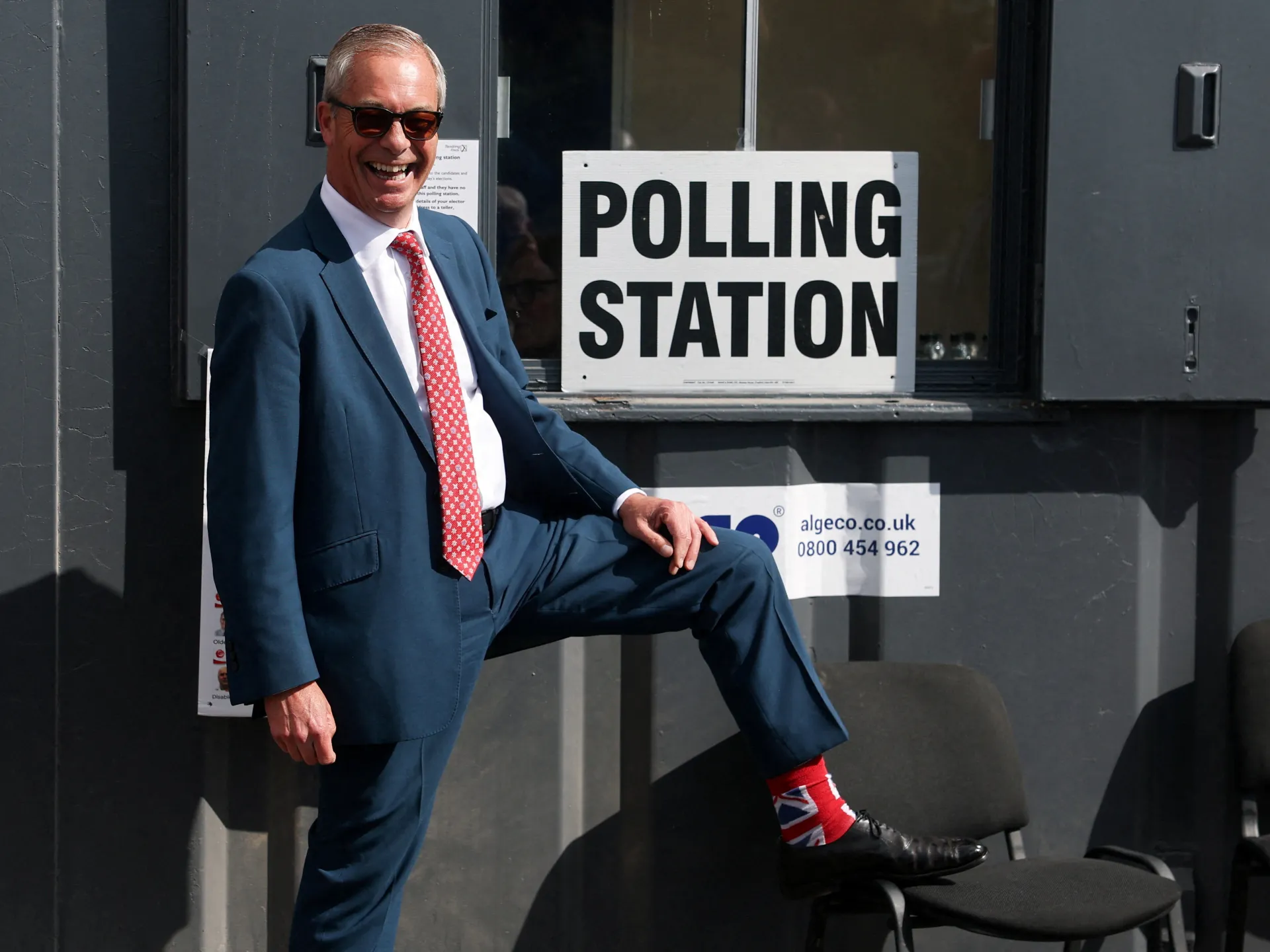
The Clacton by-election Farage result delivered exactly what the Reform UK leader wanted numerically, and something considerably more awkward optically. Nigel Farage reclaimed the parliamentary seat he vacated last month, defeating a man who campaigns wearing a rubbish bin on his head.
The Numbers
Farage took 22,239 votes. His nearest rival, the perennial joke candidate Count Binface, secured 9,455.
That gap is decisive by any measure. But the identity of the runner-up is the story.
Binface — who describes himself as an intergalactic space warrior and has stood in six elections since 2019 — recorded his strongest result to date. He achieved it largely because Britain’s major parties declined to contest the seat, leaving the field to independents, fringe parties and a long roster of novelty candidates.
Turnout reached 44 percent, down from the 59 percent recorded at the 2024 general election. That drop is unremarkable for a by-election, where enthusiasm typically dips.
An Odd Night at the Count
Farage did not appear at the official count in the early hours of Friday, and scrapped a planned victory speech, according to the BBC.
He had spoken earlier as results came in, describing the outcome as a convincing and overwhelming win.
His framing focused on who he considered the relevant jury. He said he had called the by-election because he wanted the voters of Clacton to judge him rather than the British mainstream media, and claimed the constituency had raised two fingers to the entire political establishment.
Inside the Clacton Leisure Centre, the atmosphere was reportedly collegial. Candidates on stage applauded one another as figures were read out, with many finishing below 100 votes.
The Runner-Up’s Perspective
Binface, whose manifesto included capping the price of croissants and relocating a hand dryer in a local pub toilet, was unbothered by the result.
Speaking to Al Jazeera, he suggested there is more than one definition of winning. Running through the former prime ministers he has stood against in previous contests, he asked pointedly where Theresa May, Rishi Sunak and Boris Johnson are now — arguing that fixation on numerical victory misses the point.
It is a joke that carries a genuine observation. Longevity in British politics has not correlated neatly with electoral triumph.
Why the Seat Was Empty
The by-election happened because Farage created it.
He resigned his seat in July while under investigation over whether he had failed to declare a gift of £5 million — roughly $6.75 million — from a crypto billionaire based overseas.
At the time, he stated flatly that he had done nothing wrong and had not broken the law in any respect.
Rather than wait out the process, he chose to force a contest and seek a public verdict. The strategy carried obvious risk and an obvious reward: a clear win could be presented as vindication regardless of what any investigation concluded.
The Boycott That Shaped Everything
The decision by Britain’s main parties to sit the contest out fundamentally altered its character.
Ordinarily a by-election of this profile would draw serious candidates from Labour and the Conservatives, and the result would be read as a genuine test of relative strength. Without them, Farage faced no conventional opposition.
That produced two contradictory effects. It guaranteed him victory, but it also stripped the win of comparative meaning and generated the spectacle of a prospective prime minister campaigning against a man in a metal bin.
Whether the boycott was a principled refusal to legitimise a self-triggered vote or a tactical decision to avoid an embarrassing defeat depends entirely on who is asked.
The Bigger Political Picture
Farage occupies an unusual position in British politics. A prominent Brexit campaigner and right-wing populist, he is widely regarded as a plausible future prime minister.
His policy agenda centres on immigration. He has committed to a substantial crackdown, including deploying the Royal Navy to intercept asylum seekers crossing by boat and return them — a proposal critics have described as dangerous and difficult to execute in practice.
That combination of high polling and unconventional politics explains why the Clacton contest attracted attention disproportionate to its stakes.
What It Actually Tells Us
Read carefully, the result supports several conclusions simultaneously.
Farage retains a solid personal base in Clacton, taking more than twice his nearest opponent’s total in a low-turnout contest against no serious competition.
The absence of mainstream challengers means the figure cannot be compared meaningfully to the 2024 general election performance.
And the funding investigation that prompted the resignation has not gone away. A by-election victory is not an audit finding, however it is characterised on results night.
For now, Farage is back in Parliament, the count is finished, and Count Binface has a personal best to add to his record. British politics has produced stranger evenings — but not many.
Author
-
Lucienne Albrecht is Luxe Chronicle’s wealth and lifestyle editor, celebrated for her elegant perspective on finance, legacy, and global luxury culture. With a flair for blending sophistication with insight, she brings a distinctly feminine voice to the world of high society and wealth.