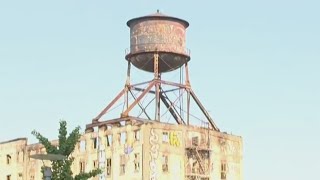
Countdown to the Blast: Portland Prepares to Topple the Centennial Mills Water Tower
The Centennial Mills demolition officially entered its final countdown on Sunday, setting up a Monday afternoon spectacle that neighbors along the Northwest Portland waterfront have been anticipating with a mix of curiosity and unease. Four controlled explosions will bring down the steel water tower that has crowned the skeletal remains of the property, and the sound will carry well past the immediate blast zone.
For a structure that has stood quietly on the riverfront for well over a century, the ending will be abrupt.
Why the Building Has to Come Down
The former mill turned 116 years old before fire tore through it two weeks ago. Long vacant and already a subject of debate among city planners, the building burned across all seven of its floors and lost its roof entirely.
What survived the blaze is essentially a shell. The outer masonry walls remain upright, and the water tank still sits atop them, but the internal structure that once held everything together is gone. Engineers have flagged the entire thing as a collapse risk, which is what pushed the city toward demolition rather than any attempt at stabilization.
Eric Kutch, who directs Portland Permitting and Development, acknowledged at a press conference last week that the fire has disrupted daily life for people in the area. His message was that the city is moving as fast as it responsibly can to remove the hazard.
The Warning Sequence Before the Blast
The city has designed a layered notification system so nobody in the vicinity is caught off guard.
The sequence runs like this:
A text alert goes out to residents in the surrounding area before any work begins
Crews clear and secure a 300-foot perimeter around the entire building
Sirens sound three minutes ahead of detonation
Sirens sound a second time at the one-minute mark
An audible five-second countdown plays
Four charges detonate simultaneously
City officials have kept their language on this blunt. Safety comes first, the building could give way at any moment, and anyone in the area is expected to respect the warnings and remain outside the perimeter.
No Published Time, and That Is Deliberate
One detail has been withheld on purpose: the precise moment of detonation. Officials declined to publicize an exact time, and the reasoning is straightforward enough.
Demolitions attract crowds. Staton Companies, the contractor handling the takedown, raised concerns that a widely advertised start time would draw spectators toward a site where the primary danger is an unstable structure and flying debris.
Neighbor John Lehman summed up the local mood with self-aware humor, noting that people are drifting down toward the site and admitting he has his rubber neck on too. That instinct is exactly what the city is trying to manage.
What Neighbors Are Expecting
Residents living near the site have adopted a fairly practical attitude toward the disruption. Dr. Ted Forcum, who lives nearby, said the community understands there will be alarms and a couple of loud booms, and that the neighborhood is simply going to look different afterward.
Megan Livingston, another neighbor, expects a loud enough noise to send her cats diving under the bed, and she is bracing for a considerable amount of dust.
No residential buildings sit inside the 300-foot exclusion zone, according to the city. Fields Park, however, remains closed. Officials spent the weekend contacting nearby households and businesses directly so that the disruption would not come as a surprise.
The Dust Is the Real Concern
The explosions will be brief. The airborne aftermath is what public health guidance is focused on.
Testing conducted after the fire identified both asbestos and lead in the debris left behind. That finding shapes nearly every precaution the city has issued.
Crews spent Sunday soaking the building and the rubble inside it, a standard technique for weighing down particulate matter so that far less of it becomes airborne when the charges go off.
For residents, the recommended steps are simple:
Stay indoors until the dust visibly settles
Wear an N95 mask if you must be outside shortly after the blast
Keep outdoor time to a minimum during that window
Avoid tracking dust indoors on clothing or shoes
None of this is unusual for a demolition involving older construction materials, but the presence of both asbestos and lead makes following the guidance more than a formality.
What Happens After the Tower Falls
The water tower is only the opening act. Once it is down, crews will shift to methodically dismantling the masonry walls that are still standing.
That phase will not be fast. Kutch estimated it could take as long as two weeks simply to reduce the building to half its current height. Every road closure, park closure and access restriction currently in place around the site will therefore remain in effect for at least that long, and possibly longer depending on how the walls behave as they come down.
A Long-Standing Landmark Reaches Its End
For more than a century, the mill occupied a distinctive position on the Portland waterfront, outlasting the industry that built it and cycling through years of proposals, delays and debate over what should replace it. The fire resolved that argument in a matter of hours.
Monday afternoon, the sirens will sound, the countdown will run, and one of the last recognizable pieces of the structure will disappear in a cloud of wetted dust. What follows is a slower, quieter process of clearing ground that Portland will eventually have to decide what to do with.
Author
-
Lucienne Albrecht is Luxe Chronicle’s wealth and lifestyle editor, celebrated for her elegant perspective on finance, legacy, and global luxury culture. With a flair for blending sophistication with insight, she brings a distinctly feminine voice to the world of high society and wealth.