Colorado River water cuts are coming, and they are steeper than anything the Lower Basin has faced in recent years. Federal officials confirmed Friday that California, Nevada and Arizona will scale back their consumption sharply over the next two years as the river’s condition continues to deteriorate.
The Numbers Behind the Plan
Under the framework announced by the Bureau of Reclamation, the three states will collectively give up 1.25 million acre-feet of water each year during the covered period. That figure is not necessarily a ceiling; officials indicated deeper reductions could follow if hydrological conditions worsen.
Arizona absorbs the largest share of the burden. The four Upper Basin states, Colorado, Utah, Wyoming and New Mexico, escape reductions entirely for the time being.
Mexico is also affected. Under the terms of a longstanding treaty with the United States, the country will take 250,000 acre-feet less from the river.
A Drought That Has Outlasted a Generation
Andrea Travnicek, assistant secretary for water and science at the Interior Department, framed the announcement within a much longer arc. She noted that the region has now endured 26 consecutive years of drought conditions, with forecasts offering little reason to expect relief.
Her emphasis fell on cooperation, arguing that basin-wide coordination will remain essential as the shortage persists.
The scale of what is at stake is difficult to overstate. Bureau of Reclamation figures put the number of people who draw water from the Colorado at somewhere between 35 and 40 million.
Reservoirs at Levels Not Seen in Decades
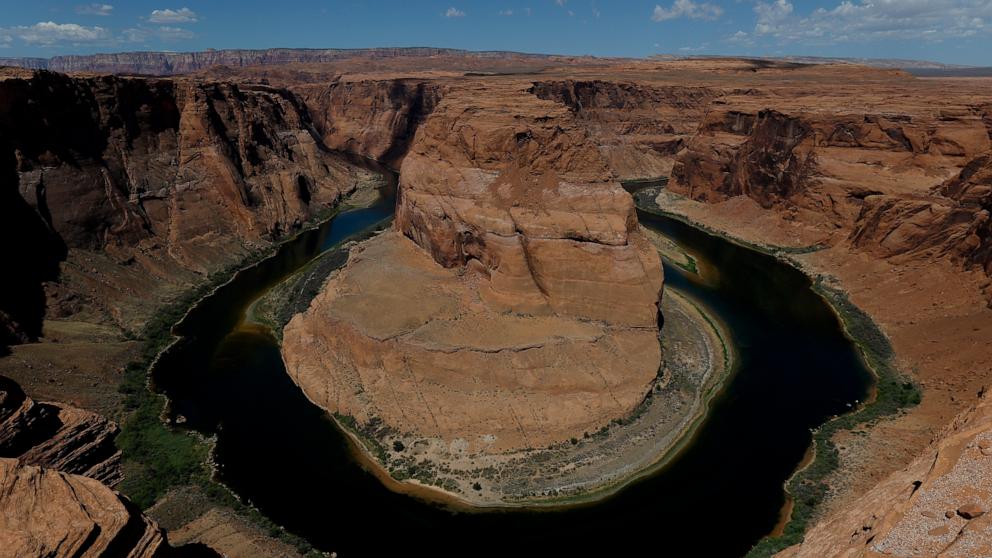
The physical evidence of decline is stark. Lake Mead recently dropped to its lowest point since it first began filling roughly ninety years ago. Lake Powell hit its own record low about a week afterward.
Taken together, the two reservoirs are holding less water than at any point in nearly seventy years.
A specific threshold now looms at Lake Powell. Should the surface fall another 33 feet, the reservoir will drop below the level required to generate hydroelectric power. At that point, water could no longer move through the dam and into the river downstream, an outcome with consequences for both electricity supply and river management.
The Winter That Made Things Worse
Last winter delivered the worst snowpack ever recorded across the Colorado River Basin. Because the river depends heavily on mountain snow melting through spring and summer, a poor season translates directly into reduced flows.
The shortfall has strained farmers, industrial users, wildlife habitat and hydropower operations simultaneously. Dozens of Native American tribes and communities in two Mexican states also depend on the same water.
Behind the immediate crisis sit three overlapping causes: sustained overallocation of the river’s water, prolonged drought and rising temperatures linked to climate change, which increase evaporation and reduce runoff efficiency.
A Deadline With No Long-Term Deal
Complicating matters further, the existing rules governing how the seven basin states share the river expire in October. Despite extended negotiations, those states have not managed to agree on a durable replacement.
That impasse is what makes the newly announced reductions significant. They provide operating certainty for the immediate future without resolving the underlying dispute.
How the States Responded
Arizona negotiators publicly thanked their counterparts in California and Nevada for sharing the burden rather than fighting over it.
Tom Buschatzke, who directs the Arizona Department of Water Resources, said the reductions covering 2027 and 2028 will offer meaningful stability for water users, while acknowledging that talks over longer-term operations will continue.
JB Hamby, California’s lead negotiator on Colorado River matters, described the arrangement as providing badly needed near-term certainty during a period of extraordinary risk. He was careful to add a qualifier, characterizing the deal as a bridge rather than a permanent fix.
Nevada officials praised the cooperation among the three Lower Basin states but maintained that an agreement covering all seven states remains their preferred outcome.
Ripple Effects in Southern Nevada
The consequences may extend well beyond agriculture and utilities. Kyle Roerink, senior adviser at the conservation organization Great Basin Water Network, pointed to several stalled projects in the Las Vegas area, including plans for a new airport, retail development and certain public land sales.
In his view, those delays reflect the same difficult hydrology now written into federal documents. Additional cuts, he suggested, could further slow real estate expansion across the metro area.
Roerink also offered a broader reflection, noting that watching Hoover Dam lose its stature as a symbol of American capability is unsettling. At the same time, he argued the moment could serve as a genuine opportunity to plan seriously for the century ahead rather than continuing to react year by year.
What Comes Next
The two-year reduction plan buys time, but it does not settle the central question: how a river that no longer produces what it once did should be divided among users whose demands were set when conditions were very different.
Negotiations over post-October rules will continue against a backdrop of shrinking reservoirs and a hard deadline at Lake Powell. For the tens of millions of people who turn on a tap without thinking about where the water originates, the outcome of those talks will matter far more than the headlines suggest.
Author