The US Space Academy is now officially on the drawing board after President Donald Trump signed an executive order establishing what would become the country’s first service institution built entirely around space.
The announcement came without advance warning, delivered Friday at NASA’s Johnson Space Center in Texas during a ceremony honoring the four astronauts of the Artemis II mission.
An Announcement Nobody Saw Coming
Standing before a room of astronauts and NASA staff, Trump told the crowd he would sign an order beginning the process of creating a new national academy dedicated to space. He called the concept a big deal and promised the facility would be top line.
He drew a direct comparison to institutions already familiar to American military life — the Naval Academy at Annapolis and the Military Academy at West Point. Both operate as undergraduate colleges that select a small number of young Americans each year and train them to become commissioned officers.
Trump acknowledged the pedigree of those schools before framing the new proposal as something more personal to the audience in front of him. They were all great, he said, but this would be an academy built around what the people in that room cared about most.
Who Will Build It
The order does more than declare an intention. It creates a presidential commission tasked with advising and assisting on how the academy actually comes together.
NASA administrator Jared Isaacman will chair that body. Its membership pulls from across the administration and includes:
- Defense Secretary Pete Hegseth
- Air Force Secretary Troy Meink
- Russ Vought, director of the White House Office of Management and Budget
The lineup reflects the dual character of the project. Space policy in the United States now sits at the intersection of military planning, civilian science, and a rapidly expanding commercial sector, and the commission’s composition acknowledges all three.
Where Graduates Would Go
Trump described a career pipeline running in several directions at once. Graduates would move into the US Space Force, into NASA, and into the civilian flight industry. The academy, he said, would attract, train, and graduate the very best the country has to offer.
That third destination is notable. Traditional service academies produce military officers almost exclusively. A school feeding talent into private aerospace companies alongside uniformed branches would represent a genuine departure from the existing model — and raises practical questions about service obligations, funding structures, and admissions that the commission will have to work through.
Building on the Space Force
None of this emerged from nowhere. Space has been a recurring priority across Trump’s time in office.
In December 2019, he signed legislation creating the Space Force, adding a sixth branch to the US military for the first time in decades. He framed the move at the time around national security, describing grave threats and arguing the new branch would help deter aggression and control what he called the ultimate high ground.
The academy proposal follows naturally from that decision. A military branch without a dedicated commissioning school has to draw its officers from elsewhere, and the new institution would close that gap.
Honoring the Artemis II Crew
The academy news shared the stage with the event’s original purpose.
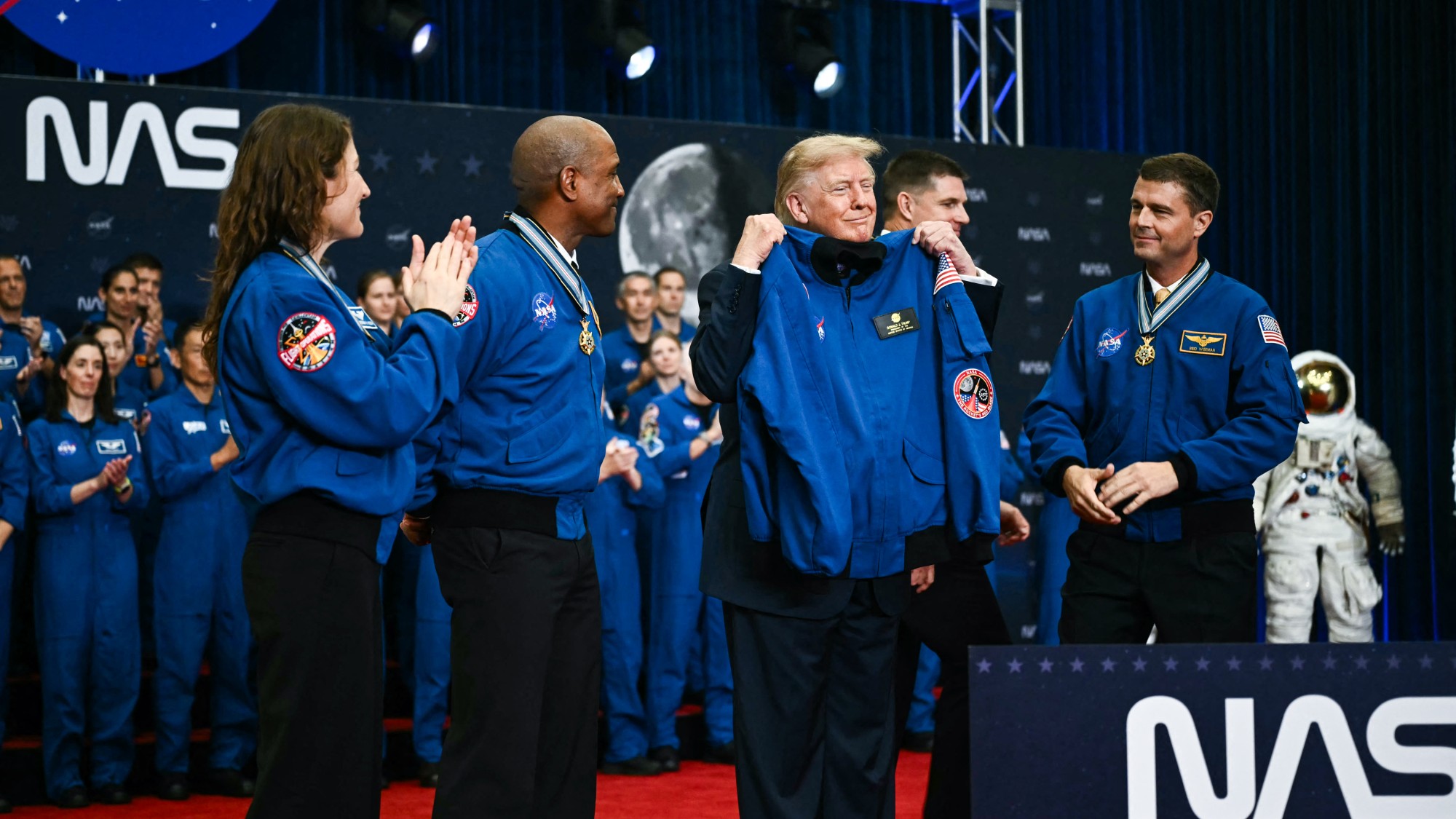
Trump presented the Congressional Space Medal of Honor to each member of the Artemis II crew: NASA astronauts Reid Wiseman, Victor Glover, and Christina Koch, joined by Canadian astronaut Jeremy Hansen. The medal stands as the highest American civilian recognition for achievement in spaceflight.
The crew earned it in April, when their mission carried them around the far side of the moon — taking human beings further from Earth than anyone had traveled before. The flight was a milestone in the administration’s stated goal of returning astronauts to the lunar surface by 2028.
Trump shared his own memory of watching it happen. He was in a meeting with what he described as the biggest people in the country when someone asked to watch the Artemis coverage. He paused the meeting, had a television brought in, and said everyone present was spellbound.
The astronauts came with a gift of their own. Glover presented Trump with a blue NASA flight jacket, referencing an earlier visit to the Oval Office where the crew had promised to bring him one.
The Program’s Uncertain Road Ahead
Beneath the ceremony, the Artemis program itself faces real complications.
In May, an uncrewed Blue Origin rocket exploded at a launch facility in Cape Canaveral, Florida, damaging the site. The failure prompted broad questions about whether NASA and its commercial partners are ready for the missions currently on the calendar.
The schedule has already shifted once. Artemis III was originally meant to put humans back on the moon. In February, NASA abandoned that plan and redefined the mission around drills in Earth orbit instead, aimed at validating safety procedures before any lunar landing attempt.
That revised mission will practice docking with lunar lander models supplied by Blue Origin and SpaceX — a necessary step, but a considerably less dramatic one than a landing.
NASA named the crew for the two-week Artemis III flight in June. It is scheduled for next year.
What It All Adds Up To
The Space Academy announcement arrives at a moment of visible tension between ambition and execution. The administration is talking about generational institution-building while the flight program directly beneath it slips and reorganizes.
Whether the academy becomes reality depends on things the executive order cannot deliver on its own — congressional appropriations, a physical campus, a faculty, an admissions system, and a defined relationship with the branches and companies it would serve. The commission’s work will determine how much of the vision survives contact with those requirements.
For now, the United States has committed on paper to training a generation of Americans specifically for space. The harder part starts next.
Author