US Iran strikes have resumed after a quiet stretch of several weeks, breaking a pause that had held since late July. American forces hit two rocket launchers on Larak Island in the Strait of Hormuz, and Tehran answered within hours with missiles aimed at US installations in Jordan and drones directed at a base in the United Arab Emirates.
The exchange marks the sharpest escalation since President Donald Trump halted a renewed military campaign last month, and it lands as the wider conflict passes its six-month mark.
What Happened on Larak Island
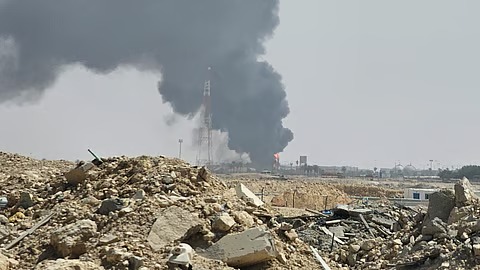
Iran’s Islamic Revolutionary Guard Corps said the American attack killed two people and wounded two more. The IRGC promised what it described as response and punishment, language that left little doubt retaliation was coming.
Tasnim, a news agency tied to the IRGC, reported that the operation was carried out using drones.
US Central Command framed the strike in narrow terms, calling it a limited and precise action directed at minelaying forces that presented an imminent threat in the Strait of Hormuz. That characterisation matters legally and politically, since Washington has consistently argued its operations are aimed at keeping the waterway navigable rather than at broad regime targets.
Iran’s Retaliation Across Two Countries
Tehran did not wait long. Iranian forces launched missiles at US military bases in Jordan, and the Jordanian army reported intercepting eight of them in the early hours of Monday.
In a separate action, Iranian state television said the army had targeted an air base in the UAE with drones. Emirati authorities confirmed shooting down a drone.
Iran’s foreign ministry issued a strong condemnation of what it called American military aggression against Larak, and defended the counterstrikes as legitimate defence. President Masoud Pezeshkian struck a similar note, saying his country was not pursuing war but would answer aggressors decisively.
Why Larak Island Matters So Much
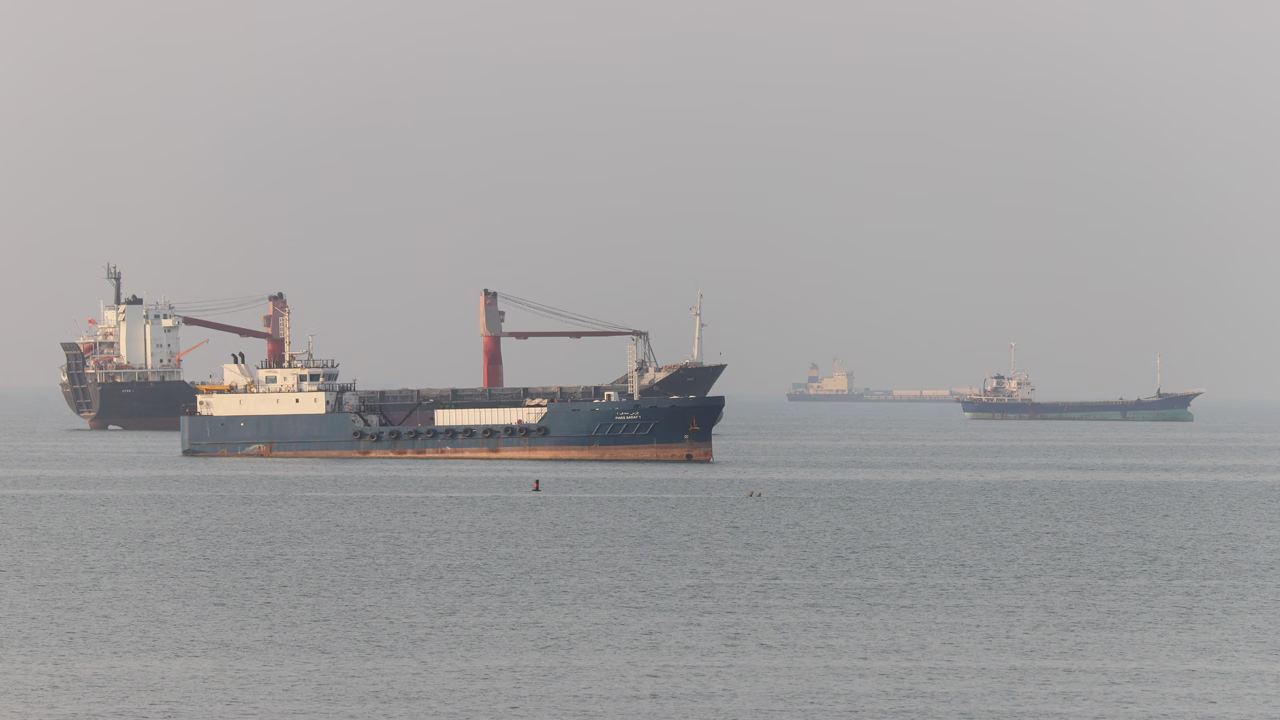
Larak sits just offshore from Bandar Abbas, one of Iran’s most important ports, and lies directly on the Strait of Hormuz. Before the war, roughly a fifth of the world’s oil and liquefied natural gas moved through this narrow passage.
That figure alone explains why a small island has become a flashpoint.
Iran has been requiring tanker traffic to pass by Larak for inspection, and reports indicate vessels are being forced to pay two million dollars, around 1.5 million pounds, to make the crossing. The arrangement effectively turns the strait into a toll gate under Iranian control, which is precisely the outcome Washington has been trying to reverse.
The Dispute Over the Mines
Last week Trump stated that every mine Iran had laid in the Strait of Hormuz as part of its blockade effort had been either detonated or cleared. He added that Tehran had been warned any vessel caught deploying new mines would be destroyed.
Iran’s Deputy Foreign Minister Kazem Gharibabadi rejected the claim outright, calling it propaganda designed to mislead.
The disagreement is not merely rhetorical. If mines remain, commercial shipping faces continuing danger. If they have been cleared, pressure builds on Iran to justify continued restrictions on traffic. Neither side’s account can be independently verified from the outside.
Trump’s Social Media Posts
Hours after the strike, Trump published what appeared to be AI-generated videos on Truth Social depicting oil infrastructure being destroyed. One carried a caption declaring that Kharg Island was being blown to smithereens.
Kharg Island is a major Iranian oil terminal, and Trump has previously spoken about seizing it. His post included no further explanation, leaving analysts to debate whether it signalled genuine intent, a negotiating tactic, or simply provocation.
Economic Pressure Building in Parallel
Military action is only one part of the campaign against Tehran. On 24 August, Washington rolled out a fresh sanctions push aimed at deepening Iran’s isolation and widening secondary sanctions targeting its partners.
Iranian officials and state media have largely brushed the measures aside, portraying them as more of the same economic pressure and arguing they followed a failed American military effort rather than a successful one.
Alongside sanctions, the US continues a naval blockade that has significantly damaged Iran’s oil export capacity. Centcom reported on Saturday that it had:
- Disabled three vessels
- Boarded two others
- Redirected 82 ships as part of blockade enforcement
Those numbers give a sense of how routine maritime interdiction has become in this conflict.
Six Months of War
The current fighting traces back to 28 February, when the United States and Israel launched broad strikes against Iran. Tehran responded by attacking Israel, American bases, and allied states across the Gulf, while effectively closing the Strait of Hormuz to marine traffic.
The war has now crossed the six-month threshold with no negotiated settlement in sight.
What This Escalation Could Mean
Several consequences deserve attention:
- Energy markets remain exposed to any disruption in the strait, and renewed strikes tend to move prices quickly
- Regional states such as Jordan and the UAE are being drawn into a confrontation they did not initiate
- Shipping costs and insurance premiums stay elevated as long as passage is contested
- Each round of tit-for-tat action narrows the space for diplomacy
The pattern visible here is a familiar one in this conflict. A pause holds for a period, one side acts, the other responds proportionally, and both then wait to see whether the other escalates further.
For now, the strikes on Larak and the answering barrages against Jordan and the UAE appear calibrated rather than open-ended. Whether that restraint survives the coming days depends heavily on decisions made in Washington and Tehran, and on whether either side sees advantage in pushing past the current threshold.
Author