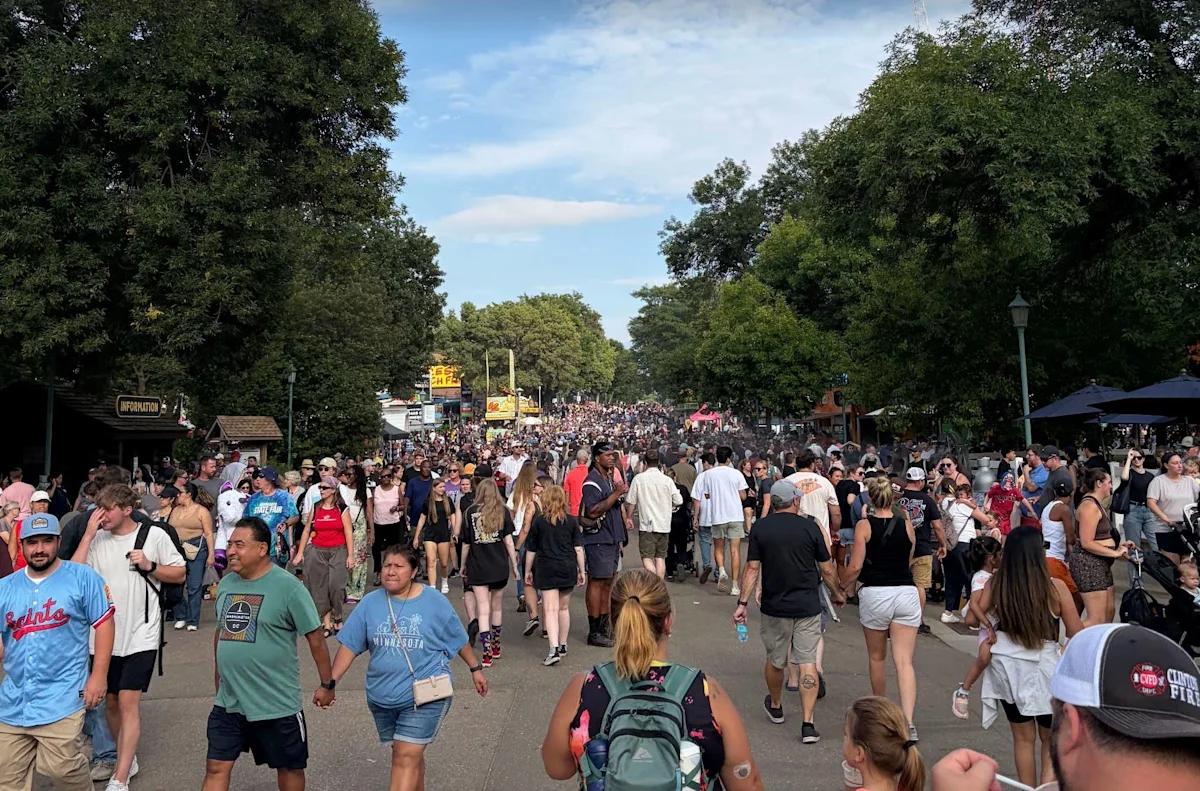
The Minnesota State Fair attendance total for 2026 is in: 1,923,325 people came through the gates before the vendors packed up and the livestock headed home.
That is a decline of 17,544 from 2025, the first year-over-year drop since 2021. Which, naturally, means it is time to overanalyse it.
Where This Number Actually Sits
Context matters more than the direction of the arrow.
This year’s figure lands right around the median of 1,933,387 stretching back to 2017. In other words, 2026 was an entirely normal fair by the standards of the past decade.
The more notable streak is the one at the top. Minnesota has now gone six straight years without reaching 2 million visitors, a threshold cleared only twice in the fair’s history, in 2018 and 2019.
A Spectacular Opening
The fair started at a sprint. New attendance records fell on each of the first two days.
The standout was the opening Friday, which drew 204,065 people. That made it only the third weekday in the fair’s entire history to break 200,000, an extraordinary result for a day when most people are supposed to be at work.
If the fair had maintained anything close to that pace, the 2 million barrier would have fallen easily.
Then the Middle of the Run Went Quiet
It did not maintain that pace. Days 5 through 9 fell off sharply relative to recent norms.
Across that full workweek, attendance came in 71,099 below the median total since 2017. Spread across those days, that works out to roughly 14,220 fewer people per day.
For a fair that missed 2 million by about 77,000, that midweek gap is essentially the whole story.
The School Calendar Explanation
There is a plausible reason for the slump, and it has nothing to do with the fair itself.
A few dozen Minnesota school districts started classes the week before Labor Day this year. That happened because the Legislature passed a temporary exemption permitting schools to open as early as September 1, a response to Labor Day falling on the latest possible date in 2026.
Families with children back in classrooms are not spending Tuesday afternoons eating things on sticks. And that exemption is not going away next year, which means the same pressure will likely apply again.
Weekends Held Steady
Weekends are where the fair does its heaviest volume, and those days performed normally.
Overall weekend attendance ran 1.6 percent above the 2022 to 2025 average, indicating the fair’s core appeal has not softened. Whatever happened in 2026, it was not a loss of enthusiasm.
Some Comparative Perspective
For anyone mourning the receding 2019 high-water mark, a few numbers help.
Iowa’s state fair drew 1,218,834 visitors across 11 days in 2026, an all-time record for the event. Impressive by their standards, and still around 20,000 short of what Minnesota managed during its pandemic-affected 2021 edition over the same number of days.
Texas offers an even sharper contrast. A state with roughly five times Minnesota’s population needed a full 24 days to reach 2 million visitors at its 2025 fair. Minnesota gets close to that figure in under two weeks, from a population base a fraction of the size.
Per capita, the Great Minnesota Get-Together remains something close to a statistical anomaly.
What This Suggests About Next Year
The pattern points to a fairly specific conclusion. Weekend demand is stable and strong. Opening days can set records. The variable is the working week, and that variable is now partly controlled by school calendars.
If more districts take the early-start option, midweek attendance may settle at this lower level permanently. If the calendar shifts back, those 14,000-per-day gaps could close on their own.
Either way, the underlying appetite for the fair appears untouched. Minnesotans still show up in numbers that embarrass much larger states.
The countdown, for those keeping track, sits at 352 days.
Author