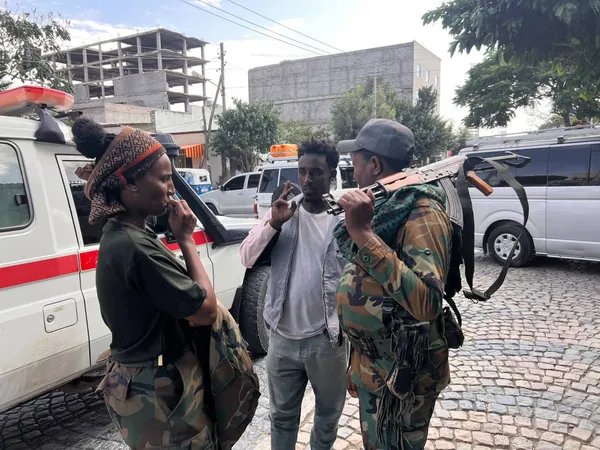
The Mekelle Tigray fighting has entered a new and worrying phase. Ethiopian federal forces, backed by allied Tigray Peace Force fighters, have taken control of Tigray’s regional capital, and for many residents the news feels like a return to the darkest days of the 2020 to 2022 war. Less than four years after a peace deal was signed, people are once again asking what comes next.
The Fall of Mekelle
The Tigray People’s Liberation Front (TPLF) confirmed on Saturday that it had pulled out of Mekelle. The group said its regional administration would temporarily operate from another location. Government-aligned forces entered the city the same day, and a pro-government militia source, a humanitarian worker and a local resident later confirmed to Reuters that they were in control.
A resident named Goitom said there was a short period of confusion after the TPLF left. He described a security vacuum in which some theft took place, including in government offices. By Saturday, he said, federal forces held key sites such as the airport. His summary was bleak: it feels like being back at square one.
Two Competing Stories
The TPLF says its departure was a tactical choice, meant to avoid more destruction in the city. It made clear that its forces will keep fighting from other positions.
The federal government sees the capture as a major step toward restoring its authority over the region. Abraham Belay, a former president of the Tigray Interim Administration, said preparations are underway to set up a new interim administration, with the goal of holding regional elections within months. He said new structures would be built from the local kebele level upward, with community involvement.
With each side telling a different story, the next phase remains uncertain.
How a Peace Deal Unravelled
The Pretoria agreement, signed in November 2022 under African Union mediation, ended two years of devastating war that killed hundreds of thousands of people and displaced millions. But several major issues were never settled:
- The status of disputed territories
- The return of displaced people
- The disarmament of Tigrayan forces
In July, the TPLF declared the agreement effectively dead, accusing the government of ignoring key provisions. The government rejected this and said it remained committed to peace, while blaming the TPLF for undermining the deal. Reports of drone strikes, sporadic clashes and troop movements followed.
A Wider and More Complicated Conflict
This round of fighting involves more players than the last. The TPLF belongs to a broader opposition alliance that includes armed groups from several parts of the country. Fighting has also spread into the Afar region.
Relations with Eritrea have deteriorated sharply as well. Ethiopian officials accuse Asmara of meddling and backing anti-government forces, which Eritrea denies. Last week Ethiopia closed its embassy in Asmara and expelled 10 Eritrean diplomats, and Eritrea responded by cutting diplomatic ties altogether. This has fuelled fears of a regional dimension.
Fear Reaches the Capital
In Addis Ababa, explosions near the military headquarters and elsewhere have unsettled residents. Diplomatic sources confirmed the blasts, and a source linked to the opposition alliance told Reuters it had carried out drone strikes on military sites. That claim could not be independently verified.
Abel, a 30-year-old shopkeeper, said the war had felt distant until the capital was hit. A student named Bisrat said he fears Ethiopia could become another Sudan, where war since April 2023 has displaced millions and created a major humanitarian crisis.
Civilians Pay the Price
For people who lived through the last conflict, memories of displacement, bombing and hunger are painfully fresh. Berihu, a 32-year-old bajaj driver in Shire, said he feels heartbroken to see Tigray back in full-scale war. After years of loss, he said, people simply want peace and cannot bear to suffer again.
What to Watch Next
- Where the TPLF regroups and whether it launches new attacks
- Progress on a new interim administration and regional elections
- Further strikes on Addis Ababa and other cities
- Any mediation by the African Union or other powers
The Bottom Line
Taking Mekelle may look like a victory for the federal government, but it does not end the conflict. With a collapsed peace deal, a wider set of armed groups and a rupture with Eritrea, Ethiopia faces a risky road ahead. Ordinary people, once again, stand to bear the heaviest cost.
Author