Weapons in space moved from rumour to official acknowledgement when US Air Force Secretary Troy Meink told a defence conference that America has fielded “on-orbit space control weapons” to protect American forces from hostile action. He gave no details about what they are, how they work or whether they target other objects in orbit. That silence has renewed an old debate about whether a treaty written in the Cold War can still keep space safe.
What Meink Said, and What He Left Out
Meink described the weapons as capable of defending the joint force against adversary action. Beyond that, the public knows very little. Some experts think the systems could be non-kinetic, such as jammers, because the United States has long tried to avoid creating orbital debris that could threaten its own satellites.
What Counts as a Space Weapon?
The 2026 Global Counterspace Capabilities Report, compiled by the Secure World Foundation from public sources, gives a sense of the possibilities:
- Satellites built to manoeuvre close to other spacecraft, inspect them, disable them or destroy them
- Ground, air or sea-launched interceptors that kill satellites on impact
- Electronic warfare, including jamming
- Lasers and high-power microwaves that can blind or damage sensors
- Cyber operations aimed at space networks
Victoria Samson of the foundation notes that where satellites are located is fairly transparent, but what they can do and why they were built is much harder to know. A UN register links each object to a responsible country, yet states are not required to disclose a satellite’s purpose.
Dual-Use Technology Blurs the Line
Many space capabilities serve both civilian and military ends. China tested a satellite with a robotic arm in 2021 and in 2022 used one to tow a dead satellite out of orbit. Samson points out that approaching a satellite could mean refuelling it, or it could mean releasing objects at it, shining a laser or jamming it. Two years ago, the US also warned that Russia was developing a space-based anti-satellite weapon, which then-spokesman John Kirby said would violate the treaty.
A Treaty Born of Nuclear Fear
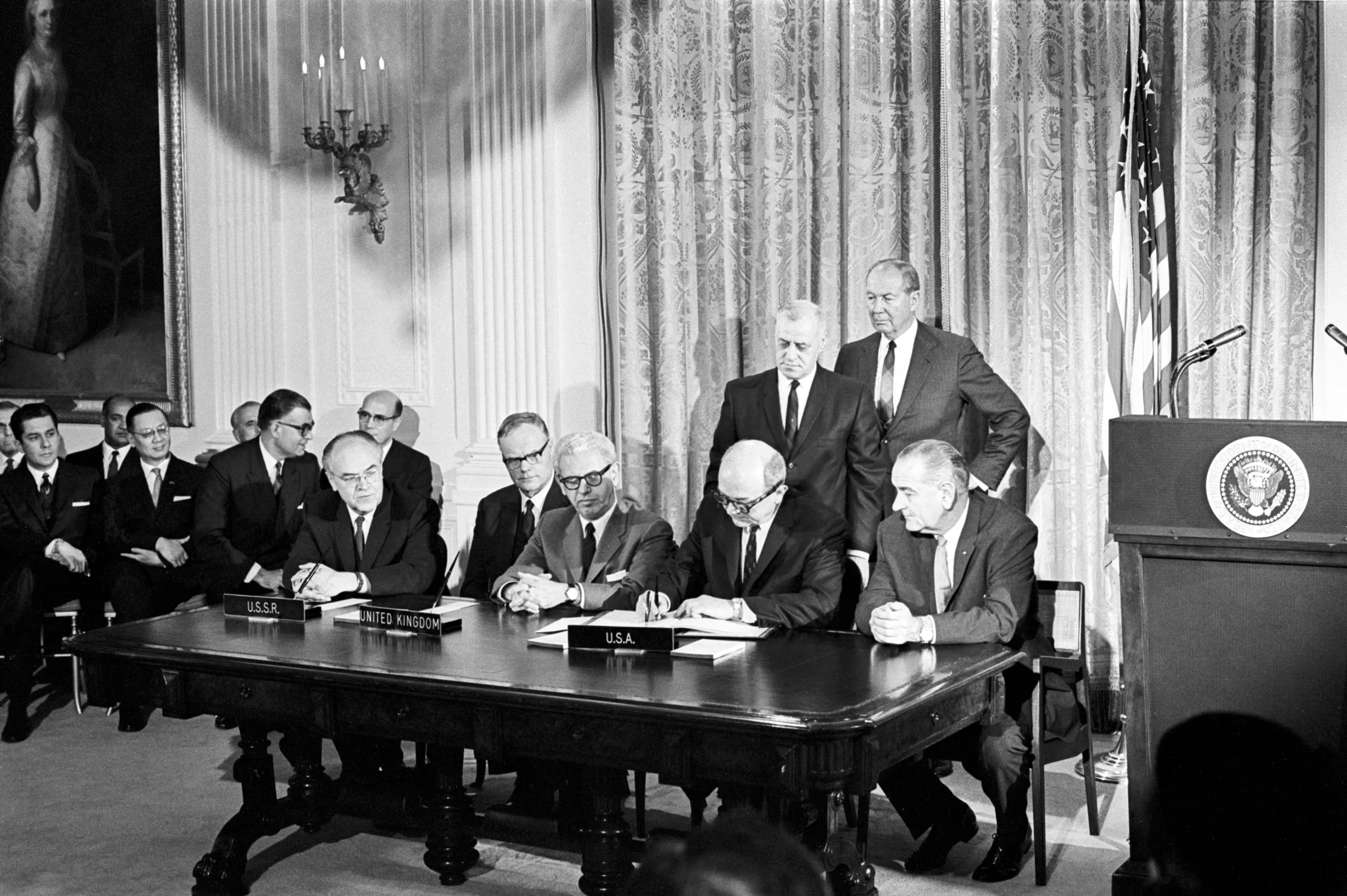
The Outer Space Treaty was concluded in 1967, after both superpowers had tested nuclear weapons in orbit. America’s Starfish Prime test in 1962 created an artificial radiation belt that destroyed satellites and disrupted lights and phone lines in Hawaii. Soviet tests in 1961 and 1962 caused grid failures, and one fire destroyed a power plant in Kazakhstan.
Article IV bans placing nuclear weapons or other weapons of mass destruction in orbit, and the treaty declares space a global commons for peaceful purposes. Russia, the US, China and the other nuclear-armed states are all parties.
Space Has Changed Beyond Recognition
At the end of 1967, about 128 satellites were operating, all state-backed. Astronomer Jonathan McDowell estimates around 16,810 functioning satellites today, many belonging to companies such as SpaceX’s Starlink.
The Gap in the Rules
Experts argue the treaty does not cover conventional weapons. Jessica West of Project Ploughshares says the framework must be fundamentally changed, and that the world has not done the hard work of building verification and wider bans around it. Michelle Hanlon of the University of Mississippi also sees a gap on conventional arms.
Efforts to negotiate a ban on all space weapons have stalled, partly because nobody agrees on a definition. Russia and China have pushed for a new treaty, but Washington says their proposals ignore ground-based anti-satellite missiles. Russia destroyed a defunct satellite with such a missile in November 2021, creating more than 1,500 pieces of debris that endangered astronauts on the International Space Station and China’s Tiangong station.
The US is also placing more emphasis on space, from creating the Space Force in 2019 to announcing the Golden Dome missile defence system, which includes plans for space-based weapons.
The Debris Problem
Talks have shifted toward responsible behaviour, such as limiting debris. Steven Freeland warns of an irreversible cascade if collisions create more debris, which then causes more collisions. The European Space Agency tracks roughly 46,950 pieces, with millions of smaller fragments estimated.
What to Watch Next
- Whether the US reveals more about its on-orbit systems
- Progress on talks about responsible behaviour in space
- Any renewed push by Russia and China for a treaty
- Developments in Golden Dome
The Bottom Line
The rules for space were written for a world of a few government satellites. Today, thousands of dual-use systems orbit overhead, and officials are quietly confirming weapons among them. Without shared definitions and verification, the risk of a costly miscalculation keeps growing
Author