Sánchez Admits Public Trust in Spain’s High-Speed Rail Is “Broken” as Minister Refuses to Resign Over Second Deadly Crash
Spain high-speed rail trust has collapsed, and the country’s prime minister is no longer pretending otherwise. Speaking on Friday, two days after a collision near Urda killed at least 69 people and injured more than 100, Pedro Sánchez conceded that public faith in a system once held up as a national success story had been shattered. The admission came as his transport minister rejected mounting calls to step down and as unions, opposition parties, and grieving families demanded to know how the same two operators could crash on the same line twice in nine months.
Two Collisions, One Line, One Year
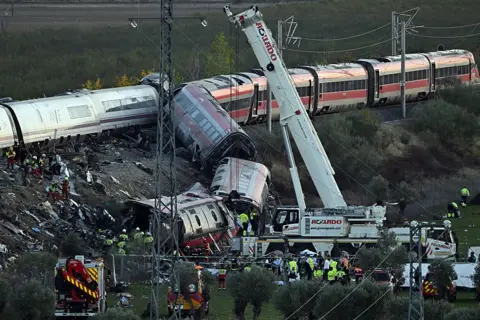
Wednesday’s disaster unfolded shortly before nine in the morning. Two trains, one run by the state operator Renfe and the other by the private company Iryo, were heading south from Madrid toward Andalucía. The Iryo train stopped on the track. The Renfe service behind it did not, ploughing into its rear and throwing several carriages off the rails near Urda in the central region of Castilla-La Mancha.
The victims include people from at least 23 countries. Sánchez said the government was working around the clock to get information to families as fast as possible.
What makes the tragedy especially hard to absorb is its echo. In January, 46 people died when a Renfe train and an Iryo train collided near Adamuz in Andalucía, on the very same route. Two catastrophic accidents involving the same companies on the same line within a single year has left the public asking whether something is fundamentally wrong.
The Prime Minister’s Reckoning
Sánchez did not attempt to minimise the scale of the failure. He described it as intolerable for a nation with such an extensive and advanced high-speed network to suffer two accidents of this severity in one year.
His framing of the government’s job was notable. Investigating what went wrong, he said, is only the starting point. The state must also deliver concrete fixes that make the system stronger, because diagnosing causes without preventing repetition would be a failure of responsibility. The language of restoring trust ran through everything he said.
Puente Digs In
Shortly afterward, Transport Minister Óscar Puente faced reporters amid growing demands for his resignation. He refused to engage with the question of his own future, arguing that his obligation now is to fix problems, establish facts, and give the public clear answers rather than debate whether he keeps his job.
Puente promised consequences if the inquiry reveals organisational or oversight failures, and said individuals found responsible would face action.
What the Preliminary Findings Show
The minister again pointed toward the Madrid control centre of Adif, the state-owned infrastructure manager, as the likely source of the error. His account of the sequence runs as follows:
The LZB signalling system, which automatically stops a train if the track ahead is occupied, had gone down before the crash. Puente stressed that such outages are not unusual.
When the automated system fails, decision-making passes to human controllers, as it does in other forms of transport.
An Adif operator cleared the Renfe train to proceed at normal speed instead of applying the fallback protocol, which caps speed at 40 kilometres per hour so drivers can spot hazards in time.
A preliminary report released on Thursday found the Renfe train was moving at somewhere between 160 and 200 kilometres per hour when it struck the Iryo service. The report concluded that a chain of malfunctions, instructions, and actions led to the collision because the safeguards that should have prevented it were absent.
Puente described the operator as a 48-year-old man with current training and two years of control centre experience who had overseen this particular section since February, meaning he knew the territory well.
Unions Reject the Blame
Rail workers have reacted angrily to the focus on a single controller. Raquel Ayllón, spokesperson for the railway traffic controllers union SCF, told the Associated Press that the minister appeared to be pinning responsibility on an ordinary employee operating under steadily deteriorating conditions.
Her central argument cut to the heart of the debate: a human mistake is understandable, but a safety system that fails on a regular basis is not. Unions say staffing levels are inadequate and workloads are too heavy to manage safely, and they are calling for more personnel rather than scapegoats.
The tension is clear. The government’s narrative emphasises an individual decision. The unions’ narrative emphasises a structural environment in which that decision became possible.
A Crisis Colliding With an Election
Spain goes to the polls in a snap general election next month, and the conservative People’s Party is forecast to defeat Sánchez’s socialist-led minority coalition. The crash has sharpened an already combative campaign.
PP leader Alberto Núñez Feijóo said his party holds both Puente and Sánchez politically accountable for the two disasters. He argued that anyone who failed to run the transport ministry properly must face consequences, and that the person who appointed and retained him bears even greater responsibility. If they refuse to resign, he said, voters will remove them.
Criticism is not confined to the right. Ada Colau, the former Barcelona mayor who heads the left-wing Frente Amplio coalition, also said Puente must go, dismissing any debate about timing and insisting the resignation should come as quickly as possible.
Asked whether he had considered how the crash might affect the vote, Puente said he had given it no thought at all, adding that no one could reasonably expect him to be focused on campaigning at such a moment.
What Comes Next
The immediate priorities are supporting the injured and bereaved and completing the investigation. Beyond that, several questions will determine whether trust can be rebuilt:
Why fallback protocols were not followed when the signalling system failed.
Whether staffing and working conditions at Adif control centres contributed to the error.
How often the LZB system fails, and whether that frequency is acceptable.
What specific changes the government will implement before the next incident.
Sánchez has promised solutions. Puente has promised accountability. Unions have promised to keep fighting for better conditions. For the families of 115 people killed on this one line in 2026, those promises will be judged by what actually changes on the tracks.
Author