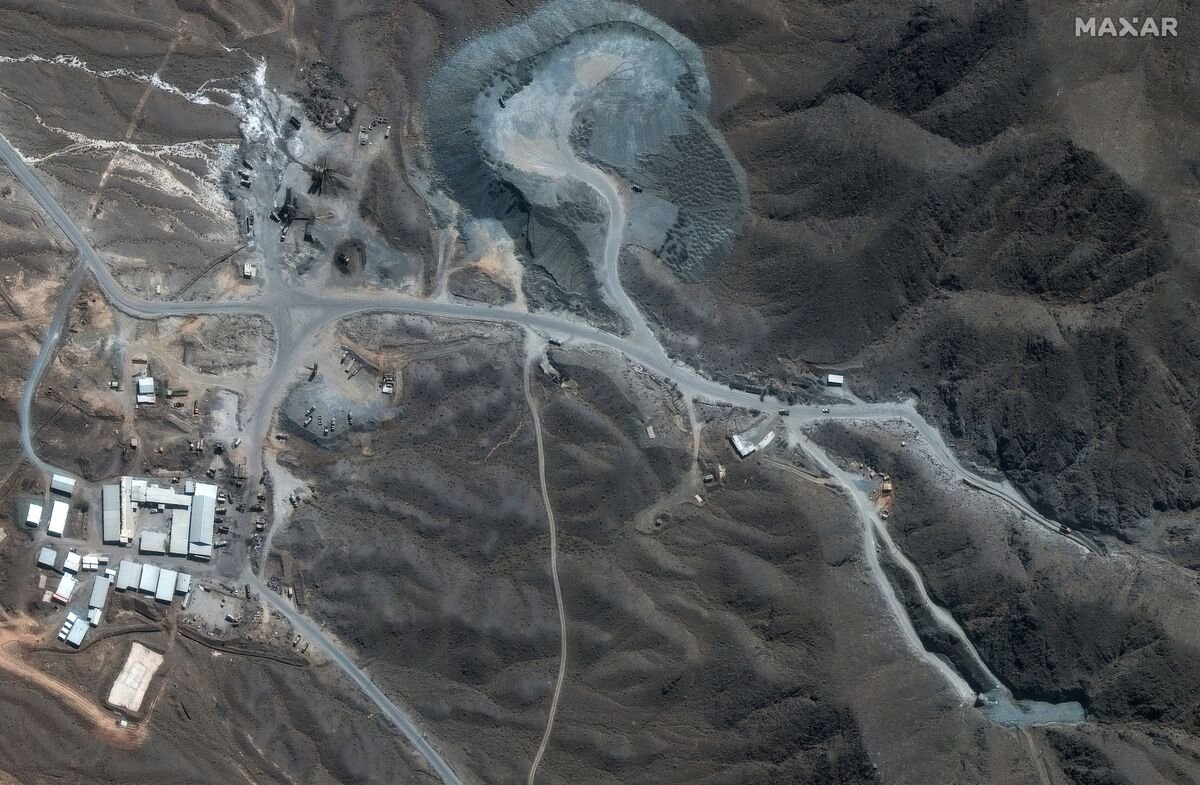
Nuclear strike on Pickaxe Mountain speculation has intensified after Tucker Carlson, the former Fox News host and prominent Trump ally, claimed on Monday that the United States was weighing the use of a nuclear weapon against the suspected underground Iranian facility. President Donald Trump has not confirmed any such plan, but he has openly acknowledged that some form of strike on the site remains under consideration. The possibility, however remote, raises an uncomfortable question for countries far from the battlefield: could radioactive fallout from such an attack drift across Pakistan and into northwestern India?
What Is Pickaxe Mountain?
Pickaxe Mountain is the last major element of Iran’s nuclear infrastructure believed to remain intact after months of American and Israeli bombing. Unlike other facilities that have been flattened by repeated strikes, this site sits deep beneath a granite mountain, placing it beyond the reach of conventional munitions. Reports earlier this year described a surge in construction activity at the location, fuelling concern in Washington that Iran was using it to protect or rebuild sensitive capabilities.
The geological protection that makes Pickaxe Mountain so difficult to destroy is precisely what has prompted speculation about more extreme options. Conventional bunker-busting bombs have limits, and a facility buried under hundreds of metres of solid rock may be beyond them.
The Carlson Claim
Carlson’s assertion that a nuclear option is being discussed has not been corroborated by the administration. Trump has said the United States still needs to deal with “one or two sites” in Iran but has described negotiations as progressing and has signalled no rush to act. The claim should therefore be treated as unverified, though its source, a figure with close ties to the president’s inner circle, has given it weight in public debate.
If such a strike were ever carried out, it would be the first use of a nuclear weapon in warfare since 1945 and would transform the conflict, and global politics, in ways that are difficult to overstate.
How Fallout Travels
The question of whether radiation could reach India depends on several factors, including the type of weapon, how it is detonated, the amount of debris lifted into the atmosphere and prevailing weather patterns at the time.
A weapon designed to penetrate deep rock would almost certainly be detonated at or below ground level. Ground bursts produce far more fallout than airbursts because they pull vast quantities of soil and rock into the fireball, where the material becomes irradiated and is then carried aloft. Heavier particles settle relatively close to the blast, while finer material can travel hundreds or even thousands of kilometres on upper-level winds.
Iran’s location places it upwind of Pakistan and northwestern India under certain atmospheric conditions, particularly when westerly winds dominate. Such winds are common during the winter months and could, in principle, carry lighter radioactive particles eastward across the region.
The Indian Exposure Question
Whether any fallout reaching India would pose a meaningful health risk is a separate matter. Radioactive material disperses and decays as it travels, and concentrations typically fall sharply with distance. The severity of any contamination would depend on the yield of the weapon, the depth of the detonation, rainfall patterns that could wash particles out of the atmosphere and the specific trajectory of the plume.
Northwestern India, including Rajasthan, Punjab and Gujarat, lies roughly 1,500 to 2,500 kilometres from central Iran depending on the exact location of the facility. At that range, the most likely scenario would involve trace levels of contamination detectable by monitoring equipment rather than acute danger to the population. However, even low-level deposits could raise concerns about agriculture, water supplies and long-term health, particularly for sensitive groups.
Experts generally caution that modelling fallout in advance involves significant uncertainty, and that the only responsible answer to the question is that the risk cannot be ruled out, even if it would most likely be limited.
Pakistan in the Path
Pakistan, lying directly between Iran and India, would face greater exposure. Its western provinces, especially Balochistan, sit much closer to Iranian territory and would be the first to encounter any eastward-moving plume. The implications for a nuclear-armed state already navigating a volatile region would be profound.
Beyond the Physical Risk
The broader consequences for India would extend well past any radiological concerns. The country imports close to 90 percent of its crude oil, much of it through the Gulf, and already faces economic strain from the war’s effects on energy prices and shipping. A nuclear escalation would likely send oil prices soaring, disrupt the Strait of Hormuz indefinitely and endanger the roughly nine to ten million Indians living and working in the region.
Diplomatically, India has balanced strategic partnerships with the United States and Israel against long-standing ties with Iran and heavy investment in Gulf states. A nuclear strike would make that balancing act far harder to sustain.
A Threshold Few Expect to Be Crossed
For all the alarm generated by Carlson’s remarks, most analysts regard an actual nuclear strike as highly unlikely. The political, legal and strategic costs would be enormous, and the administration has shown a preference for limited conventional action combined with economic pressure and negotiation. Trump’s own statements have leaned toward a deal rather than dramatic escalation.
Nonetheless, the fact that the idea is being discussed at all reflects how far the conflict has drifted from its original aims and how few conventional options remain for dealing with a facility as well protected as Pickaxe Mountain.
What India Can Do
Indian authorities have the capacity to monitor atmospheric radiation and would be expected to activate those systems if any strike occurred. More broadly, New Delhi has an interest in using whatever influence it holds to discourage escalation, whether through direct engagement with Washington, support for Qatari and Pakistani mediation efforts or coordination with other Asian energy importers such as China, Japan and South Korea.
The fallout question, in the end, is a reminder that in an interconnected world, a war in one region does not stay contained. Even a country thousands of kilometres from the front line has reasons to care deeply about how the confrontation with Iran is resolved.
Author