Supreme Court Abortion Pill Access Back in the Spotlight
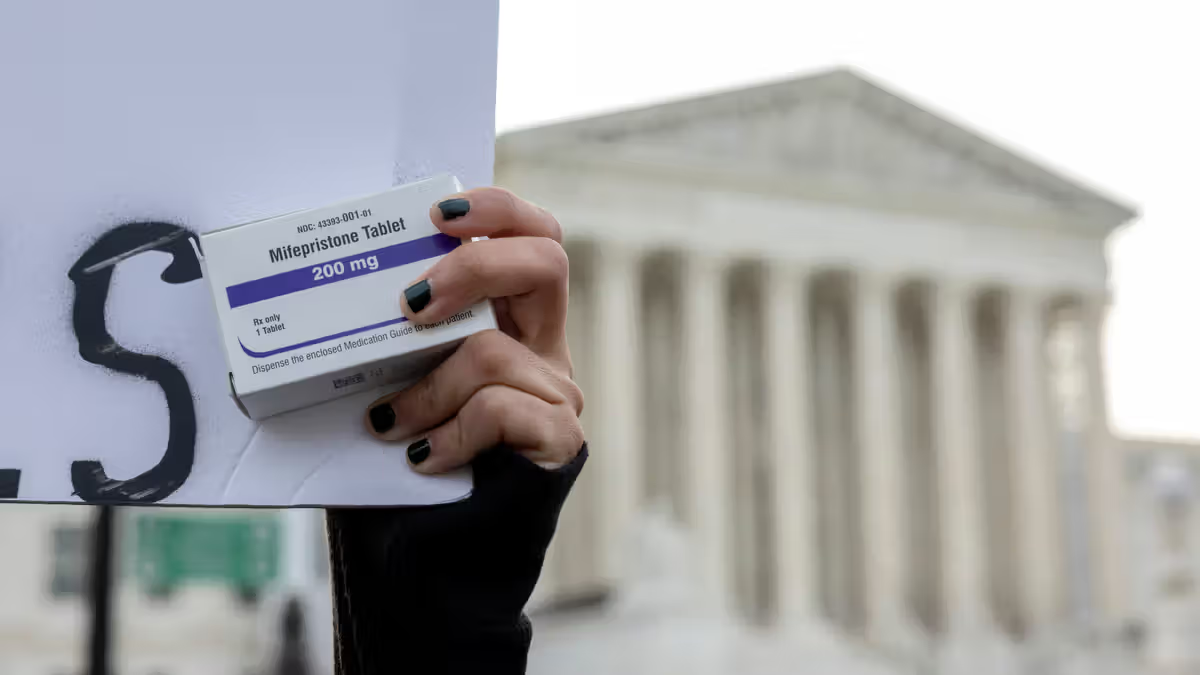
The fight over Supreme Court abortion pill access has erupted once again, dragging one of the most divisive issues in American politics back into the national conversation right in the middle of an election year. On Saturday, two pharmaceutical companies that manufacture mifepristone urgently petitioned the Supreme Court to step in and overturn a lower court ruling that has thrown nationwide access to the abortion medication into uncertainty.
A Sudden Shift From the Fifth Circuit
The legal turbulence began on Friday when a three-judge panel of the US Court of Appeals for the Fifth Circuit ruled in favor of Louisiana in its lawsuit against the Food and Drug Administration. The court effectively reinstated a long-standing FDA rule requiring that mifepristone only be prescribed after an in-person consultation between a patient and a healthcare provider — a requirement that had been lifted back in 2021.
The ruling temporarily blocks abortion providers across the country from prescribing the drug through telemedicine or sending it to patients via mail. If the order holds, it could disrupt one of the most widely used pathways for abortion access in America today, since around one in four abortions in the United States now happen through telemedicine services.
Drug Makers Race to the Supreme Court
Danco Laboratories and GenBioPro, both named as defendants in the Louisiana case, wasted no time in escalating the matter. Danco filed an emergency request with the Supreme Court on Saturday afternoon, urging the justices to immediately suspend the lower court’s order. GenBioPro followed with a similar filing later that evening.
Evan Masingill, GenBioPro’s chief executive, said the Supreme Court must reject what he described as a baseless attack on a vital medication. He warned that anti-abortion interest groups appear to be working to weaken the FDA’s regulatory authority — and that’s why the company is taking its case to the highest court in the country.
In its filing, GenBioPro stressed that countless patients and clinicians have depended on telemedicine prescriptions for years, particularly women living in rural areas, those with caregiving responsibilities, and those whose work schedules make in-person visits a serious barrier. Danco, in its own filing, argued the appeals court ruling has injected sudden chaos into time-sensitive medical decisions, leaving providers, patients, and pharmacies guessing about what’s allowed.
What Louisiana Argued in Court
Louisiana has built its case on the claim that the FDA’s 2021 decision to drop the in-person requirement was based on flawed or insufficient data. State officials argue that allowing mifepristone to be mailed has enabled illegal abortions to continue inside Louisiana despite its near-total abortion ban, and that the state has spent thousands of dollars in Medicaid funds caring for women allegedly harmed by the drug.
Medical organizations sharply dispute Louisiana’s claims. They point to more than 100 published studies showing that mifepristone is safe and that serious complications from its use are extremely uncommon.
GenBioPro’s Supreme Court filing pushed back hard against Louisiana’s argument, calling its narrative provably false. The company emphasized that lifting the in-person requirement does not force anyone to prescribe or dispense mifepristone, nor does it stop Louisiana from enforcing its own abortion laws. It simply removes one federal regulation.
Trump-Appointed Judges Lead the Ruling
The Fifth Circuit panel was composed of Judge Stuart Kyle Duncan and Judge Kurt D. Engelhardt — both appointed by President Trump — along with Judge Leslie Southwick, who was appointed by President George W. Bush. In his written order, Judge Duncan accepted Louisiana’s argument that the FDA’s policies were undermining state laws designed to protect unborn life and were also burdening Medicaid budgets.
Earlier this year, a Louisiana district court judge had agreed that the state was likely to succeed in its challenge but had stopped short of pausing mail access to the pills. That judge had instead given the FDA time to finish its ongoing safety review of the drug.
Trump Administration Walks a Political Tightrope
The case puts the Trump administration in an uncomfortable spot. While the Justice Department has been defending the FDA in court, it has stayed silent on whether it actually supports the rules that allow mifepristone to be sent by mail. Instead, officials have repeatedly pointed to an FDA review that, according to administration sources, won’t be completed until the end of this year — conveniently after the midterm elections.
A spokesperson for the Department of Health and Human Services declined to comment on Saturday, citing the ongoing legal proceedings.
How Mifepristone Fits Into Today’s Abortion Landscape
Following the Supreme Court’s 2022 decision to overturn the nationwide right to abortion, Republican-led states like Louisiana enacted sweeping restrictions. In response, several Democratic-led states passed shield laws to protect telemedicine providers who mail abortion pills into states with bans.
Today, nearly two-thirds of abortions in the United States are carried out with medication, typically within the first 12 weeks of pregnancy. The standard regimen involves taking mifepristone first, followed by misoprostol roughly a day or two later. Misoprostol, which has multiple medical uses beyond abortion, is not affected by the recent ruling.
Other Legal Battles Still Brewing
The Louisiana case isn’t the only legal challenge swirling around the abortion pill. In 2024, the Supreme Court unanimously rejected an effort by anti-abortion doctors to revoke the FDA’s approval of mifepristone, ruling the plaintiffs lacked legal standing. That case was later revived and is now pending in a federal court in Missouri. Texas and Florida have also filed a separate lawsuit against the FDA targeting the same medication.
What Comes Next
The Supreme Court abortion pill access case now stands as one of the most significant legal showdowns of the year. With drugmakers, healthcare providers, and millions of patients waiting to see how the justices respond, the outcome could reshape abortion access across the country — and reignite a political firestorm just as the midterm elections approach.
Whatever the court decides, the ripple effects will be felt far beyond Louisiana, touching everything from rural healthcare to the boundaries of federal regulatory authority itself.
Author