Black rain in Russia has become the haunting symbol of an unfolding environmental and humanitarian crisis along the Black Sea coast. As Ukraine intensifies its drone campaign against Russian oil infrastructure, the city of Tuapse is now drowning in toxic smoke, oily droplets, and growing public anger. What began as a series of military strikes is rapidly turning into one of the most serious ecological disasters Russia has faced since the Soviet Union collapsed.
Tuapse Under Attack
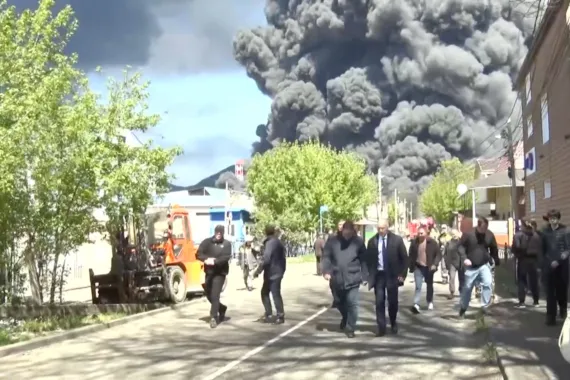
The strategic Black Sea city of Tuapse has been struck four times in just two weeks, with Ukrainian drones repeatedly targeting its major oil refinery and terminal. The most recent attack on Friday sent yet another tower of black, choking smoke high above the city, just as firefighters were still struggling to contain blazes from earlier strikes.
Each time emergency teams brought a fire under control, fresh drone attacks reignited it. The first strike landed on April 16, and since then the situation has only grown worse. Carcinogenic fumes have spread across the city, oily black droplets have rained down on residents, and an oil slick has reportedly contaminated more than 30 miles of Black Sea coastline.
A Growing Environmental Catastrophe
Environmental experts are sounding the alarm. According to Vladimir Slivyak, head of Russian environmental group Ecodefense, the smoke contains highly dangerous compounds, including benzene, a known cause of leukemia. Slivyak said the level of pollution in the air is so severe that the local government should have ordered a full evacuation of Tuapse rather than restricting movement to a few streets near the refinery.
Reports have already emerged of:
- Heavy black rain falling on residents and rooftops
- Dead fish washing ashore along the Black Sea coast
- Dolphins found dead in contaminated waters
- A massive oil slick spreading along the shoreline
- Fires releasing toxic smoke for days at a time
For people living in Tuapse, the disaster is not abstract. It is something they breathe in every morning and wash off their cars and balconies every evening.
Residents Frustrated and Frightened
Locals have grown furious with what they describe as government indifference and a deliberate effort to suppress the truth. Many say Russian federal media is barely covering the situation, leaving them to rely on social media and messaging apps to learn what is actually happening.
One resident, Alina Orlova, expressed her frustration online, asking why President Vladimir Putin has not visited the affected region himself. She wrote that residents are living in smoke and fear for their children’s future, even as the government continues to push routine, polished statements.
Another resident, Alla Kevshina, accused officials of staging a media coverup, noting that television news has barely mentioned the catastrophe. Others have linked recent crackdowns on internet access, including restrictions on Telegram, to the government’s apparent fear of public backlash and citizen organizing.
Putin Downplays the Crisis
President Vladimir Putin only acknowledged the strikes after the third attack and even then suggested that the situation was under control. He stated that there were no serious threats and that local people were “coping with the challenges.”
Russia’s consumer watchdog, Rospotrebnadzor, echoed this position, declaring that there were “no health risks” for residents despite the ongoing fires. Environmentalists strongly disagree, calling these reassurances dangerously misleading.
Analysts say Putin’s response reflects a system in which officials filter out bad news to protect the president’s image. Moscow-based political analyst Andrei Kolesnikov said Putin has “completely lost an adequate understanding of events” and is unable to grasp how serious the situation in Tuapse really is.
Local Government Response Falls Short
Authorities in the Tuapse area have taken some action, though residents say it falls far short of what is needed. Officials have:
- Closed schools in affected zones
- Canceled events tied to public holidays in May
- Asked residents to stop drinking tap water
- Advised people to remain indoors with windows closed
- Ordered partial evacuation only for streets near the refinery
According to environmental groups, this is simply not enough given the scale of the contamination. The lack of a citywide evacuation has fueled fears that vulnerable residents, especially the elderly, the very young, and those with existing health conditions, are being exposed to dangerous levels of pollution every day.
Ukraine’s Expanding Strike Capability
The strikes on Tuapse are part of a much larger campaign by Ukraine, which has dramatically expanded its long-range drone capabilities in recent months. According to Michael Kofman, a senior fellow at the Carnegie Endowment for International Peace, Ukraine has not only increased the number of strike platforms it can produce but has also made major leaps in the quality and coordination of its operations.
A drone even reached Moscow on Monday, striking a high-rise residential building only a few kilometers from the Kremlin. The reach of these strikes is reshaping perceptions inside Russia about how secure the country truly is.
Recent damage has not been limited to Tuapse. Ukrainian drones also targeted a refinery and oil-pumping station in Perm near the Urals, demonstrating that very few corners of Russia are now beyond reach.
Heavy Costs to Russian Oil Revenue
The economic toll on Russia is rising fast. Since the beginning of the year, Ukraine has struck Russian oil infrastructure more than 20 times, hitting refineries, export terminals, and pipelines. According to Borys Dodonov from the Kyiv School of Economics:
- Strikes on Ust-Luga, Primorsk, and Novorossiysk caused about $2.2 billion in lost revenue earlier this year
- Tuapse refinery damage may force a full reconstruction costing up to $5 billion
- Russian oil companies have already cut output by 300,000 to 400,000 barrels in April
While Russia did benefit from soaring oil prices triggered by the U.S.-Iran conflict and disruptions in the Strait of Hormuz, the Ukrainian campaign has clawed back a meaningful portion of those gains. Dodonov refers to these strikes as “Ukrainian kinetic sanctions,” a label that captures the strategic intent behind them.
A Strained Russian Budget
According to Craig Kennedy, a Harvard scholar and former Bank of America executive, Russia would need global oil prices to average around $115 per barrel through the rest of the year to keep its 2026 budget plan intact without major cuts. With drone strikes reducing export capacity at the same time the budget is under strain from war spending and Western sanctions, the pressure on the Kremlin’s finances continues to grow.
The fact that Russian oil firms are reducing production despite record-high prices is telling. Damage to refineries, storage facilities, and pipelines has left them with little choice but to scale back, even when conditions favor maximum output.
A Crisis With No End in Sight
The picture forming around Tuapse is grim. Repeated strikes are creating an environmental disaster that local officials seem unwilling or unable to confront. Residents feel abandoned, their concerns minimized, and their trust in government communication eroding rapidly.
Meanwhile, the Kremlin’s narrative continues to clash with what people in affected regions are actually experiencing. The disconnect between official reassurances and the toxic reality on the ground is widening, especially in places like Tuapse where the air, water, and shoreline tell a very different story.
A Symbol of a Larger War
Black rain in Russia has become more than a local emergency. It is a powerful symbol of the war’s mounting consequences for ordinary Russians, the increasing reach of Ukrainian forces, and the fragile state of a system that struggles to admit failure. As long as Russian oil infrastructure remains a strategic target, Tuapse may not be the last city to face such a disaster.
For its residents, the question is no longer whether the crisis will be acknowledged. It is whether anyone in power will act before the damage to their health, their environment, and their futures becomes irreversible.
Author