A devastating Pakistan car bomb attack has rocked the northwestern district of Bannu, leaving at least 12 police officers dead following a coordinated assault that combined a suicide bombing, a fierce firefight, and a calculated ambush on responding personnel. The incident, which took place late Saturday in the Khyber Pakhtunkhwa province bordering Afghanistan, has once again raised serious concerns about deteriorating security along Pakistan’s volatile western frontier.
A Coordinated Assault on a Security Post
According to police and security sources, the violence began when an explosives-laden vehicle was driven into a police post in Bannu. A suicide bomber, along with several other armed fighters, detonated the vehicle near the security checkpoint. The blast was so powerful that it caused the entire structure to collapse, instantly killing several officers stationed there.
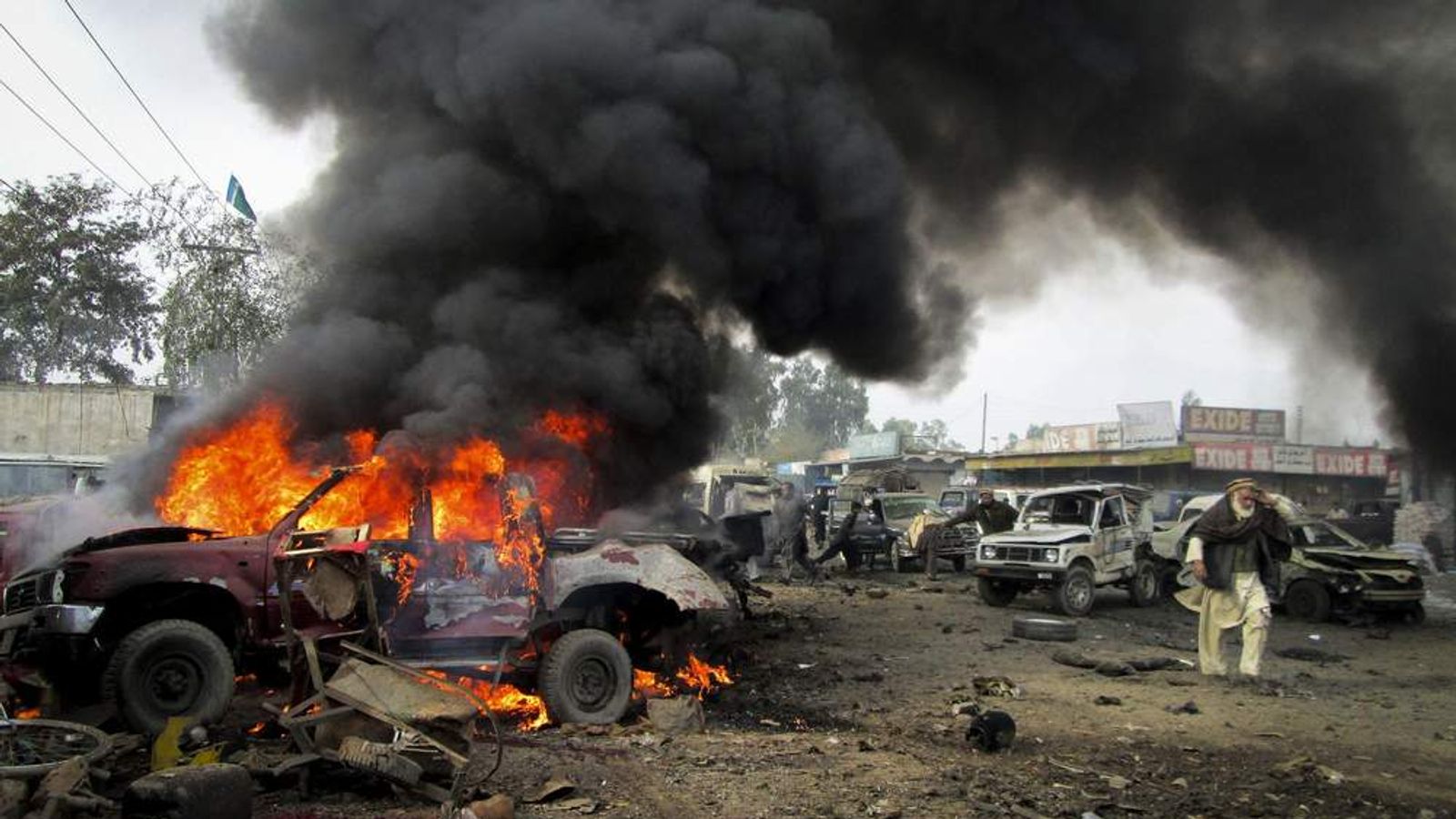
Police official Zahid Khan, who spoke with international media, confirmed that the explosion was followed by additional blasts and a sustained firefight. Photos taken from the scene showed widespread destruction — the security post reduced to rubble, vehicles twisted and charred, and bricks scattered across the surrounding area.
Reinforcements Walked Into an Ambush
Adding to the tragedy, the attackers reportedly anticipated the arrival of police backup. Once additional officers rushed to the scene to assist their fallen colleagues, they were met with a deliberate ambush.
A police source, speaking on the condition of anonymity, explained that the gunmen first crashed into the post with the explosive-filled vehicle and then stormed the premises, opening fire on those inside. As reinforcements arrived, the attackers were already in position to strike again, leading to further casualties.
Authorities have confirmed that drones were also used during the assault, signaling a worrying evolution in the tactics employed by armed groups in the region.
Group Claims Responsibility
An alliance of armed factions known as the Ittehad-ul-Mujahideen Pakistan has claimed responsibility for the attack. The group, comprising several anti-state outfits, has been involved in numerous deadly assaults over recent years, particularly targeting law enforcement and security personnel in Pakistan’s tribal belt.
This latest claim is consistent with a broader pattern of violence carried out by groups ideologically aligned with the Pakistan Taliban, also known as Tehrik-e-Taliban Pakistan (TTP).
Civilian Damage and Emergency Response
The destruction was not limited to military or police targets. Local reports indicated that civilian areas near the police post sustained significant damage from the explosions. At least two civilians were reported wounded as a result of the blasts.
Authorities quickly mobilized rescue agencies and dispatched ambulances from civil hospitals to the scene. A state of emergency was declared in government hospitals across Bannu to ensure that all victims could be treated swiftly. Police official Sajjad Khan warned that the death toll could rise, with rescue operations continuing as fighting persisted into the night.
Tensions Along the Afghan Border
The Pakistan car bomb attack comes at a moment of heightened tension between Pakistan and Afghanistan. Earlier this year, in February, the worst clashes in years broke out between the two former allies. Pakistani forces conducted airstrikes inside Afghanistan, claiming they had targeted strongholds of armed groups operating in the area.
Although large-scale fighting has since cooled, sporadic skirmishes continue to flare along the rugged border. To date, no formal ceasefire has been agreed upon between the two governments.
Islamabad and Kabul Trade Accusations
Pakistan continues to accuse Afghanistan’s Taliban-led government of providing safe haven to armed groups responsible for staging cross-border attacks. Islamabad claims that fighters operate freely from Afghan soil, planning and executing attacks against Pakistani targets.
The Afghan Taliban, however, has consistently rejected these accusations, arguing that armed insurgency inside Pakistan is an internal matter and not connected to Afghanistan’s leadership. The Pakistan Taliban, while operationally separate from the Afghan Taliban, shares strong ideological ties with the group that took control of Kabul in 2021.
A Pattern of Escalating Violence
Attacks on Pakistani security forces have surged dramatically since the Afghan Taliban returned to power. Border regions, particularly Khyber Pakhtunkhwa, have become hotspots for armed activity, with police checkpoints, military convoys, and government installations increasingly under threat.
The use of explosives-laden vehicles, combined with coordinated ambushes and the addition of drones, suggests that armed groups are becoming more sophisticated in their planning and execution. This evolution has placed enormous strain on Pakistan’s security apparatus, which has struggled to contain the growing wave of violence.
Calls for Stronger Action
Following the latest attack, security analysts and political observers are urging Pakistan’s government to adopt a stronger and more strategic response. Many are calling for greater intelligence coordination, enhanced border surveillance, and renewed dialogue — or pressure — directed at Kabul to address the militant safe havens believed to exist on Afghan territory.
Local communities in Bannu and surrounding areas are reportedly living in fear, with many residents demanding stronger protection from authorities. The repeated targeting of police forces has not only weakened morale among officers but also damaged public trust in the state’s ability to maintain order.
A Region on Edge
As rescue operations continue and investigators work to piece together the full sequence of events, one thing is clear — the Pakistan car bomb attack in Bannu is more than just an isolated incident. It is part of a broader, deeply concerning trend of escalating violence that threatens to reignite tensions along the Afghan border and destabilize an already fragile region.
For the families of the fallen officers, however, the immediate concern is grief. Twelve lives have been lost, and many more remain at risk as long as armed groups continue to operate with impunity. Whether the Pakistani government can halt this rising tide of attacks will depend on its willingness to take decisive action — both within its borders and beyond.
Author