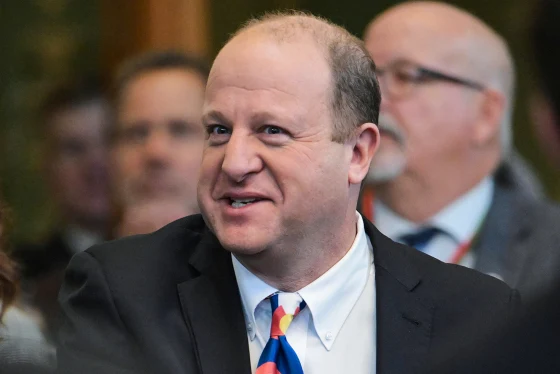
The Jared Polis censure has officially reshaped the political mood inside Colorado’s Democratic Party, with rank-and-file members openly rebuking the sitting governor in an unusually public display of frustration. On Wednesday night, the Colorado State Democratic Party voted overwhelmingly to censure Gov. Polis after his controversial decision to commute the prison sentence of Tina Peters — a high-profile election denier serving a nine-year sentence for tampering with voting machines.
The resolution passed with 89.8% support during a central committee meeting, following weeks of mounting outrage from Democratic leaders, grassroots activists, and even some Republicans who had urged Polis not to grant Peters clemency.
Why Peters’ Release Triggered Such Fury
Tina Peters, 70, became one of the most recognizable figures in the post-2020 election denial movement. As the former Mesa County clerk, she was convicted for facilitating a security breach involving voting machines under her authority — a scheme tied to her belief that the 2020 election had been rigged.
Until last week, she remained one of the most prominent election deniers still behind bars.
Despite her age and the fact that this was her first felony conviction, Democrats argued she:
- Showed no remorse for her actions
- Remained an active voice in election conspiracy circles
- Posed an ongoing threat to election integrity
- Symbolized the broader effort to undermine democratic processes
For months, dozens of state Democrats — and even several Republicans — publicly and privately pleaded with Polis not to intervene in her case. Their warnings, however, were ultimately ignored.
Polis Defends His Decision
Gov. Polis, who is now serving as a lame-duck governor, justified the commutation by arguing that Peters’ nine-year sentence was disproportionately harsh. According to him, the punishment reflected hostility toward her political views and conspiracy theories rather than the actual severity of her conduct.
His spokesperson, Eric Maruyama, doubled down after the censure vote, saying that doing what one believes is right isn’t always going to be popular. He added that democracy thrives on debate, not “censorship.”
The commutation, signed last Friday, paves the way for Peters to walk out of a state prison in Pueblo on June 1, after serving fewer than two years of her original sentence.
A Party Boiling Over
The censure move was driven by a grassroots wave of anger. More than 700 Democrats had signed onto the petition pushing for the rebuke before it ever reached a formal vote. On Wednesday night, over 250 party activists, state lawmakers, and local officials gathered virtually to discuss what many described as conduct “detrimental” to the Democratic Party.
Some supporters of the censure went further, demanding a formal investigation into Polis’ decision-making. Others raised concerns about how the commutation might affect Denver’s bid to host the Democratic National Convention in 2028 — a potential blow to the state’s political profile.
Ian Coggins, a 33-year-old political consultant and local Democratic captain who launched the censure campaign, didn’t mince words. He described the governor as “wildly out of touch with the party he effectively leads.”
Polis Was Already on Thin Ice With Democrats
The Peters commutation wasn’t the first move that alienated Polis from his party. Tensions had been simmering for some time, particularly because of:
- His vetoes of bills championed by Democratic lawmakers
- His endorsement of Robert F. Kennedy Jr. — a vaccine skeptic — as health secretary
- His court battles to cooperate with federal immigration subpoenas
For many in the state party, the Peters decision was simply the final straw rather than an isolated outrage.
Not Everyone Agreed With the Rebuke
Despite the overwhelming vote, the conversation wasn’t entirely one-sided. A few attendees argued that censuring a sitting Democratic governor — particularly so close to a major election cycle — could distract from more pressing political priorities.
Among the upcoming political battles:
- Choosing Polis’ successor in November, a seat Democrats are expected to retain
- Flipping two Republican-held congressional districts
- Strengthening the Democratic coalition heading into the 2028 election cycle
Ann la Plante, a criminal defense attorney from Greeley, defended the governor, calling his decision “brave” — even if widely unpopular. For her and others, principled disagreement should not necessarily translate into formal party punishment.
A Symbolic but Stinging Move
The censure, while powerful in tone, is largely symbolic. It carries no legal consequences and doesn’t impact Polis’ authority as governor. However, it does bring some practical restrictions, including:
- Barring Polis from speaking at major Democratic Party events
- Excluding him from gatherings like the upcoming DemFest in Denver — a showcase for the party’s rising candidates
The optics, though, may be the real story. A sitting governor publicly rebuked by his own party in such an emphatic vote sends a strong signal about internal divisions and political accountability.
Echoes of Past Party Censures
Polis isn’t the first political figure to be reprimanded by his own party. In recent years:
- Arizona Republicans censured then-Sen. John McCain in 2014 over his voting record.
- His wife Cindy McCain, along with another former GOP senator, faced censure in 2021 for supporting Joe Biden over Donald Trump.
- Arizona Democrats censured Sen. Kyrsten Sinema in 2022 for opposing efforts to eliminate the filibuster.
Like those past actions, the Colorado vote is largely a statement of disapproval rather than a mechanism for direct political consequences.
What This Means for Colorado Politics
The Polis-Peters episode has exposed a wider rift inside the Democratic Party — one between pragmatic governance, ideological consistency, and the politics of election integrity. Polis’ defenders argue he made a constitutional and principled decision. His critics insist he provided a high-profile lifeline to someone who represents a continued threat to American democratic norms.
As Colorado heads into a pivotal election year, Democrats will need to balance internal disagreements with broader political goals. Whether the censure becomes a defining moment of Polis’ final months in office — or simply a temporary flashpoint — remains to be seen.
For now, one thing is unmistakable: the Colorado Democratic Party drew a clear line on Wednesday night, and its own governor was on the wrong side of it.
Author