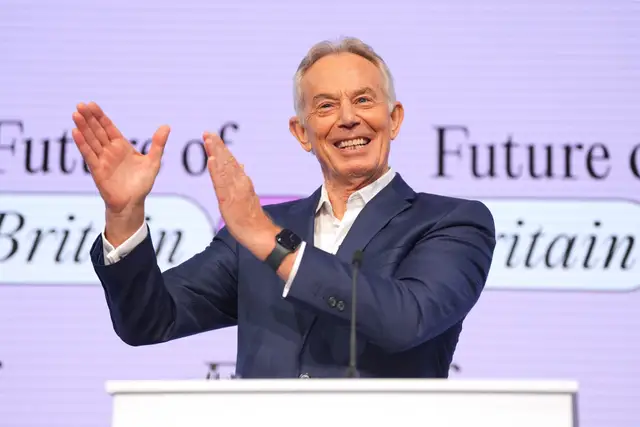
Tony Blair’s Essay Sparks Fresh Labour Soul-Searching Over Its Future
A sweeping new intervention has thrown the Labour Party into yet another round of intense internal debate, with the Tony Blair essay on Labour leadership landing like a deliberate jolt to the center-left. The former British prime minister set out to shock the political system into confronting what he sees as its failure to address pressing problems facing the U.K. at home and abroad, and on that front, he has clearly succeeded.
The result has been a flurry of reactions, recriminations, and rival positioning that has exposed just how divided the party remains about its direction and identity.
A Calculated Provocation
Blair’s essay, running well beyond 5,000 words and published late Tuesday, was designed to make an impact. It has dominated political discussion at a particularly sensitive moment, coming just ahead of a crucial June by-election and a possible summer leadership challenge against his Labour successor, Keir Starmer.
The timing is no accident. As the party wrestles with its future, Blair, Labour’s most electorally successful prime minister, used the piece to weigh in on the very question consuming the party: what should Labour stand for, and who should it try to win over?
Dismissing the Alternatives
At the heart of the controversy is Blair’s blunt assessment of the leadership options now circulating within Labour. He dismissed the emerging alternatives to Starmerism as downgrades from the approach that defined his own late 1990s “New Labour” era.
The two main contenders drawing his scrutiny are:
- Andy Burnham, whose vision has been dubbed “Manchesterism.”
- Wes Streeting, whose leadership bid represents what observers describe as a left-right blend.
Blair’s message was clear: neither of these directions, in his view, measures up to the ambition and electoral success of the New Labour project.
A Cabinet Divided
The essay has been dissected by senior officials within a Cabinet already split over the government’s direction and the causes of a disappointing local election performance in May.
One senior Cabinet minister, previously loyal to Starmer and speaking anonymously, offered a striking interpretation. He described the essay as “motivational” and likened it to a forensic test of the leadership contenders, arguing that it made them appear backward-looking, a kind of “Labour fundraiser greatest hits” rather than a serious vision for the present moment.
This minister noted that Blair’s essay ultimately called for ambition matching his own earlier record, posing the uncomfortable question of why such ambition hasn’t materialized. As he put it, everyone knows that’s the question the party needs to answer.
He also made a prediction that quickly proved accurate, warning that some would mistakenly believe positioning themselves against Blair’s intervention would be good politics, or that being called out by Blair might help them with the party membership.
The Contenders Strike Back
Sure enough, by late Wednesday, both Burnham and Streeting had responded with their own sharp critiques. Each took aim at Blair’s enduring commitment to market-first solutions, pushing back against the framework he champions.
This back-and-forth illustrates exactly the kind of division the anonymous minister had foreseen, with leadership hopefuls using Blair’s intervention as a foil to define their own distinct identities.
Tensions Long in the Making
The frustrations driving Blair’s essay didn’t appear overnight. They have been building for some time, well before the current wave of open challenges to Starmer’s leadership.
Starmer has faced heavy criticism on several fronts. He has been accused of losing the voters who delivered Labour’s 2024 landslide through repeated policy U-turns and a perceived lack of vision. He also drew fire for appointing the now-disgraced Blair-era figure Peter Mandelson as Britain’s ambassador to the U.S.
Against this backdrop, the relationship between Blair and Starmer has reportedly grown distant in recent months. According to a senior figure at the Tony Blair Institute for Global Change, Blair has largely given up trying to influence the Starmer operation directly.
Rising Above Left and Right
That same source explained Blair’s broader intent. Rather than picking sides in the left-right struggle, Blair now wants to elevate the conversation, focusing on the center more broadly and on the ideas Britain needs to thrive.
The aim, this person said, is to encourage politics to look upwards and outwards, leaving it to others to carry those ideas forward. In other words, Blair positions himself less as a factional combatant and more as a thinker challenging the entire party to raise its sights.
Coded Messages and Pointed Targets
Still, it’s difficult to strip the raw politics out of any Blairite clash with the Labour Party. Observers note that the essay contains coded messages aimed squarely at his rivals.
Burnham, who hopes to return to Westminster through the forced June by-election, is one clear target. So too is Streeting, the former health secretary who resigned after the disastrous local elections earlier this month in protest at what he saw as drift under Starmer.
The TBI senior figure pushed back firmly on the contenders’ framing. He noted that Burnham has defined himself against 40 years of neoliberalism, a period that includes the New Labour era, and said the institute would strongly challenge that characterization. Even Streeting, he added, has been critiquing New Labour. The institute’s counterargument is that dismissing that legacy is not the best way to look outward at a changing world and what it means for Labour today.
A Battle of Ideas
The intervention was conceived long before the present leadership standoff, but it has now become a flashpoint in the contest of ideas between two camps: those who support Starmer’s effort to hold onto power and the challengers eager for a change at the top.
Jack Straw, who served as home and foreign secretary during the Blair years, interpreted the essay as a tough intellectual critique of the current leadership and defended his old boss against accusations of drifting rightward in his political afterlife.
Straw voiced strong support for Blair’s message. He pointed out that Blair had stayed silent during the local elections and argued that most people recognize the government made serious, unforced errors, including failing to properly prepare for governing. He found the intervention useful precisely because it forces a discussion about what has gone wrong, something he insisted has plainly happened. With three years to turn things around, Straw also took a jab at Burnham’s talk of 40 years on the wrong path, noting he didn’t recall Burnham making that argument when they served in government together.
Clashing Visions for Labour
The substance of Blair’s contribution puts him at odds with much of the party’s current thinking. His calls for more supply-side market reforms and lighter regulation clash directly with Labour plans to return to nationalizations and a higher tax base aimed at addressing voter frustration over public services.
The essay also serves as a challenge to center-left think tanks working to refresh the government’s policy offer. Ed Owen, a former special adviser during the Blair years and now head of policy at the centrist Think Labour organization, acknowledged the mixed reception.
Owen observed that interventions from Blair inevitably produce both antibodies and expressions of support. While he expressed uncertainty about the timing, he agreed that Blair’s analysis of the challenges is correct and that Labour needs more debate on the big issues rather than retreating to its comfort zone.
More Discomfort Than Harmony
Taken together, the reactions suggest that this blast from Labour’s past has generated far more friction than unity. Rather than rallying the party around a shared vision, Blair’s essay has sharpened existing divisions and forced uncomfortable questions to the surface.
The Tony Blair essay on Labour leadership has accomplished its goal of provoking debate, but it has also laid bare the deep uncertainty at the heart of the party. As Labour weighs whether its future lies with or without Starmer, the competing visions of Burnham’s Manchesterism, Streeting’s blend, and Blair’s enduring centrism remain unresolved.
What Comes Next
With a by-election looming and a potential leadership challenge on the horizon, Labour faces a defining period. The party must somehow reconcile its competing instincts, between market-oriented reform and a more interventionist state, between looking back to past successes and forging a new path for changing times.
Blair clearly hopes his intervention will push the party toward greater ambition. Whether it ultimately unites Labour around a clearer purpose or simply deepens its internal rifts remains to be seen. For now, one thing is certain: the conversation he set out to provoke is well and truly underway, and it shows no sign of quieting down anytime soon.
Author