The Colombia presidential runoff is set for 21 June, pitting two candidates who could hardly be further apart on the political spectrum. After Sunday’s first-round vote failed to produce an outright winner, the country now faces a stark choice between a leftist senator and a right-wing admirer of Donald Trump.
The decision will shape not only Colombia’s approach to its long-running internal conflict, but also its relationships with the United States and key neighbors in the region.
A Razor-Thin First Round
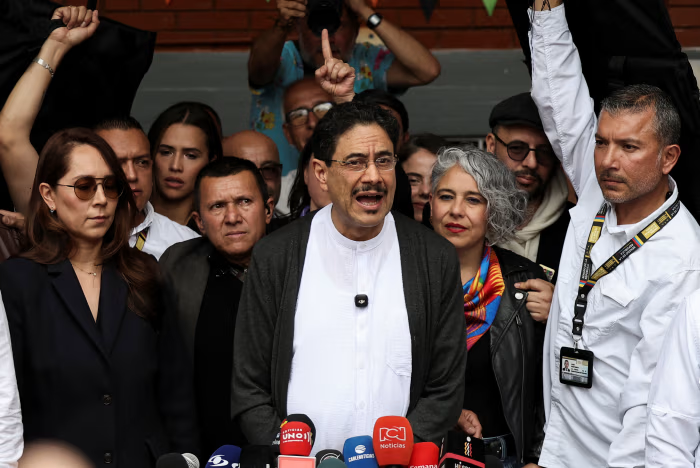
When the votes were counted, right-wing candidate Abelardo de la Espriella edged ahead of the pack, narrowly followed by leftist senator Iván Cepeda, a close ally of current President Gustavo Petro.
Neither man crossed the 50% threshold needed to win outright, sending the contest to a second round. The numbers told a surprising story:
- De la Espriella finished first with roughly 43.7% of the vote.
- Cepeda trailed at around 41%, despite polls that had tipped him to come out ahead.
- Moderate conservative Paloma Valencia placed third with under 7%.
The gap, while small, defied expectations and set the stage for a tense few weeks of campaigning.
A Campaign Marred by Violence
The road to this runoff has been anything but peaceful. The campaign was shadowed by drone strikes, kidnappings, homicides, and even the assassination of a presidential candidate at a rally last year.
That backdrop of bloodshed underscores exactly what’s at stake. Both candidates are offering sharply different answers to the same urgent question: how can Colombia finally calm a violent internal armed conflict that has dragged on for decades and surged again in recent years?
Disputed Results and Allegations of Fraud
The aftermath of the vote has been clouded by controversy. After topping the count, De la Espriella struck a triumphant tone, vowing to “defeat tyranny” in the runoff and casting the result as a victory for those who have never relied on the state for support.
Cepeda, by contrast, held back, saying he would not comment until judges had verified the count.
The sharpest reaction came from President Petro, who had endorsed Cepeda. He refused to accept the preliminary results, insisting he would wait for final figures reviewed by judges. Petro went further, alleging that hundreds of thousands of votes had been improperly added, though he offered no evidence to back the claim. Electoral authorities, for their part, said voting had proceeded normally and safely.
Meanwhile, Valencia threw her support behind De la Espriella, potentially strengthening his position heading into the second round.
Iván Cepeda: Architect of “Total Peace”
Cepeda brings a long history of peace advocacy to the race. He played an active role in the talks that produced the landmark 2016 agreement between the Colombian government and the FARC guerrilla group, a deal that led thousands of fighters to lay down their arms.
He is widely seen as a key architect of Petro’s “total peace” strategy. That approach favors dialogue, negotiation, and ceasefires with armed groups over outright military force.
Yet the strategy remains deeply contested. Critics point to troubling trends under Petro’s presidency:
- Cocaine production reached a record high.
- Membership in armed groups expanded.
- Border violence surged to its worst level in years, displacing tens of thousands of people.
For many security analysts, these developments suggest “total peace” has failed. Petro counters that his government has seized more drugs than any other in history, and points to economic gains, including significant growth and a sharply higher minimum wage, even as roughly one in three Colombians still live in poverty.
If elected, Cepeda has promised to push economic reforms, expand welfare benefits, and redistribute land to victims of the internal conflict.
Abelardo de la Espriella: “El Tigre” and the Iron Fist
On the other side stands De la Espriella, a lawyer and businessman who has branded himself “El Tigre,” the tiger. His platform is built around a hardline rejection of negotiation in favor of force.
He has sharply criticized Petro’s talks with armed groups and instead champions a tough military crackdown on crime. His proposals include:
- Closer cooperation with the United States, including bombing cartels with American support.
- Expanded powers for the military.
- Possible mass trials of suspected criminals.
- Building 10 mega-prisons in the jungle.
His prison plan openly echoes the hardline policies of El Salvador’s President Nayib Bukele. Observers have noted that De la Espriella has borrowed not only some of Bukele’s ideas but even modeled his beard on the Salvadoran leader. He has also pledged to dramatically shrink the size of the state.
His past, however, has drawn scrutiny. He once served as lawyer to Alex Saab, a close ally of ousted Venezuelan leader Nicolás Maduro who faced money-laundering charges, and he defended Colombian fraudster David Murcia Guzmán, mastermind of a multibillion-dollar pyramid scheme. De la Espriella defends this as simply the work of a defense lawyer, while critics accuse him of profiting by representing powerful criminals.
A Runoff With Regional Stakes
The 21 June vote reaches far beyond Colombia’s borders, with major implications for the country’s ties to the United States and its neighbors.
Trump has pursued an assertive policy toward Latin America, including seizing former Venezuelan leader Maduro in a military raid, striking alleged drug-trafficking boats, imposing an oil blockade on Cuba, and forming a regional “Shield of the Americas” security alliance with right-leaning leaders. Across the region, the political tide has shifted rightward, with Ecuador, Chile, Argentina, Bolivia, Honduras, and El Salvador all moving in that direction.
The two candidates embody opposing visions for this relationship. Cepeda, like Petro, insists Colombia should never be a “vassal state” to the United States. De la Espriella, by contrast, openly aligns himself with Trump and wants to deepen the security partnership with Washington. Notably, Trump has not formally endorsed anyone in this race.
Tensions With Ecuador
The outcome could also reshape relations with neighboring Ecuador. While Colombia remains the world’s largest cocaine producer, most of that cocaine now passes through Ecuador, fueling a sharp rise in violence there.
Ecuador’s conservative president Daniel Noboa had slapped tariffs on Colombia, accusing it of failing to secure the shared border. He recently said he had reached an agreement with De la Espriella to drop those tariffs on 1 June, citing plans for the handover of Ecuadorean criminals and a joint fight against narcoterrorism.
Colombia’s foreign ministry was not pleased, accusing Noboa of deliberately interfering in the election.
What Comes Next
As Colombia heads toward 21 June, voters face a defining choice between two radically different futures. One path continues the search for peace through dialogue and reform. The other promises an iron-fisted crackdown modeled on the region’s toughest leaders.
With the first round so close, allegations of fraud swirling, and powerful outside interests watching closely, the runoff promises to be one of the most consequential elections in Colombia’s recent history.
Author