President Donald Trump’s proposed 250-foot triumphal arch cleared a procedural hurdle this week, even as the chairman of the federal commission reviewing it made a striking argument: that a century-old law limiting building heights in Washington simply does not apply to the project. The claim has set off fresh debate over a monument that already faces broad public opposition and legal challenges.
A Bold Legal Interpretation
Will Scharf, the Trump-appointed chairman of the National Capital Planning Commission, said Thursday that he had thought deeply about whether the Height of Buildings Act should govern the arch. Enacted in 1910 to protect the capital’s historic views and character, the law caps most construction in Washington at 130 feet, and the commission has long applied it when weighing projects in the region.
Yet Scharf voiced skepticism about the legal reasoning that has traditionally tied the Height Act to projects like this one. He pointed to existing structures that already exceed the limit, such as the 166-foot National Archives building on Pennsylvania Avenue. Speaking personally, he said his best reading of the law was that it does not apply to federal construction at all.
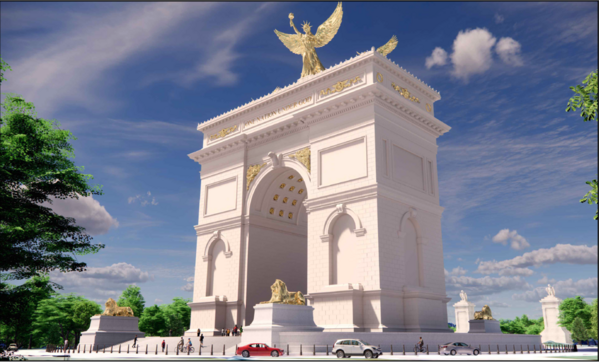
The arch stands at roughly twice the law’s 130-foot ceiling, making the question of applicability far from academic.
Advancing Without Final Approval
After hearing public comment, the commission voted to advance the project but stopped short of granting final approval. The administration, which maintains it does not need congressional authorization, has said it will give at least 14 days’ notice before construction begins.
The project carries clear presidential priority. Trump has championed the arch as part of the nation’s 250th-anniversary celebrations, and it would rise in Memorial Circle, a traffic roundabout at one end of Arlington Memorial Bridge that falls within Washington’s boundaries. The Interior Department is steering the effort, with classical architect Nicolas Leo Charbonneau of Harrison Design overseeing the design. Last month, the Commission of Fine Arts, another panel Trump has stocked with allies, voted to approve it.
A Chorus of Objections
The proposal drew pointed criticism from architects, historical preservationists, and Washington residents, many of whom warned that the arch would loom over nearby landmarks. By comparison, the Lincoln Memorial stands at about 100 feet, less than half the arch’s planned height.
Several speakers leaned directly on the city’s height rules. Carol Quillen, chief executive of the National Trust for Historic Preservation, argued the structure was inconsistent with the Height of Buildings Act and the city plan it protects. Her organization, tasked by Congress with helping preserve historic buildings, is already suing the administration over Trump’s planned White House ballroom.
Concerns also surfaced from within the commission itself. Career staff questioned how the arch would comply with the height law, noting in a report ahead of the hearing that the commission has always applied the Height of Buildings Act to federal projects. They asked the Interior Department to justify the project in light of those restrictions.
Notably, Scharf, who also serves as Trump’s staff secretary, said he supported that request and hoped the response would bring clarity to the legal questions surrounding the Height Act and the arch.
Safety, Public Opinion, and Legal Battles
Beyond the height dispute, practical and political obstacles remain. The Interior Department has said it is coordinating with the Federal Aviation Administration to assess whether the arch might create new safety risks given its proximity to Reagan National Airport.
Public sentiment runs decidedly against the project. According to an April poll, 52 percent of Americans oppose the planned arch, while just 21 percent support it. The structure has also drawn a lawsuit from several military veterans who contend it would alter the experience of visiting nearby Arlington National Cemetery.
A Long-Running D.C. Debate
The Height Act has long divided opinion in the capital. Critics say it stifles development, while defenders argue it preserves the distinctive character of the nation’s capital. The law does carve out an exception allowing certain buildings on Pennsylvania Avenue NW to reach 160 feet.
Those who champion the restriction frame it in almost reverential terms. A 2013 letter from the fine-arts commission described Washington’s status as the nation’s capital as something expressed through its physical form, a piece of national heritage far weightier than ordinary questions of real estate development.
For now, the arch moves forward in limbo, advanced but not approved, its fate entangled in competing readings of an old law, unresolved safety reviews, and a public that, by the numbers, would rather it not be built at all.
Author