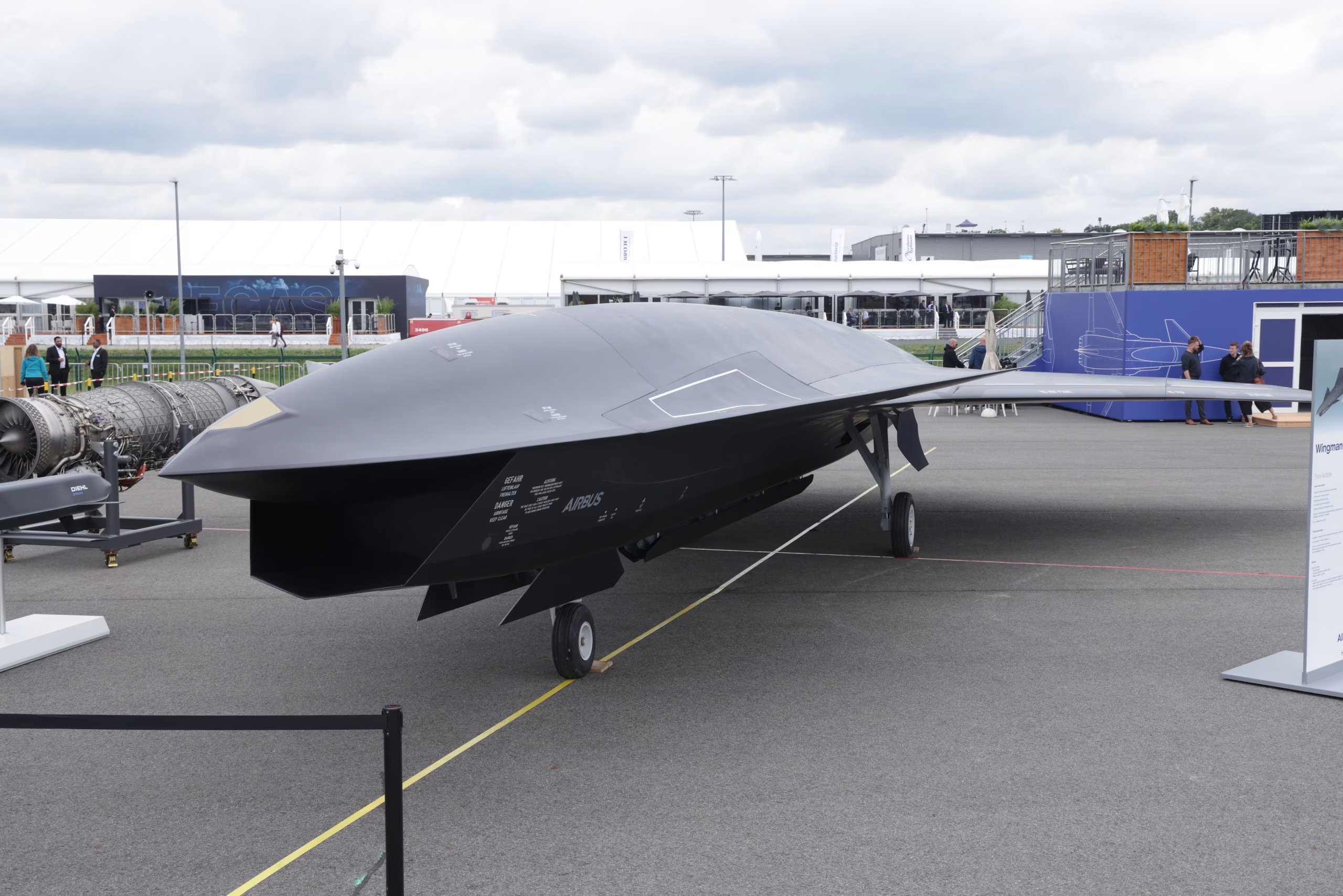
Wingman drones stole the spotlight at last week’s Berlin airshow, emerging as Europe’s latest-generation weapon in a rapidly shifting defence landscape. Designed to fly alongside fighter jets, these AI-powered aircraft represent a vision of air combat where machines and human pilots operate side by side, and they are quickly becoming a centerpiece of the continent’s rearmament push.
A Response to a Changing Battlefield
The surge of interest is no accident. The war in Ukraine has driven home just how decisive drones and electronic warfare have become, prompting both European and U.S. defence forces to accelerate development of their own intelligent systems.
These drones are built to complement fighter jets by carrying additional sensors, jammers, and weapons, extending the reach and capability of crewed aircraft. In Berlin, four major players, Airbus, Boeing, Helsing, and General Atomics, showcased their latest designs to Germany’s military and a wider international audience.
What Exactly Is a Wingman Drone?
Formally known as collaborative combat aircraft, or CCA, wingman drones come in a striking range of sizes. Some are compact interceptors, while others are as large as full-sized planes.
Their defining feature is how they operate. Flying in what’s called a “loyal wingman” arrangement, they flank manned aircraft, acting as partners rather than replacements. The idea is to multiply the effectiveness of human pilots while taking on some of the riskiest tasks.
The Push for Sovereign Defence
The investment in this technology arrives amid a broader European debate over self-reliance. As the continent weighs the value of building its own sovereign defence industry, the question of who controls these systems has become central.
That concern is especially acute when it comes to the artificial intelligence at the heart of the drones. As Stephanie Lingemann, head of air domain at German defence startup Helsing, put it, the AI agent functions as the brain of these systems and needs to be controlled in a sovereign fashion.
The politics of cooperation are shifting too. Germany and France recently shelved plans for a joint fighter jet, but rather than abandon the effort entirely, the two countries are now looking to salvage parts of the Future Combat Air System programme by developing a related drone system and data network.
The Companies and Their Designs
Each firm at the airshow brought a distinct approach to the technology:
- Helsing is developing an electronic attack drone designed to operate alongside strike drones in autonomous swarms, reflecting how disrupting sensors and communications can rival outright kinetic attacks in importance.
- Boeing is positioning its MQ-28 Ghost Bat as something more than a drone. Boeing Australia’s Managing Director Amy List described it instead as an unmanned jet built to enhance crewed platforms and serve as a force multiplier.
- Airbus is advancing its own model, the U760b Ravenstorm.
- General Atomics is testing its YFQ-42A, which the U.S. Air Force selected in 2024 for funding and support in prototype development.
Boeing, which is collaborating with German firm Rheinmetall, emphasized the maturity of its technology. List explained that the Ghost Bat can fly ahead of crewed platforms to provide situational awareness, analyze and fuse data, and deliver decision-quality information back to a human operator.
Still Waiting to Reach the Battlefield
For all the excitement, these aircraft have yet to see actual combat. The timelines vary considerably from one program to the next:
- Boeing says its model could enter service with the German Luftwaffe by 2029.
- Airbus indicates its Ravenstorm won’t be available until sometime in the 2030s.
- General Atomics’ YFQ-42A remains in testing.
In other words, the wingman drone is still a technology of the near future rather than the present, even as it dominates conversations at defence showcases.
What Comes Next
The momentum shows no sign of slowing. Lockheed Martin and U.S. defence technology startup Anduril are both expected to display similar systems at upcoming events, including Britain’s Farnborough airshow, which begins on July 20.
As Europe continues to rearm and reconsider its dependence on the United States, the wingman drone sits at the intersection of cutting-edge technology, industrial strategy, and geopolitics. Whether these aircraft live up to their billing will depend on how quickly the prototypes on display in Berlin can make the leap from showroom to skies.
This is an evolving story, and the coming years will reveal which of these designs ultimately reshape the future of air combat.
Author