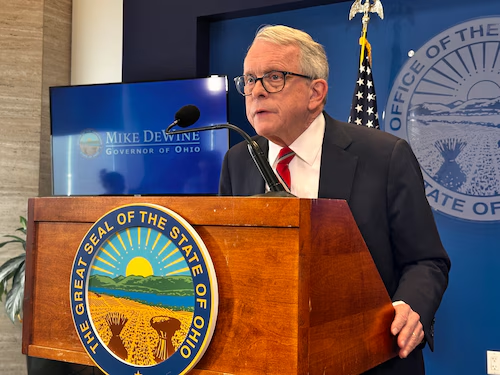
The Ohio death penalty debate took a striking turn this week when Republican Gov. Mike DeWine publicly called for the state to abolish capital punishment — a remarkable reversal for a man who helped write the very law that reinstated it more than four decades ago.
DeWine, 79, made the announcement Tuesday during a news conference in Columbus, confirming a change of heart that has been building for years. Having repeatedly delayed executions over the past seven years, the term-limited governor said the time had come to speak plainly about where the evidence has led him.
A Belief Built on Deterrence Collapses
For most of his career, DeWine viewed the death penalty through a specific moral lens: that it deterred violent crime. That conviction, he said, no longer holds up against the data.
“I do not believe that argument today can be successfully made, nor do I believe that there’s any chance in the future the facts that I’ve cited to support that belief will change,” he told reporters. “Therefore, I believe Ohio should abolish the death penalty.”
To make his case, DeWine came armed with charts and graphs. His presentation highlighted two trends:
- The steadily shrinking number of death sentences handed down by courts
- The extraordinarily long delays that stretch out as legal appeals wind through the system
He pointed out that condemned prisoners are increasingly unlikely to ever be executed at all. Many die of natural causes or by suicide before their scheduled execution dates arrive. As he summed it up, with each passing decade the odds of a convicted murderer actually being put to death grow more and more remote.
The Human Cost of Delay
Beyond the statistics, DeWine emphasized the toll the system takes on people. He spoke about the prolonged anguish endured by victims’ families forced to wait years for resolution, and about the strain placed on the mental health of state employees who serve on execution teams.
Drawing on five decades of experience — as a young county prosecutor, a congressman, a U.S. senator, and Ohio’s attorney general — DeWine said he felt obligated to share his conclusions now, before leaving office in December. Though his views had shifted gradually over the years, he said his outright opposition only solidified within the past year.
A Divided Response
DeWine’s announcement landed in a politically uncertain environment, and reaction split along familiar lines.
Even before he spoke, the prospect of a legislative repeal looked slim. Republican House Speaker Matt Huffman has signaled he would oppose any such effort. Interim Republican Attorney General Andy Wilson, meanwhile, expressed relief that DeWine chose not to use commutations to empty death row and said his office would keep working to uphold current law.
Supporters of abolition welcomed the governor’s stance:
- Kevin Werner, executive director of Ohioans to Stop Executions, framed the decision as part of a broader evolution on the issue across the political spectrum, arguing that no one benefits from a system that harms victims’ families, risks convicting the innocent, and wastes millions without improving public safety.
- Abraham Bonowitz of Death Penalty Action said his group had anticipated the move and praised it as well-reasoned.
Death penalty supporters pushed back. Kent Scheidegger, legal director of the Criminal Justice Legal Foundation, conceded DeWine may be correct that Ohio’s death penalty isn’t currently deterring crime, but argued the real solution is political will and effective leadership rather than abolition.
Why Ohio’s Executions Stalled
DeWine’s practical objections aren’t new. In repeatedly postponing scheduled executions, he has pointed to a persistent problem: pharmaceutical companies have refused to supply the drugs used in lethal injections.
That supply issue gained national attention in January 2025, when President Donald Trump directed then-Attorney General Pam Bondi to help states resolve it. DeWine has already said he expects no further executions during his remaining time in office, and he stressed that the data supporting his position holds true whether or not you count the past seven years of paused executions.
A Nation Still Wrestling With the Question
Ohio’s situation reflects a larger national shift. Both the use of and public support for capital punishment have been declining across the country for two decades.
A snapshot of where things stand nationally:
- 27 states currently allow the death penalty, while 23 do not, according to the Death Penalty Information Center.
- Ohio is one of four states where executions are paused through executive action.
- In 2023, for the first time, more Americans said they believed the death penalty is applied unfairly than fairly.
The landscape varies dramatically from state to state. Texas has executed 600 people since resuming the practice in 1982. Yet even there, reform efforts have gained ground — Republican state Rep. Jeff Leach led a group of lawmakers who last year halted what would have been the first U.S. execution tied to a shaken baby syndrome conviction.
History offers other examples of executive intervention. Former Illinois Gov. George Ryan, also a Republican, cleared his state’s death row through pardons and commutations in 2003, and numerous governors have since granted clemency to empty parts of their own death rows.
Still, the country remains deeply split. Since 2019, Colorado, New Hampshire, and Virginia have abolished capital punishment. At the same time, five states have approved nitrogen gas executions since 2024 to sidestep lethal injection problems, and Trump continues to push for expanded federal executions — his first administration carried out 13, more than any president in modern history.
DeWine’s Long Journey
DeWine’s evolution traces back to the very origins of Ohio’s current law. The state reinstated capital punishment in 1981 under legislation he co-wrote. Executions resumed in 1999, and 56 people have since died by lethal injection in Ohio.
His shift has unfolded gradually since his political career began in 1976. As attorney general, he ordered the prison system to explore alternative lethal injection drugs, and by 2020 he was telling lawmakers they would need to choose a different method before any more executions could proceed. Neither a bipartisan push to ban the practice nor a competing effort to introduce nitrogen gas has gained traction in the years since.
The practical consequences of all this delay are significant. Ohio currently has 30 executions scheduled over the next four years, according to the state’s Department of Rehabilitation and Correction — yet the state hasn’t actually put anyone to death since July 18, 2018, the year before DeWine took office.
What Comes Next
Whether DeWine’s call translates into action remains far from certain. With legislative leaders resistant and his term winding down, the governor’s words may carry more moral weight than immediate legal force. But coming from the architect of Ohio’s death penalty law, his reversal adds a notable voice to a national conversation that grows more contested with each passing year.
This is a sensitive subject that touches on crime, justice, and loss. For anyone personally affected by these issues, support and resources are available.
Author