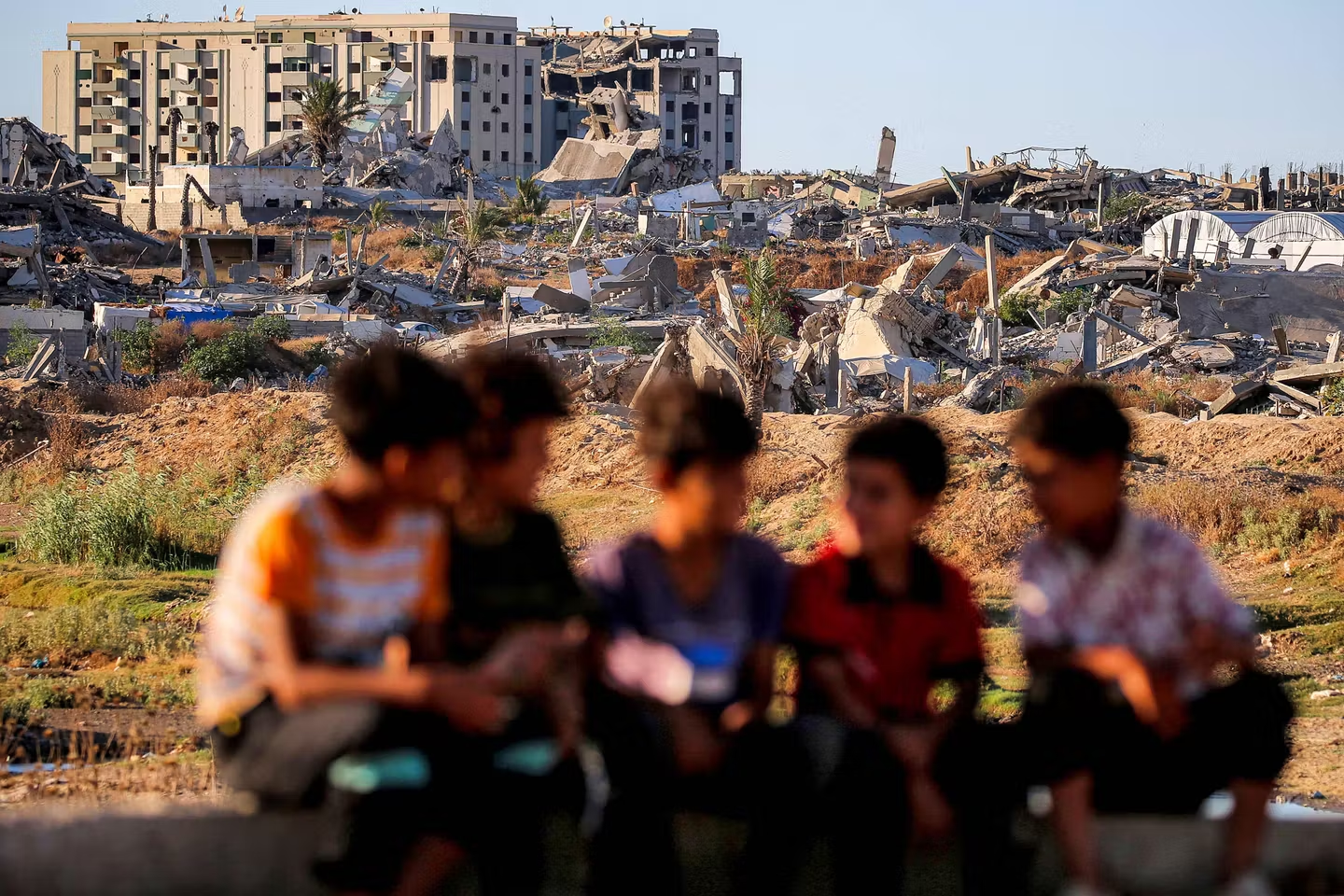
A U.N. report on Gaza children released Tuesday has leveled grave accusations against Israeli security forces, alleging abuse and deliberate killings of Palestinian children eight months after Israel and Hamas reached a truce in the Gaza Strip. The findings, which Israel has forcefully rejected, conclude that the killings amount to genocide.
This article addresses serious allegations of violence against children and contested claims from both sides of a deeply divisive conflict. Readers should be aware that the subject matter is distressing, and that the underlying facts remain disputed.
What the Report Found
The report was compiled by an independent commission of three senior international jurists tasked with investigating the violence. Their central conclusion is stark: that the killings formed part of a strategy to destroy the future of Palestinians in Gaza, which the commission said constitutes genocide.
The investigators also documented killings of Palestinian children by Israeli security forces in the occupied West Bank, characterizing those as war crimes.
The commission defined a child as anyone under 18, consistent with the Convention on the Rights of the Child. While the report did not directly address whether older minors might have been combatants, it assessed that the high number of boys killed reflected what it called a policy of targeting boys based on their perceived threat as terrorists and “future terrorists.” Notably, the report did not provide a death toll for children specifically since the ceasefire.
The Commission’s Central Argument
Commission chairman Srinivasan Muralidhar framed the findings in sweeping terms. He stated that even after the October 2025 ceasefire, children continued to be killed and seriously injured, reflecting what he described as Israel’s ongoing disregard for the truce and for the protections owed to Palestinian children under international law.
Muralidhar tied the issue directly to Palestinian self-determination, arguing that by targeting children, Israel was attacking the very capacity of the Palestinian people to exist and shape their own future.
Israel’s Forceful Rejection
Israel dismissed the report in unequivocal terms. Its U.N. mission in Geneva called the document a “libelous sham” and condemned the commission as a “fundamentally flawed mechanism” designed to single out and vilify Israel.
The Israeli foreign ministry went further, arguing on social media that the report:
- Completely erases Israeli children who were murdered, kidnapped, and targeted by Hamas
- Ignores what it described as Hamas’s cynical use of Palestinian children as human shields and pawns of war
The ministry also asserted that the commission lacked any credible verification mechanism for its claims.
Mounting International Alarm
The investigators’ findings reflect growing concern among U.N. and international humanitarian agencies that the October ceasefire has failed to deliver genuine peace.
The U.N. children’s agency, UNICEF, said last week that on average, one Palestinian child has been killed every day since the ceasefire began. UNICEF spokesman James Elder offered a grim description, saying children had been killed in their homes, schools, while playing football, and while fishing, shot, bombed, and hit by airstrikes. He called the truce a “cruel and deadly illusion.”
The Broader War’s Toll
The commission had previously reported in September 2025 that Israeli forces conducted “extensive and deliberate” targeting of children, a key factor in its earlier finding of genocidal intent in the two-year Gaza war set off by the Hamas-led attacks on Israel on October 7, 2023.
The Hamas-controlled Ministry of Health in Gaza has estimated that more than 21,000 Palestinian children were killed during the war. The report detailed especially harrowing figures among the youngest victims:
- At least 5,031 children under 5 were killed during this period
- 1,029 of them were under the age of 1
- Roughly 420 were newborns
The commission said its report drew on information from healthcare workers, lawyers, academics, journalists, and interviews with minors where possible. It added that it had sent 13 requests for information to Israel since October 7, 2023, but received no reply.
Specific Allegations and Israel’s Account
The report alleged that Israel targeted Palestinian children in Gaza in two main ways: through direct shooting and through the use of high-impact weapons in widespread attacks on residential buildings, schools, and displacement camps crowded with children. It also faulted Israel for failing to protect Palestinian children in the West Bank from Israeli security forces and Jewish settlers.
One account centered on the 2025 death of a 14-year-old Palestinian boy in the West Bank’s Al-Faraa refugee camp. According to the commission, he was shot by Israeli soldiers as he left his house to play, and video showed soldiers standing around him for 45 minutes as he bled to death, shooting at his mother to stop her from helping and preventing an ambulance from reaching him.
The Israeli military offered a sharply different account. It said a “terrorist” had been identified attempting to attack soldiers during an operation in the camp. According to the military, soldiers fired at and wounded him, then provided initial medical treatment. These competing accounts illustrate how contested the underlying facts remain.
Detention and Healthcare Concerns
The report further alleged that Israeli forces continued to detain Palestinian minors, particularly adolescent boys, holding them in prisons and detention centers where they were “routinely subject to torture and physical violence,” including some cases of sexual violence. It claimed authorities denied these minors access to lawyers and parents and withheld information about their whereabouts.
The commission also raised alarm about healthcare. It said Israel’s attacks on hospitals and the destruction of neonatal and maternity facilities systematically dismantled children’s access to essential care, leading to preventable deaths compounded by siege tactics that caused hunger and chronic malnutrition. According to the commission, Gaza’s birthrate has declined over two years, undermining the continuity of the Palestinian population.
Ongoing Humanitarian Strain
Although food supplies to Gaza have increased since the ceasefire, U.N. and humanitarian agencies say aid efforts remain hampered by Israeli restrictions on fuel, spare parts, and equipment. UNICEF’s Elder warned that restrictions on essential medicines mean wounded children endure greater pain and face heightened risks of infection, complications, and amputations.
The report identified 11 Israeli military units linked to the killing and injury of Palestinian minors.
A Deeply Contested Picture
The U.N. report on Gaza children adds to an intensely polarized debate, with the commission presenting detailed and damning allegations and Israel rejecting them as biased and unverified. The genocide determination, in particular, is a profoundly serious and contested legal conclusion that many governments, scholars, and observers dispute.
As the fragile ceasefire continues to fray, the report underscores how far the region remains from durable peace, and how sharply the two sides continue to disagree over the most basic facts on the ground. Given the gravity and sensitivity of these allegations, readers may wish to consult a range of sources and perspectives to form their own understanding of this ongoing tragedy.
Author