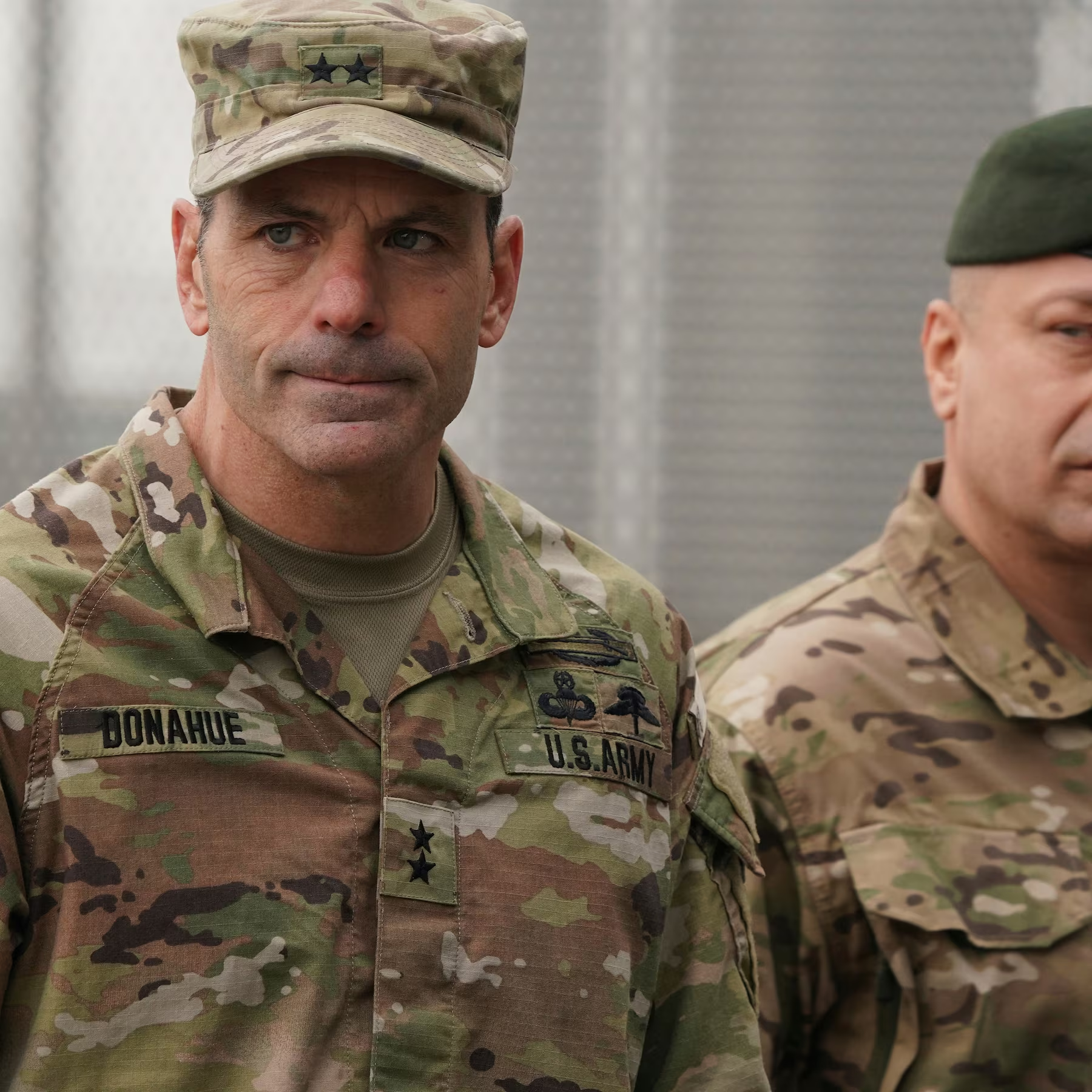
General Christopher Donahue, widely regarded as one of the Army’s finest warfighters, is on his way out, and the circumstances behind his departure point to a deliberate effort by Defense Secretary Pete Hegseth to end his career. According to people familiar with the matter, Hegseth blocked a behind-the-scenes campaign within the Army and on Capitol Hill to extend Donahue’s service, prompting the general to file his retirement paperwork.
A Brief Tenure Cut Short
Donahue, who leads U.S. Army Europe and Africa, will step down on July 2 after an unusually short 18-month stint in the role. Several of the people describing the situation spoke anonymously given the sensitivity of personnel matters.
The move has frustrated some Army officials, especially given Donahue’s reputation as a standout Special Operations commander and Hegseth’s own stated mission to make the military more lethal. One retired senior Army officer didn’t mince words, describing Donahue as “singularly our best warfighter at every level.”
Part of a Broader Purge
Donahue’s exit marks the latest apparent casualty in Hegseth’s sweeping removal of senior military leaders, many of whom the secretary has deemed insufficiently loyal to the Trump administration or labeled “woke” over past support for diversity initiatives.
The scale of the shakeup has been significant. Hegseth has fired or removed dozens of generals and admirals, frequently without offering any explanation. In April, the Army’s top officer, General Randy George, and two other generals were forced into retirement, and the administration has yet to nominate replacements.
When asked about Donahue’s departure, the responses were notably tight-lipped. Donahue declined to comment through a spokesman. Hegseth’s spokesman pointed questions to the Army. An Army spokeswoman confirmed Donahue would step down and thanked him for his leadership but offered no reason why. Major General Christopher Norrie, the deputy commander, will take over his duties.
Uncertainty and Downgraded Roles
Donahue submitted his retirement after months of uncertainty about his future, coinciding with plans by Hegseth’s team to downgrade his position, and many others across the services, to three-star commands. While the general reportedly left the door open to another assignment, none has been offered.
His supporters had floated several possibilities for him, including:
- Replacing George as the Army’s chief of staff or serving as its second-ranking officer
- Taking over Army Transformation and Training Command, whose commander was also fired by Hegseth in April
For years, Donahue had been viewed within the military as a transformative leader and a potential future chairman of the Joint Chiefs of Staff or Army chief of staff.
A Decorated Combat Record
Donahue’s résumé reads like that of an elite soldier. As commander of the legendary Delta Force, he played a central role in operations against the Islamic State in Iraq and Syria. He later served as a top Special Operations commander in Afghanistan and led both the 82nd Airborne Division and the 18th Airborne Corps before moving to his current post in Germany in December 2024.
The Afghanistan Shadow
Despite that record, Donahue became a political target following the chaotic and deadly U.S. evacuation from Afghanistan under the Biden administration. The criticism persists even though he was sent in as commander of the 82nd Airborne Division only days after the U.S.-backed government collapsed, when the Pentagon decided reinforcements were urgently needed as the Taliban advanced on Kabul.
His soldiers arrived at the Kabul airport with weapons drawn. Donahue later told military investigators that he delivered a blunt warning to Taliban leaders, telling them U.S. forces would control the gates and that any fight would cost the Taliban far more lives than the Americans. According to him, their tone shifted afterward.
The evacuation turned tragic when an Islamic State suicide bombing near its end on August 26, 2021, killed 13 U.S. troops and roughly 170 Afghans. Officials noted those troops were not under Donahue’s control at the time. Four days later, the U.S. military left, and the Pentagon released a now-famous photograph of Donahue boarding an aircraft as the last American service member to exit the war, an image that significantly raised his profile.
A Lightning Rod for Accountability
That same evacuation made Donahue a focus of those demanding accountability for how the war ended. His 2024 nomination to his current role was temporarily held up by then-Senator Markwayne Mullin, now the Trump administration’s secretary of homeland security, before being released following advocacy from Army leaders and lawmakers.
Among his critics was Anthony Tata, a retired Army general now serving as undersecretary of defense for personnel and readiness. Tata pointedly asked whether commanders are accountable, citing the deaths under Donahue’s command and suggesting intelligence existed that could have prevented the attack. He also dismissed the famous photograph as “staged” and questioned whether that represented success.
Donahue’s defenders push back firmly. They stress that he did not control the airport’s Abbey Gate, where the bombing occurred, and that he brought order and security to a weeks-long crisis. One supporter who served with him said simply that Donahue did everything he could, carrying out his duty even when he disagreed with the policies driving it.
Earlier Snubs and a Pointed Comment
This isn’t the first time Hegseth has passed over Donahue. Last year, the general was considered a potential nominee to head U.S. European Command, which oversees all American military operations in Europe, but Hegseth instead nominated then-Air Force Lieutenant General Alexus Grynkewich. People familiar with the matter say Hegseth raised the Afghanistan photograph in some private discussions about that decision.
There may be another wrinkle. Before the second Trump administration began, Donahue had openly rejected the Republican-driven narrative that the military had grown weak due to diversity efforts. Back in 2023, he insisted his focus was on people, warfighting, and preparing for the next fight, declaring there was “no ‘woke’ here.” Whether those remarks factored into Hegseth bypassing him remains unclear.
A Loss Felt Across the Ranks
Donahue’s departure leaves the Army without one of its most celebrated combat leaders at a moment when the administration says it wants a more lethal force. The apparent contradiction, sidelining a soldier praised as the service’s best warfighter while preaching warrior values, has left many within the Army puzzled and frustrated. As the purge of senior leaders continues, Donahue’s exit stands as a striking example of how loyalty and politics, rather than battlefield credentials, increasingly appear to shape who rises and who falls in today’s Pentagon.
Author