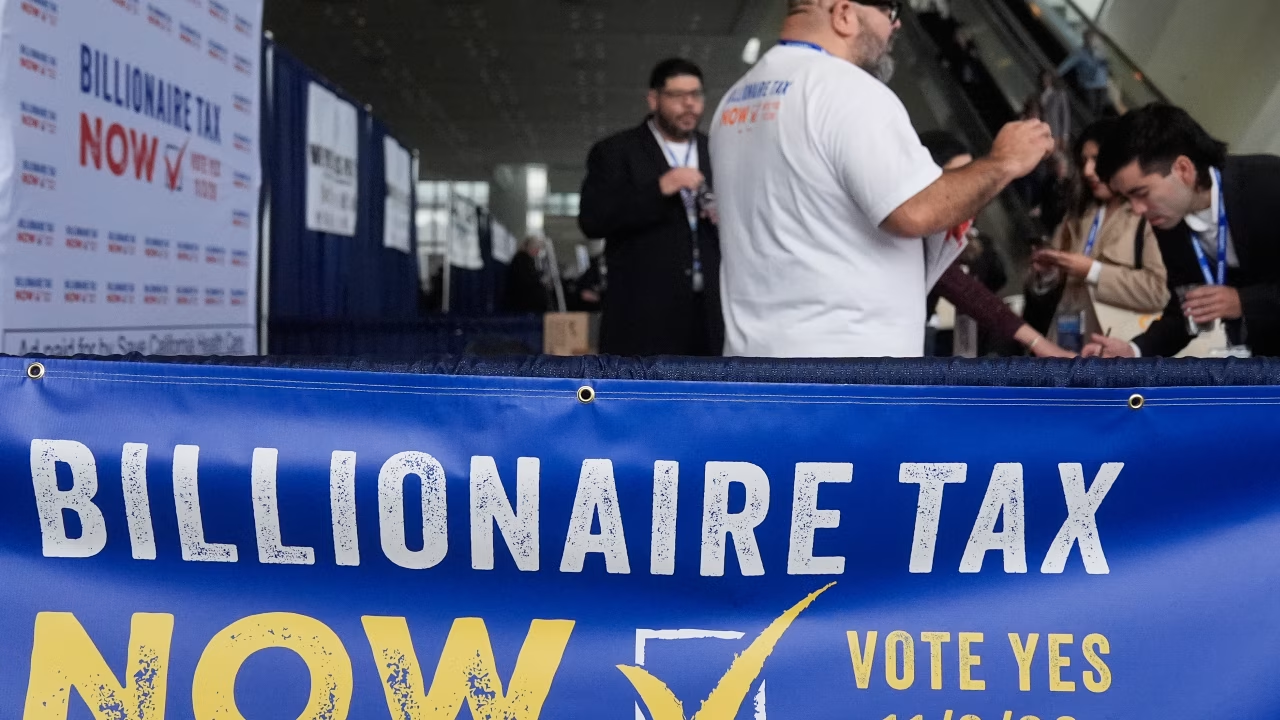
California billionaire tax proposals rarely make it this far, but one is now officially headed to voters this November, setting up a high-stakes battle over how the state should respond to deep federal healthcare cuts. The measure, a one-time 5% levy on the assets of the state’s wealthiest residents, has already split the political left, alarmed Silicon Valley, and triggered a wave of countermeasures designed to kill it.
What the Measure Actually Proposes
At its core, the initiative would impose a single 5% tax on the assets of California’s richest individuals. It would apply retroactively to billionaires who called the state home as of January 1, affecting more than 200 people.
Supporters frame it as an emergency stop-gap rather than a permanent fixture. The goal is to soften the blow of sweeping federal healthcare cuts passed by the Republican-led Congress and signed by President Trump nearly a year ago. Those cuts are projected to drain roughly $100 billion in funding, hitting California’s most vulnerable residents hardest.
To get the measure on the ballot, a labor union poured $31 million into a signature-gathering campaign, ultimately submitting nearly 1.6 million signatures in April, about double the required threshold.
A Fight Framed as the People Versus the Powerful
The coalition behind the tax has leaned into a populist message. Backed by the Service Employees International Union-United Healthcare Workers West, supporters cast the opposition as wealthy elites and entrenched Sacramento insiders looking out for their own interests.
A campaign spokesperson argued that a small group of billionaires and their political allies would rather see hospitals close than give up tax advantages, insisting that ordinary voters feel very differently. Organizers point to backing from public opinion polls, lawmakers, unions, and grassroots volunteers as proof their movement reflects the public will rather than deep pockets.
Why So Many Leaders Are Saying No
Despite that energy, the proposal has drawn a remarkably broad coalition of opponents, and not just from the usual conservative quarters. Leaders across healthcare, education, public safety, housing, business, and labor have united against it.
Their central worry is California’s budget. The state’s finances are unusually dependent on its wealthiest residents, which makes revenue swing wildly from year to year. Critics argue that a wealth tax would only deepen that instability, putting funding for schools, clinics, public safety, and infrastructure at greater risk.
Prominent voices from the California Medical Association, the California Primary Care Association, and the California School Boards Association warned that the measure would inject even more volatility into an already shaky system. They have pledged to make sure voters understand the stakes before casting their ballots.
A Rare Split Among Democrats
What makes this fight unusual is how sharply it has divided the left. On one side, figures like Senator Bernie Sanders and Representative Ro Khanna have thrown their support behind the tax. On the other, Governor Gavin Newsom emerged as one of its most influential opponents.
Newsom and like-minded Democrats raise several objections:
- The measure could push billionaires to leave the state, shrinking the very tax base California relies on.
- A patchwork of state-level wealth taxes would be ineffective; such policies, they argue, belong at the national level.
- The proposal is poorly crafted and risks unintended consequences.
There’s also a strategic concern. Some Democratic leaders believe the party’s energy and resources in the 2026 midterms should be focused on flipping the House and checking Trump’s agenda, rather than on a state measure they view as a short-term fix that fails to address the deeper problem.
The Billionaire Flight Problem
The fear that the wealthy will simply pack up and leave is more than hypothetical. Some of the roughly 200 affected individuals have already moved themselves or their companies out of California in response to the proposal.
Among them is Google co-founder Sergey Brin, who has reportedly relocated and donated at least $82 million to an organization working to invalidate the tax. For a state whose budget hinges on a small number of ultra-rich taxpayers, that kind of exodus carries real consequences.
Business leaders have also warned that the measure’s reach could extend well beyond billionaires. One opponent argued that the proposal would force every California taxpayer to file a sworn declaration of their net worth, and that it could eventually empower lawmakers to extend the tax to ordinary property like home equity and retirement savings without returning to voters.
A Failed Compromise and the Final Deadline
In the days before the deadline, the union behind the measure tried to find middle ground, floating a scaled-back legislative alternative that would have imposed a 2% tax on billionaire assets instead of 5%. The Newsom administration rejected it outright.
With no agreement reached by the Thursday evening cutoff for withdrawing the measure, the original proposal stayed on the ballot, locking in a November showdown.
The Poison Pills Lurking on the Same Ballot
Perhaps the biggest threat to the tax isn’t public opinion, it’s two competing measures designed specifically to neutralize it. Dubbed “poison pills,” both have qualified for the same November ballot.
One would block new state taxes on personal property. The other would prohibit any new tax from being exempted from existing spending rules and would require regular audits. Here’s the catch: even if voters approve the billionaire tax, it could still be voided if either rival measure receives more votes.
That structure means supporters don’t just need to win, they need to outpoll the very initiatives built to cancel their victory.
What Else Voters Will Decide in November
The billionaire tax is just one of several notable items on the crowded November 3 ballot. Californians will also weigh in on:
- A requirement for government-issued voter identification to cast a ballot.
- Reforms to the California Environmental Quality Act, a law facing fresh scrutiny amid rebuilding efforts after the Palisades and Eaton wildfires.
- An $11.3-billion affordable housing bond.
Meanwhile, two other proposals were removed from the ballot after negotiations between the California Hospital Association and labor unions: one that aimed to cap healthcare executive compensation, and another that would have required many healthcare clinics to spend 90% of their revenue serving low-income and underserved communities.
The Bottom Line
The California billionaire tax sets up one of the most closely watched contests of the November election. It pits a union-driven push to protect healthcare funding against a powerful alliance of business interests, education and healthcare groups, and even the state’s own Democratic governor. With poison pills waiting in the wings and billionaires already heading for the exits, voters face a decision that could reshape both the state’s budget and its political future.
Author