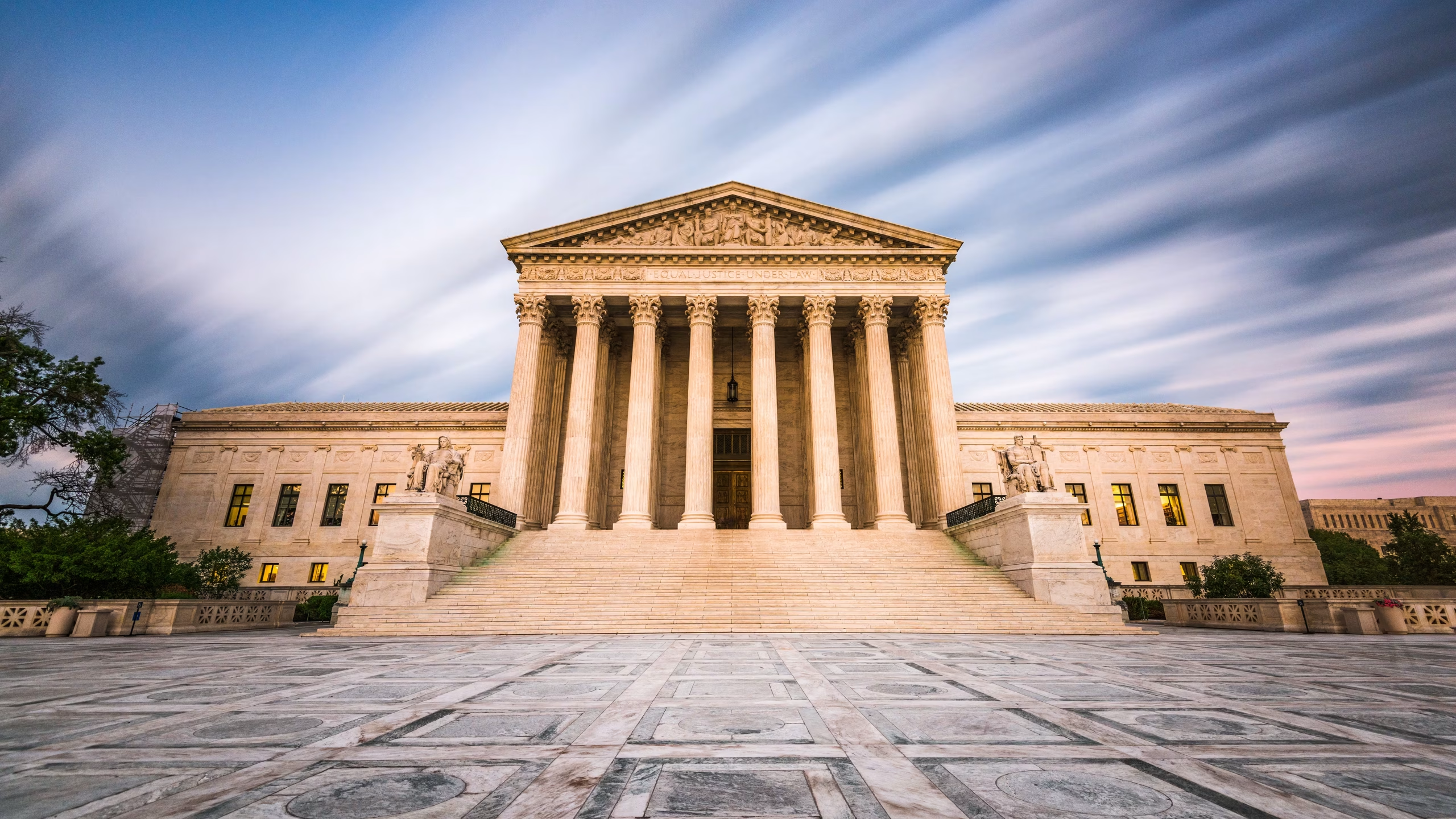
Mail-in ballots that land in election offices after polls close can still be counted, the Supreme Court decided on Monday, settling a question that had hung over voting systems nationwide as the midterm elections approach. The justices upheld a Mississippi law permitting officials to count absentee votes postmarked by Election Day even when they arrive afterward, a move that leaves existing rules untouched in more than a dozen states.
A Closely Divided Court
The ruling landed at 5-4, but not along the usual ideological lines. Justice Amy Coney Barrett wrote for the majority, joined by Chief Justice John G. Roberts Jr. and the three liberal justices. Their reasoning was straightforward: nothing in federal election law spells out a deadline for when ballots have to physically arrive.
Barrett argued that the statutes setting a single national Election Day simply do not speak to ballot receipt, and the Court could not invent language Congress never wrote. In her words, judges cannot stretch the text beyond what lawmakers actually chose to say.
The decision rejected a challenge brought by Republicans and Libertarians, who insisted that federal law overrides Mississippi’s statute. That state allows ballots to be tallied if they trickle in up to five days after polls close.
The Dissent’s Warning
Four conservative justices pushed back hard. Justice Samuel A. Alito Jr. authored the dissent, joined by Justices Clarence Thomas, Neil M. Gorsuch, and Brett M. Kavanaugh. He framed the outcome as a break with the law’s plain meaning, its history, and prior rulings.
Alito went further, warning that the majority had opened the door to a tangle of unresolved election-law disputes and risked chipping away at public trust in how votes are counted. He suggested the consequences could prove regrettable down the line.
Why This Matters Beyond Mississippi
The practical reach of the ruling extends well past one state. Fourteen states currently accept mail-in ballots that show up days or even weeks after polls close, and others extend that flexibility specifically to service members stationed away from home. Had the Court ruled the other way, every one of those systems could have been thrown into doubt right before voters head to the polls.
Most states still require ballots to arrive by Election Day itself. But for those with grace periods, this decision removes a looming legal threat. It also makes copycat lawsuits in similar states less likely to succeed.
Mail-in voting has surged in popularity since the pandemic reshaped how Americans cast their ballots. Roughly a third of voters used the method in 2024, though it tends to be more common in states that lean Democratic.
Political Reactions Pour In
President Donald Trump, who has repeatedly and without evidence claimed that mail-in voting fuels widespread fraud, called the outcome a major defeat. He blamed mail-in votes in part for his 2020 loss and once urged states to halt counting them mid-election. Following Monday’s decision, he pressed Congress to advance the Save America Act, which would demand proof of citizenship to register and a photo ID to vote.
Election officials in states with grace periods welcomed the news. Nevada Secretary of State Francisco Aguilar, a Democrat, noted that a reversal would have forced costly campaigns to re-educate voters about changed rules. He framed everyday voters as the true beneficiaries, emphasizing consistency, access, and fairness at the ballot box.
Voting rights groups echoed that relief. NAACP President Derrick Johnson described the ruling as a rare bright spot from this Court and a genuine win for democracy. Virginia Kase Solomón of Common Cause argued that no one should be silenced because of postal delays they cannot control.
Republican leaders saw it differently. RNC Chairman Joe Gruters vowed to push federal legislation requiring every state to receive ballots by Election Day, accusing Democrats of dragging elections out for days or weeks and inviting disorder.
How the Case Reached the Court
The legal fight began in 2024 when the Republican National Committee, the Mississippi Republican Party, a voter, and a county election commissioner sued the state. Their argument: counting late-arriving ballots violates federal law because elections are fixed for a single day. The Libertarian Party soon filed a parallel claim.
A federal judge merged the cases and let groups of veterans and retirees join in defense of Mississippi, then dismissed the lawsuit. The 5th Circuit Court of Appeals overturned that dismissal, prompting Mississippi to take the matter to the Supreme Court.
During March arguments, attorney Paul D. Clement told the justices that casting and counting votes have long been linked to the same moment, and warned that counting ballots afterward could breed suspicion, especially if the early leader ultimately lost. He cautioned that losing candidates would inevitably distrust delayed results.
Mississippi Solicitor General Scott G. Stewart countered that the law only asks voters to complete their ballots by Election Day. He pointed to a long American tradition of remote voting, including soldiers casting votes in the field during the Civil War, noting that states have permitted the practice for over a century with Congress’s tacit blessing.
A Busy Term for Election Law
This case is one of several voting disputes the justices have tackled this term. In January, the Court let an Illinois Republican congressman challenge that state’s mail-in rules, ruling that candidates have an inherent right to contest election procedures. That case raises the same after-deadline argument and now returns to the lower courts.
The justices also sharply narrowed a core provision of the Voting Rights Act, a move that has allowed several Republican-controlled Southern states to redraw districts long held by Black Democrats ahead of the midterms. A separate pending case could loosen limits on coordinated spending between parties and candidates, potentially handing Republicans a financial edge in November.
Meanwhile, the broader trend among Republican-led states runs the other direction. Kansas, North Dakota, Ohio, and Utah all scrapped their ballot grace periods last year, signaling that the political battle over when votes count is far from settled.
Author