The Roman shipwreck Sicily divers stumbled onto last week had been sitting undisturbed on the seabed since roughly the first or second century B.C. It took a boat sonar reading, a hunch, and one free diver’s decision to go look.
Italian Culture Minister Alessandro Giuli described it as one of the most significant underwater archaeological discoveries of recent years.
The Moment of Discovery
Giacomo De Mola was out on the water off Mazara del Vallo with his friend Igor Bisulli when their sonar picked up what appeared to be a rock formation.
Visibility was poor. What De Mola saw as he descended was a large dark mass, and his first thought was that it was exactly what the sonar suggested: another big rock.
Then he got closer.
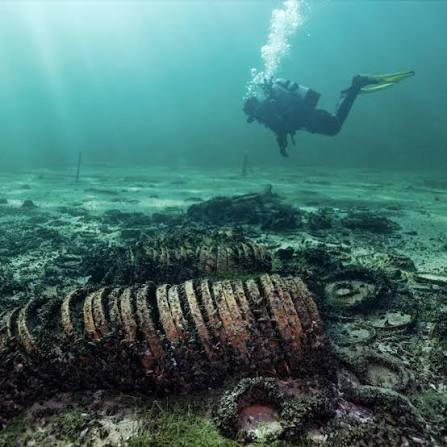
Describing the moment in a video posted to Instagram, he said his heart stopped. Below him stretched an immense field of amphorae, hundreds of clay vessels resting on the seabed for more than two thousand years. A Roman ship, as he put it, sleeping in the silence of the Mediterranean.
When he surfaced, he told Bisulli that he could not imagine what was down there.
The two men reported the find immediately to the Sicilian Region’s Superintendency of the Sea.
De Mola later said it is difficult to convey what it felt like to be among the first people in nearly twenty centuries to lay eyes on that place.
What the Wreck Contains
Divers from the Palermo police cultural heritage protection unit subsequently examined the site, located at a depth of about 150 feet.
The vessel measures roughly 70 feet in length and 20 feet across.
Its cargo consisted largely of Dressel 1A amphorae, the long cylindrical jars with pointed bases that Romans used primarily to transport wine. Investigators also recovered two lead anchor stocks and a further structure believed to be lead as well.
The cultural ministry said work will continue with additional documentation and study, aimed at reconstructing the archaeological context of the wreck and ensuring its preservation.
Why Amphorae Tell Archaeologists So Much
To a non-specialist, hundreds of clay jars might seem like a lot of pottery. To archaeologists, they are closer to a shipping manifest.
Amphora shapes changed over time and varied by production region, which means a type like Dressel 1A can date a wreck within a relatively narrow window and often indicate where the cargo originated. Stamps and markings on handles or necks can identify workshops and sometimes merchants.
A hold full of wine amphorae also says something about the trade route the ship was working. Roman wine moved in enormous volume across the Mediterranean, and vessels carrying it connected producing regions to distant markets in a commercial network that operated at a scale people often underestimate.
Why the Depth Matters
The wreck’s position at 150 feet is part of why it survived in this condition.
Shallow wrecks get broken apart by wave action, scattered by storms and picked over by divers across centuries. Deeper sites sit below most of that disturbance. Cold, dark, low-oxygen conditions slow decay considerably, and organic material that would vanish in shallow water can occasionally persist.
That depth also puts the site beyond casual recreational diving, which offers a measure of protection while formal preservation work is arranged.
Life Has Moved In
One detail from De Mola’s account is worth sitting with.
He described a genuine underwater museum thriving among the amphorae, with forkbeards, moray eels, dusky groupers and abundant marine life making homes in and around the cargo.
That is common with wrecks. Structures on an otherwise flat seabed become artificial reefs, offering shelter and attracting the food chain that follows. A Roman merchant vessel that sank carrying wine has spent two millennia functioning as habitat.
More Than a Shipwreck
De Mola summed it up simply. The sea never stops surprising, he said, and this time what they found was not just a shipwreck but a piece of history.
Research will now proceed on documenting the site properly. For a wreck that has waited two thousand years, the timeline is unlikely to feel urgent.
Author
-
Lucienne Albrecht is Luxe Chronicle’s wealth and lifestyle editor, celebrated for her elegant perspective on finance, legacy, and global luxury culture. With a flair for blending sophistication with insight, she brings a distinctly feminine voice to the world of high society and wealth.