Beneath the Playgrounds: Why Neutral Switzerland Keeps Building Nuclear Shelters
Swiss nuclear bunkers are so thoroughly woven into daily life that you can walk past one without noticing. In Lucerne, the entrance to the Sonnenberg shelter sits in the middle of a children’s playground.
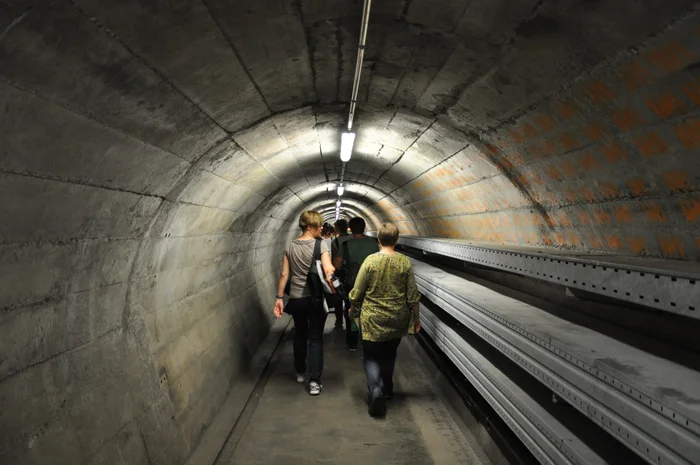
Behind the seesaws and swing sets, cut into a hillside, is a blast-proof door. Open it and a narrow, well-lit tunnel descends gently into the hill, running further than the eye can follow.
A Shelter Built for a Third of a City
Sonnenberg was constructed in the 1970s, at the height of the Cold War, with a startling design capacity: 20,000 people.
Guide Zora Schelbert puts that figure in context. At the time, 20,000 people represented a third of Lucerne’s population. Every third resident of the city was assigned a place inside this single structure.
The reasoning behind it was distinctly Swiss.
Officials assumed that in a nuclear exchange between the United States and the Soviet Union, historically neutral Switzerland would probably not be struck directly. But it sat squarely in the path of fallout from neighbours who were not neutral at all.
The planning reflected that logic. Diesel generators were installed with enough fuel to run the facility for two weeks.
After that, as Schelbert notes, there would be no more food, no more water, no more power.
Modern civil defence thinking has adjusted the framing. Duration of stay now depends on what is actually happening outside. Looking at Ukraine or Israel, she says, that makes sense. In a conventional war, people shelter temporarily and then emerge.
Doubling Down After the Cold War
Most countries quietly abandoned their shelter programmes once the Cold War ended. Switzerland did the opposite.
It kept building, and it made a remarkable guarantee: a shelter space for every one of its 9 million citizens.
The country now has more than 370,000 nuclear bomb shelters.
That commitment did face a serious challenge. Daniel Jordi, vice director of Switzerland’s federal office of civil protection, recalls political debate around 2010 and 2011, when parliament considered ending the system entirely.
Then Fukushima happened.
As lawmakers debated in 2011, the Fukushima Daiichi nuclear plant in Japan melted down following a massive earthquake and tsunami. Parliament reversed course, concluding that maintaining the shelters as a national reserve was worthwhile for a genuine emergency.
The Law Behind the Bunkers
The obligation is written into building requirements.
Every residential building in Switzerland must either include a bunker with proper blast doors and ventilation, or the developer must set aside funds for a nearby state-maintained shelter.
Citizens contribute directly, paying an upfront fee ranging from roughly 1,700 to 3,500 dollars toward construction and maintenance.
In peacetime, which for Switzerland is essentially permanent, these spaces get repurposed. They become wine cellars, saunas, or plain storage. At the University of Bern, one serves the latter function.
The Island in a Sea of Chaos
History professor Silvia Berger Ziauddin, an expert on the country’s shelter network, opens a foot-thick reinforced concrete door beneath her department building and explains the deeper idea at work.
The bunkers rest on a national self-image more than a century old: Switzerland as an island of calm surrounded by turmoil.
That metaphor emerged during the First World War, resurfaced during the Second, and was transferred during the Cold War onto the nuclear shelter itself.
Teaching It to Children
The idea is actively cultivated, particularly in schools.
Berger Ziauddin describes a civil defence curriculum in which many students spend a week each year on the subject. They draw shelters, watch civil defence films, visit a bunker, and eventually spend a night sleeping in one.
At the end of the week, children present their drawings.
The pattern in those drawings is revealing. Above ground, students depict destruction, death and chaos. Below, they draw warmth and security: the shelter, the family, the pet, a mother working, a father reading.
That imagery, she says, stays with them.
She is also clear that the reality would look nothing like it.
The Problems Nobody Drew
Back at Sonnenberg, Schelbert walks past a hospital painted in bright green, a stylistic relic of the 1970s, to the fourth level. There sits a security station with three prison cells, painted vivid yellow.
Sixteen detention spaces for 20,000 people.
Over the past two decades, she says, serious doubts emerged about whether that was remotely adequate given the circumstances that would drive people underground in the first place. The sheer scale of the facility, and the social and psychological pressures that come with confining such a mass of people, contributed to the decision to shrink it.
In 2002, the Swiss government cut Sonnenberg’s official capacity from 20,000 to 2,000.
What the Bunkers Are Used for Now
The space did not go empty. Its floors of bunk beds, along with the prison and hospital, have been repurposed over the years as overflow accommodation for refugees, asylum seekers and homeless people.
That use has drawn criticism from organisations working with those populations, and some asylum seekers have protested against being housed there.
Sonnenberg has never served its original purpose. No one has sheltered there from nuclear fallout.
Still Paying, Still Waiting
The Swiss government continues spending tens of millions of dollars annually maintaining Sonnenberg and hundreds of thousands of other shelters nationwide.
It is an enormous ongoing investment in something that has never been needed and, ideally, never will be.
Whether that represents prudence or expensive habit depends largely on how you read the world above ground. Switzerland has decided that being wrong about safety is far more forgivable than being wrong about danger.
Author
-
Lucienne Albrecht is Luxe Chronicle’s wealth and lifestyle editor, celebrated for her elegant perspective on finance, legacy, and global luxury culture. With a flair for blending sophistication with insight, she brings a distinctly feminine voice to the world of high society and wealth.