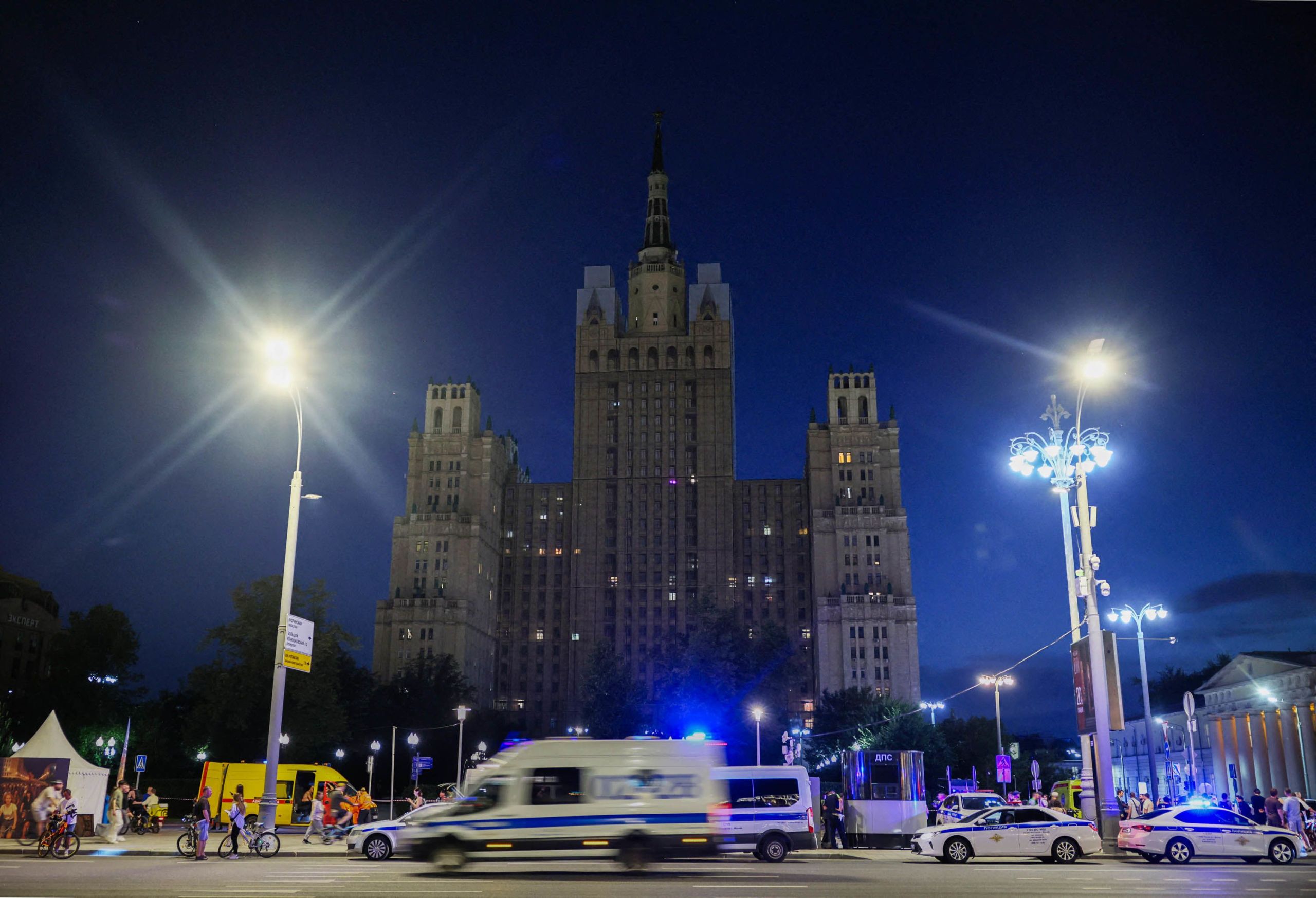
The Moscow restaurant bombing that killed five people on Saturday evening has been attributed by Russia’s foreign ministry to Ukraine, as speculation intensifies that the intended target was one of the country’s most senior military commanders rather than the civilians who died.
What Happened on Kudrinskaya Square
The explosion took place near the entrance to an upmarket Italian restaurant housed in one of Moscow’s seven Stalin-era skyscrapers, the imposing buildings that dominate the city’s skyline and carry considerable symbolic weight.
According to Russian prosecutors, an unidentified woman carrying an improvised explosive device attempted to enter the premises but was stopped by a security guard at the door. Moments after being turned away, the device detonated.
Five people were killed. A further 19 were injured.
The detail about the security guard is significant. Had she been permitted inside, the casualty figures would almost certainly have been far higher. Whoever planned the operation appears to have counted on entry being possible.
Moscow Points at Kyiv
Russia’s foreign ministry issued its accusation on Sunday in characteristically stark language, describing the attack as the work of what it called the bloody tentacles of Volodymyr Zelenskyy’s terrorist gang reaching the Balzi Rossi restaurant.
Notably, Russian authorities have not publicly identified an intended target and have not released the names of those killed.
Kyiv has offered no comment on the incident. This is consistent with its established approach to operations of this type inside Russian territory, where Ukrainian agencies have historically neither confirmed nor denied involvement.
The Birthday Party Theory
The gap left by official silence has been filled by pro-Kremlin military bloggers and several independent Russian outlets, all reporting a common account.
According to those reports, the attack was aimed at Colonel General Alexander Chaiko, commander of Russia’s aerospace forces, who was said to be attending a private banquet at the restaurant marking his 55th birthday.
Images and video circulating online shortly after the blast, said to originate from the private event, showed a stage with the words “Aleksandr 55” displayed behind it.
Chaiko occupies a prominent position within the Russian military. He led the failed assault on Kyiv during the opening phase of the invasion in early 2022 and was subsequently promoted to command the air force, a trajectory that has drawn attention given the outcome of that initial operation.
Who Was Hurt
The Telegram channel VChK-OGPU, which has a track record of publishing material leaked from inside Russia’s security apparatus, reported that Chaiko himself was unharmed.
The same source stated that his daughter, Maria, sustained serious injuries, and that her husband, Daniil Peredriy, was killed. Both were reportedly on the restaurant’s outdoor terrace when the device detonated.
If accurate, this account describes an operation that failed in its objective while killing members of the target’s family instead. It is an outcome with grim precedent in this conflict.
Another of those reported killed was a member of the Federal Protective Service, the elite agency responsible for guarding senior Russian officials. The presence of FSO personnel would be consistent with a high-ranking figure attending the venue.
The Woman Who Carried the Bomb
One of the more disturbing elements of the case comes from Kommersant, which reported that investigators believe the woman carrying the device may have had no idea what she was transporting.
Under that theory, the bomb was triggered remotely by someone else, killing her along with the others.
This method has been documented in previous operations. A courier is recruited to deliver a package under a false pretext, often for payment, and is detonated alongside the target. It removes the need for a willing attacker and eliminates a witness in the same moment.
If confirmed, the woman would be counted among the victims rather than the perpetrators.
A Pattern of Deep-Territory Operations
Since the start of the full-scale invasion, Ukrainian intelligence services have pursued dozens of senior Russian military officers and Russia-installed officials, justifying the campaign on grounds of alleged involvement in war crimes.
Their methods have varied considerably. Some operations have relied on willing saboteurs recruited inside Russia. Others have used unwitting civilians in the manner described in the Kommersant report.
The results have been substantial by any measure. At least four Russian generals have been killed, along with several other senior military figures and prominent pro-war activists, in attacks carried out deep within Russian territory.
But the record also includes failures. In 2022, a car bomb killed Darya Dugina, daughter of the ultranationalist ideologue Aleksandr Dugin, in an attack widely assessed to have been intended for her father. The parallel with Saturday’s bombing, if the reports about Chaiko’s family prove accurate, is uncomfortably close.
Why This Matters Beyond the Casualties
Operations of this kind serve purposes beyond the immediate elimination of a target. They demonstrate reach, forcing senior figures to alter their routines, restrict their movements, and treat private gatherings as security risks.
That psychological effect persists whether or not the target is killed. A general who cannot celebrate a birthday without lethal risk is a general operating under permanent constraint.
For Moscow, an attack in a landmark building in the centre of the capital raises awkward questions about security failures at the heart of the city.
What Remains Unclear
Much of the account circulating rests on Telegram channels and unnamed sources rather than official confirmation. Russian authorities have not verified that Chaiko was present, have not named the dead, and have not described the intended target.
Until they do, the fullest available picture comes from leaks and independent reporting, both of which carry their own limitations in an environment where information is tightly managed and heavily contested.
Author
-
Lucienne Albrecht is Luxe Chronicle’s wealth and lifestyle editor, celebrated for her elegant perspective on finance, legacy, and global luxury culture. With a flair for blending sophistication with insight, she brings a distinctly feminine voice to the world of high society and wealth.