Britain Strait of Hormuz Mission 2026: UK Deploys Autonomous Mine-Hunting Tech to Reopen Vital Waterway
The Britain Strait of Hormuz Mission has emerged as one of the most ambitious naval operations in recent decades. As the ongoing war with Iran continues to disrupt global oil shipments, the United Kingdom is preparing for a delicate but critical operation — to clear naval mines from one of the world’s most strategically important waterways. From its tactical hub in Gibraltar, the British military is gearing up to deploy cutting-edge autonomous mine-hunting equipment the moment a peace agreement is reached.
This move not only places Britain at the center of global maritime security but also signals an effort to ease growing diplomatic tensions with the United States.
Britain Steps Up Amid Global Pressure
The war between the United States and Iran was not started by Britain, but its consequences have spread far beyond the battlefield. The Strait of Hormuz, which previously carried about a fifth of the world’s daily oil supply, has effectively been shut down for international shipping. With around 850 large vessels and roughly 20,000 seafarers stranded in the region, the global energy crunch has hit consumers across the United States, Europe, and Asia.
To address the crisis, Britain has begun assembling an extensive operation designed to reopen the strait once a ceasefire takes effect. The mission is being led from Gibraltar, the UK’s strategic outpost at the southern tip of Spain, where British forces have been preparing for weeks.
Tensions With Washington Remain High
President Donald Trump has openly criticized Britain for what he perceives as a lack of support during the war. His frustrations have triggered diplomatic tension between the long-standing allies, prompting Britain to publicly highlight its contributions to the conflict.
Despite the criticism, British officials have argued that their nation has been deeply involved from the very beginning. The UK has:
- Allowed American bombers to launch strikes from southern England
- Deployed fighter jets across the Middle East for defensive missions
- Coordinated efforts with NATO allies on intelligence-sharing
- Sent destroyers and naval forces to support regional stability
- Shot down more than a hundred Iranian drones during operations
Armed Forces Minister Al Carns, a former Royal Marine officer with significant combat experience, brushed off the criticism. He emphasized that Britain has had more jets in the Middle East than at any point in the past 15 years and is now leading a global coalition aimed at solving an extraordinarily complex international crisis.
The R.F.A. Lyme Bay: Britain’s New Mine-Hunting Hub
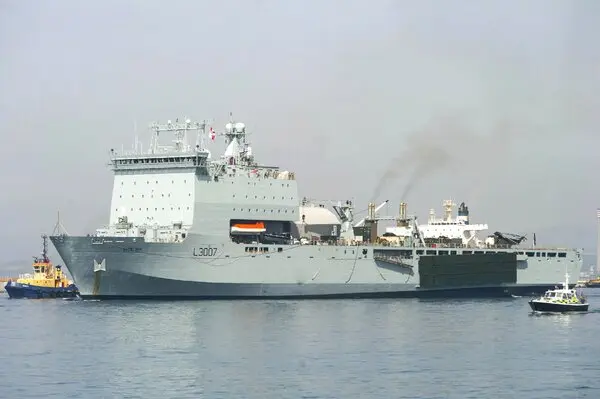
At the heart of Britain’s new mission is the R.F.A. Lyme Bay, an amphibious landing vessel currently being outfitted with the latest autonomous maritime systems. The ship will serve as the “mother vessel” for unmanned weapons and underwater drones that will be deployed to detect and neutralize mines in the strait.
For the past several weeks, British military engineers have worked rapidly to install autonomous mine-hunting technology on the ship. The Lyme Bay will join other Royal Navy ships already operating in the region, including the H.M.S. Dragon — one of Britain’s six destroyers — which has been actively patrolling Middle Eastern waters.
The Lyme Bay will depart for the region as soon as clearance is given. Once there, it will play a central role in opening up safe shipping lanes for stranded commercial vessels.
Inside Britain’s Autonomous Mine-Hunting Technology
The British Royal Navy has invested heavily in modern unmanned systems, and the upcoming mission will allow the UK to deploy some of its most advanced equipment in real-world conditions. On board the Lyme Bay, two specialized squads of mine-clearing experts have begun demonstrating new sea drones designed to clear hostile waters with maximum efficiency.
Key features of Britain’s autonomous mine-clearing systems include:
- Small autonomous underwater drones operable from compact boats
- Larger submersible drones capable of diving 300 meters with high-fidelity sonar
- Surface vehicles for deploying and retrieving the drones
- Battery-powered systems requiring minimal human intervention
- Real-time data systems for mapping mines on the seabed
The biggest advantage of these systems is that they significantly reduce the need to place human divers and traditional mine-clearing teams directly in dangerous zones. By using autonomous drones, mine-clearing operations that once took weeks can now be completed in days.
Iran’s Mine Arsenal Poses a Serious Threat
The Strait of Hormuz is believed to be heavily mined by Iran, making the upcoming clearance operation extraordinarily dangerous. Iran has deployed a wide variety of advanced naval mines, some of which can lie undetected on the seabed before launching devastating attacks on passing ships.
These mines reportedly use multiple targeting mechanisms, including:
- Magnetic detection
- Acoustic sensors
- Light-based detection systems
- Gas-bubble triggers designed to crack ship hulls
Some of the mines contain hundreds of kilograms of explosives, capable of causing catastrophic damage to large oil tankers and warships. Officials confirm that no definitive count of mines exists, making the operation even more challenging.
Commander Gemma Britton, who oversees the mine-clearing operations aboard the Lyme Bay, said the primary goal will be carving out a 1,000-yard-wide safe shipping lane to allow stranded vessels to exit. A second lane will then be added for ships traveling in the opposite direction — essentially turning the strait into a controlled maritime highway.
A Multinational Effort
The mission is not a UK-led operation alone. It is part of a broader multinational coalition involving more than 40 countries. France is co-leading the initiative and has already deployed its carrier strike group to the region. Germany is contributing a minesweeper, and several other allies are providing additional military and logistical support.
Some of the major contributions to the coalition include:
- French naval forces with full carrier strike capability
- German specialized minesweeping vessels
- British destroyers and autonomous systems
- Intelligence support from NATO members
- Coordinated communication and surveillance networks
This level of coordination has rarely been seen in modern maritime missions and highlights the global importance of restoring access to the strait.
Why This Mission Matters Globally
The Strait of Hormuz is one of the most strategically vital waterways in the world. Its closure has triggered:
- Higher fuel prices across the globe
- Disrupted oil exports from the Middle East
- Inflationary pressures in major economies
- Delays in shipping consumer goods
- Increased tensions in already volatile regions
Reopening the strait is critical not only for global trade but also for stabilizing energy markets that have been deeply shaken by the war.
Will This Be Enough for Trump?
While Britain’s renewed efforts are likely to ease some of the criticism coming from Washington, it remains unclear whether President Trump will be fully satisfied. Secretary of State Marco Rubio has continued to express frustration with NATO allies, including comments suggesting that the United States is “very disappointed” with the alliance.
Even so, British officials are confident that their mission demonstrates strong commitment to global security and to the longstanding US-UK relationship.
Final Thoughts
The Britain Strait of Hormuz Mission represents a pivotal moment in modern naval operations. With autonomous mine-hunting technology, world-class coordination, and strategic leadership from Gibraltar, the UK is preparing to play a central role in restoring one of the world’s most critical waterways.
Whether the mission ultimately succeeds will depend on a combination of political negotiation, military precision, and international cooperation. But one thing is clear — Britain is positioning itself not just as a supporter of global security, but as a leader in shaping the future of maritime defense.
As the world waits for a possible end to the conflict, the readiness shown at Gibraltar may very well be the moment that signals a turning point in the war’s broader impact on global stability.
Author