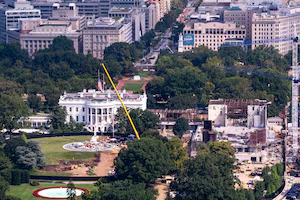
The White House ballroom ruling handed down Monday allows construction to continue, but it arrived with an unusual complication: the Chief Justice of the United States wrote that the project is probably illegal.
The Supreme Court split 5-4, with John Roberts joining the court’s liberal justices in dissent.
What the Court Actually Decided
The majority’s unsigned order maintained the court’s hold on a federal appeals ruling that had called for the project to stop.
Two reasons were given. First, the historic preservation group that brought the suit appeared to lack legal standing. Second, national security considerations weighed in favour of letting construction proceed.
The majority explicitly declined to address whether the project itself is lawful.
That distinction matters less in practice than it does on paper. The order means the ballroom will almost certainly be finished before any court definitively answers the underlying question about presidential authority to make major structural changes to the White House.
Roberts Breaks From the Conservatives
Writing for the dissenters, Roberts stated the project is likely unlawful.
He described the White House as an iconic American building whose symbolism and history are inseparable from its architecture, and argued it is essential that those responsible follow the rules when deciding what to demolish and what to construct at what he called the People’s House.
The Standing Fight
The majority’s reasoning centred on whether the National Trust for Historic Preservation had the right to sue at all.
Standing doctrine requires parties to demonstrate a concrete stake in a case, preventing courts from ruling on abstract disputes. The conservative majority on this court has enforced it increasingly strictly in recent years.
The Trust based its standing partly on the interests of Alison Hoagland, a historian and member. The majority was dismissive, observing that nearly any government action or project offends someone’s sensibilities, and concluding the Trust was unlikely to sustain a suit resting on offence, disagreement or distaste.
Trump has repeatedly mocked the idea that one person’s objection could form the basis of the lawsuit, though precedent establishes that standing can indeed rest on a single individual’s claims.
Roberts took direct aim at his colleagues’ reasoning here, arguing they were distorting earlier precedents in which environmental challenges proceeded on largely or entirely aesthetic grounds. The distinction they drew, he wrote, does not hold up.
How the Project Got Here
The sequence explains why the case reached the emergency docket.
- Last October, construction crews abruptly demolished the White House East Wing on Trump’s orders
- He subsequently sought approval from review panels to build a ballroom on the site
- Congress never appropriated funds for the project or approved it
- Trump has put the cost of the ballroom and related facilities at $400 million, to be covered by private donors
- The National Trust sued, and a district judge blocked above-ground construction, though that order never took effect
- A D.C. Circuit panel ruled 2-1 earlier this month that Trump had proceeded in violation of laws requiring congressional approval for construction in Washington
- The appeals court paused its own order so the administration could seek Supreme Court relief
- With that reprieve expiring on 21 August, Roberts issued an emergency order allowing work to continue while the full court considered the request
The Shifting Justification
The rationale offered for the ballroom has changed over time.
Trump initially presented it primarily as a practical matter: a larger permanent space at the White House for ceremonial functions such as state dinners.
In recent weeks he has increasingly described it as a national security requirement, citing features planned for the redesigned East Wing. That framing appears to have carried weight with the majority, which cited national security among its reasons for allowing construction to continue.
Reactions
Trump posted on Truth Social that he was pleased with the ruling, saying it would allow the project to be completed without further contingency, doubt or threat.
Attorney General Todd Blanche welcomed the decision on X, calling it a straightforward national security matter and predicting future administrations would be grateful for it.
Brent Leggs, president and CEO of the National Trust for Historic Preservation, expressed disappointment while pointing to the dissent. He said the organisation was pleased with Roberts’ strong opinion, which he said restated what the Trust has argued from the beginning: that construction of the ballroom is unlawful.
The Practical Consequence
There is a structural problem embedded in this outcome that goes beyond the ballroom.
When a court permits construction to proceed while the legality question remains unresolved, the passage of time effectively decides the case. A finished building is not easily unbuilt, and courts are reluctant to order demolition of completed structures.
That dynamic means the emergency docket ruling, formally provisional, functions as something close to final.
Roberts appears to have recognised exactly that, which is likely why a chief justice who typically avoids public breaks with his conservative colleagues chose to write that the project is probably illegal even as the court cleared the way for it.
Author