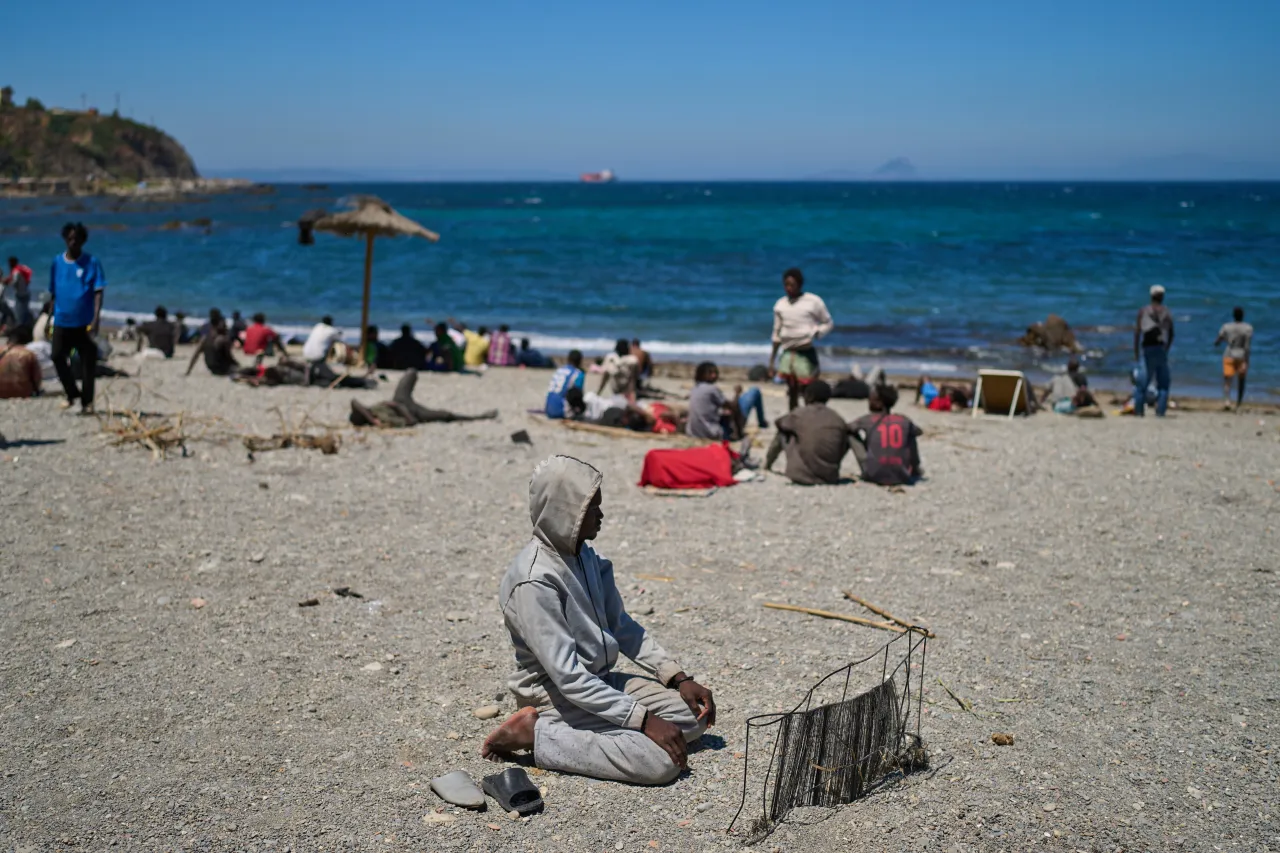
The Ceuta migrant crisis has pushed Spain’s small North African territory into a state of exhaustion, with thousands of people still stranded days after one of the largest single border surges the enclave has ever recorded. What began as a sudden rush across the frontier last week has turned into a slow, grinding emergency, with beaches doubling as shelters and public services stretched far past what they were built to handle.
A Beach That Became a Makeshift Shelter
On Monday, hundreds of people were still camped out on El Trampolin beach, spread across the sand with little more than towels wrapped around their shoulders to blunt the coastal wind. Most were from sub-Saharan Africa. There were no tents in any organised sense, no rows of aid stations, just people waiting.
Behind them, along the coastal road, military and police vehicles moved back and forth in a near-constant patrol. The scene captured the strange limbo of the moment: too many people to shelter indoors, nowhere else for them to go, and no clear resolution on the horizon.
The Numbers Tell a Confusing Story
Spanish authorities estimate that roughly 69,500 people have crossed back into Morocco over the course of four days. That figure is striking, largely because it dwarfs the original estimate of about 50,000 arrivals recorded on Thursday.
The gap suggests the initial count badly understated how many people actually entered the territory during the surge. In fast-moving situations like this, tallies taken in the first hours are rarely reliable, and the revised numbers hint at a movement far larger than officials first believed.
The human cost has been severe. Spanish authorities have confirmed 72 deaths on their side of the border. Moroccan authorities have recorded 11 more. Those figures may yet change as the situation is fully assessed.
Why So Many Turned Back
One of the more revealing details of this episode is that the vast majority of those who crossed did not stay. Many chose to return to Morocco within days, and their reasons were remarkably consistent.
Food became scarce almost immediately. Shops across Ceuta shut their doors as the surge unfolded, cutting off the most basic supply line for people who arrived with nothing. Hunger, more than policy, drove many decisions.
Others described open hostility from residents. In a city of limited size and limited resources, the arrival of tens of thousands of people in a matter of hours created friction that was impossible to contain.
Perhaps most decisively, onward travel to mainland Spain was blocked. For people whose goal was continental Europe, Ceuta offered no route forward. Once that became clear, remaining in a crowded enclave with no food and no welcome made little sense.
Reception Centres Have Collapsed
Ceuta’s leader, Juan Jesus Vivas, told broadcaster Telecinco that somewhere between 3,000 and 5,000 people were still in the territory. He described the enclave’s two reception centres, one for adults and one for minors, as having collapsed under the pressure.
That word choice matters. It is not a warning about future strain but an admission that the system has already failed. Ceuta covers under twenty square kilometres and has a population of roughly 85,000. Its infrastructure was never designed to absorb a sudden influx of this magnitude, and the numbers made that plain within hours.
The Children Caught in the Middle
Local official Alberto Gaitan confirmed that the city is currently processing 862 unaccompanied minors. This group presents the most complex challenge of all.
Under Spanish and European law, minors carry special protections that shield them from deportation. They must be housed, assessed, given guardianship arrangements, and eventually placed in the care system. That process takes months, sometimes longer, and it requires trained staff and physical space that Ceuta simply does not have in the quantities now required.
Whatever happens to the adult population, these children will remain a long-term responsibility for Spanish authorities, and their care will likely become a point of political friction between Ceuta and the mainland.
A Gift to Europe’s Anti-Immigration Movement
The political fallout has spread well beyond Spain. Images from Ceuta have circulated widely across the continent and have been seized upon by anti-immigration voices as evidence that Europe’s external borders are indefensible.
Within the European Union, the episode has reopened old arguments about who bears responsibility for border management. Spain has accused several partner states of responding in ways it considers unhelpful and needlessly polarising, sharpening divisions rather than addressing the situation.
Spain Asks for the Favour to Be Returned
Foreign Minister Jose Manuel Albares made Spain’s position explicit on Monday. He pointed out that his country had stood behind other EU member states during their own migration emergencies and said Spain now expects that support to flow in the opposite direction.
It is a direct appeal to the principle of burden sharing, a concept the bloc endorses in theory but has struggled to apply in practice for the better part of a decade. Whether it produces anything concrete remains uncertain.
What Comes Next
EU interior ministers have been summoned to an emergency video conference to address the crisis. Expectations should be measured. Emergency meetings of this kind tend to produce statements of solidarity and pledges of coordination rather than binding commitments.
Ceuta and its sister exclave Melilla occupy an unusual position, sitting on Morocco’s Mediterranean coast while remaining Spanish and therefore European territory. That geography has made both cities recurring pressure points for people attempting to reach Europe, and periodic crossing attempts are nothing new.
What is new is the scale. This surge involved numbers that no local system could realistically absorb, and it exposed how quickly a border can be overwhelmed when movement happens all at once. For the thousands still sleeping on Ceuta’s sand, the diplomatic conversation in Brussels is a distant thing. Their immediate concerns are food, shelter, and some indication of what happens tomorrow.
Author
-
Lucienne Albrecht is Luxe Chronicle’s wealth and lifestyle editor, celebrated for her elegant perspective on finance, legacy, and global luxury culture. With a flair for blending sophistication with insight, she brings a distinctly feminine voice to the world of high society and wealth.