A Meeting That Broke Years of Silence
The Myanmar government confirmed that Aung San Suu Kyi met Arnaud de Baecque, the ICRC’s resident representative in the country, at a location in the capital. A government spokeswoman announced the meeting, and the Red Cross subsequently confirmed that one of its delegates had indeed seen the former leader, though the organisation declined to identify the official by name.
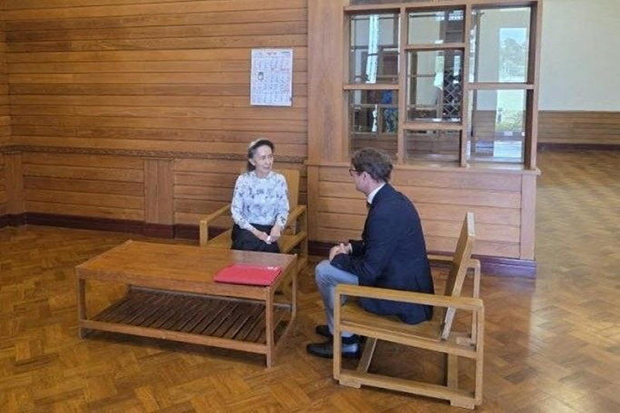
The ICRC stated that the visit followed its established standards and procedures for seeing individuals deprived of their liberty. Crucially, it noted that there had been an opportunity to speak with her in private, without officials present.
That detail carries real significance. Private conversation is a core requirement of any credible detention visit, because it allows a detainee to speak freely about their treatment and conditions. A supervised meeting would have told the world very little.
The Photographs and What They Show
Alongside the announcement, the Myanmar government released a series of photographs. In them, the 81-year-old is shown standing without assistance and shaking hands with the visiting official, appearing physically capable and alert.
One image provided something rarer still: an apparent view inside her living quarters. Another showed her cutting a birthday cake with her name written across it, which suggests the pictures may have been taken during a celebration for her 81st birthday back in June rather than during Monday’s visit itself.
That timing discrepancy is worth noting. Photographs released by a government that controls all access to a prisoner are, by their nature, curated. They show what authorities want shown, at a moment of their choosing.
Her Son Responds With Cautious Hope
Kim Aris, who lives in London and has campaigned publicly for his mother’s release, offered a measured reaction. He made clear that he had not received any independent confirmation of her condition or wellbeing.
His statement struck a careful balance between acknowledgement and pressure. He described the meeting as possibly a first step, while insisting firmly that it must not be the last.
What he asked for was specific. He called for further humanitarian progress, direct contact with his mother, access for the wider family, and credible information about her health that could be independently verified. Above all, he demanded her immediate and unconditional release, alongside that of every other political prisoner held in Myanmar.
The restraint in his words reflects years of experience. Families of detainees in Myanmar have learned that isolated gestures do not always lead anywhere.
How She Ended Up in Detention
Aung San Suu Kyi has been held since February 2021, when Myanmar’s military seized power in a pre-dawn operation that removed her elected government from office. The coup ended a fragile decade of partial democratic transition and returned the country to direct military rule.
Since that morning, her situation has been almost impossible to verify from outside. No foreign leader has publicly met her. No visiting envoy has emerged with a firsthand account. Her exact whereabouts have shifted between reports of prison confinement and house arrest, with little reliable information to settle the question.
That vacuum of information produced repeated demands from her family, from international organisations, and from foreign governments for simple proof that she remained alive. When a prominent figure disappears from view for years at a time, silence itself becomes alarming.
The Legal Case Against Her
She was originally handed a 33-year prison sentence following convictions on corruption charges and for breaching state secrecy laws. Legal observers, human rights organisations, and foreign governments widely regarded those proceedings as politically driven rather than genuine.
The trials were conducted largely behind closed doors, with limited access for independent monitors and severe restrictions placed on her defence team.
The sentence has since been reduced on several occasions, most recently in April. According to her legal representatives, she still faces 18 years behind bars. For a woman of 81, that remains, in practical terms, a life sentence.
A Country Still at War
The consequences of the 2021 coup extended far beyond one detained politician. The military takeover triggered enormous street protests across Myanmar’s cities, which security forces suppressed with lethal force.
Peaceful demonstration gave way to armed resistance. Ethnic armed organisations that had long operated in Myanmar’s border regions found common cause with newly formed civilian defence groups. The result has been a civil war that continues to displace hundreds of thousands of people and has fractured control of the country’s territory.
Against that backdrop, a single visit by a Red Cross official is a small development in a very large crisis. But small developments matter when the alternative has been total silence.
What This Might Signal
Analysts will inevitably ask why the visit was permitted now, and why it was publicised so readily. Myanmar’s ruling authorities face substantial international isolation, sanctions, and diplomatic pressure. Allowing a humanitarian visit and releasing images of a healthy-looking detainee serves a clear presentational purpose.
Whether it indicates any real shift in approach is impossible to judge from one meeting. It could mark the beginning of expanded humanitarian access. It could equally be a contained gesture designed to ease pressure without changing anything fundamental.
The measure of it will be what follows. If ICRC delegates are permitted to return regularly, if family members are eventually granted contact, and if independent medical assessment becomes possible, then Monday’s meeting will have meant something.
If nothing else follows, it will be remembered as a single photograph released at a convenient moment. For now, her family and much of the watching world are left holding the same thin thread of information they have held for years, with one small addition: someone from outside has finally seen her, and spoken to her alone.
Author
-
Lucienne Albrecht is Luxe Chronicle’s wealth and lifestyle editor, celebrated for her elegant perspective on finance, legacy, and global luxury culture. With a flair for blending sophistication with insight, she brings a distinctly feminine voice to the world of high society and wealth.