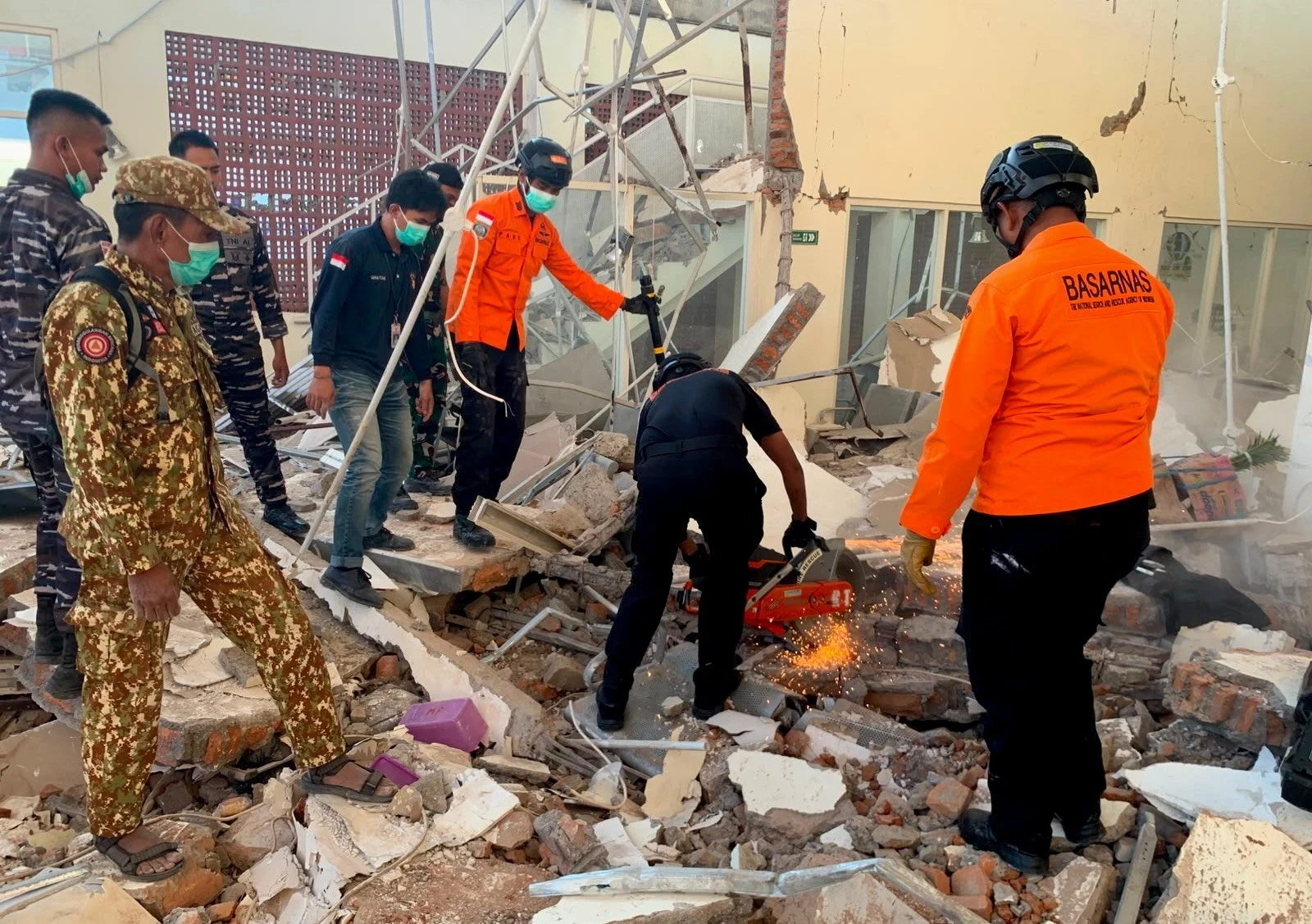
The Flores earthquake that struck off eastern Indonesia early Saturday has killed at least 20 people, injured six and driven thousands from their homes, with rescue teams still searching collapsed structures for anyone trapped beneath.
Rescue official Fathur Rahman confirmed the death toll on the popular tourist island and said at least two people were known to be alive under rubble as recovery efforts continued.
The magnitude 7.7 quake was shallow, with its epicentre located just off the island’s north coast according to both US and Indonesian authorities. Shallow quakes generally produce more violent surface shaking than deeper events of similar size.
“Like We Were on a Trampoline”
For residents, the shaking arrived without warning at around 5:30 a.m.
Yulian Juita Ekalia, a 37-year-old university lecturer living in Ruteng city — more than 100 kilometres west of the epicentre — described being jolted awake by something unlike anything she had experienced.
She said the sensation resembled standing on a trampoline and called it genuinely frightening. As she moved toward the door, the contents of her home came down around her: the television, her son’s trophies, dish racks, suitcases stored atop wardrobes. By the time she got outside, her son and neighbours were already there, screaming.
The Sea Pulled Back
In Nagekeo, close to the epicentre, residents witnessed one of the most recognisable warning signs of an incoming tsunami — the ocean visibly retreating from the shoreline.
People ran for higher ground immediately.
Long columns of evacuees moved inland on foot, by motorbike, in cars and packed into the beds of pickup trucks after Indonesia’s Meteorology, Climatology and Geophysics Agency issued its initial tsunami alert.
That warning was later lifted. But officials cautioned residents against returning to damaged buildings, warning that continuing aftershocks could bring weakened structures down.
Dozens of aftershocks rattled the island through the morning, the strongest measuring magnitude 6.1. Many people were still outdoors at midday.
Life Outside
Yulian said she had hauled her stove into the open and was cooking there, unwilling to be indoors with tremors ongoing.
At a nearby hospital, she saw patients being treated in emergency tents set up on the grounds.
She also described seeing images of her badly damaged university circulating online, and expressed relief that the quake had struck on a Saturday morning with no campus activity underway. She said she could not imagine the outcome had it happened while everyone was there.
Yohanes Babo, a 56-year-old resident of Nagekeo, was at a market when the shaking began. He described it as strong and said he was fortunate to already be outside. People panicked and scattered in all directions, he said, and residents were evacuating toward the hills.
In Maumere, hospital customer service official Lukas Lotar said the jolt was substantial and that he observed cracked walls. Some patients fled the building.
Rescue Work Under Difficult Conditions
Fathur said the immediate priority has shifted to locating people who may still be buried.
That effort has been hampered by landslides blocking roads, cutting access to affected areas and slowing the movement of teams and equipment.
The full extent of damage remains under assessment. The region is largely rural with few if any high-rise buildings — a factor that likely reduced casualties compared with an urban event of similar magnitude, though it also means damage is dispersed across scattered communities that are harder to reach.
Why Indonesia Faces This Repeatedly
Indonesia sits within the Pacific Ring of Fire, a horseshoe of intense seismic and volcanic activity extending from Japan down through Southeast Asia and around the Pacific basin. Frequent earthquakes are a permanent feature of life across the archipelago.
Flores itself has a painful history with this exact magnitude. In 1992, a 7.7 quake struck the island and generated a tsunami that killed roughly 2,500 people.
Other major events in recent Indonesian history include:
- The 2004 magnitude 9.1 quake off Sumatra, which triggered a tsunami killing around 220,000 across the region, roughly 170,000 of them in Indonesia
- A series of quakes on Lombok in 2018 that killed more than 550 people
- A magnitude 7.5 quake and tsunami on Sulawesi later in 2018, leaving more than 4,300 dead or missing
Those events shape how quickly people move when the ground shakes or the water withdraws. The evacuation seen in Nagekeo reflects hard-earned instinct rather than panic.
What Comes Next
The immediate concerns are locating survivors, clearing landslide-blocked routes and assessing structural safety before people return indoors.
Aftershocks are expected to continue for days and can cause further collapse in already compromised buildings. Authorities have urged residents to stay out of damaged structures until inspections are completed.
The death toll may change as teams reach isolated areas that remain cut off.
Author
-
Lucienne Albrecht is Luxe Chronicle’s wealth and lifestyle editor, celebrated for her elegant perspective on finance, legacy, and global luxury culture. With a flair for blending sophistication with insight, she brings a distinctly feminine voice to the world of high society and wealth.